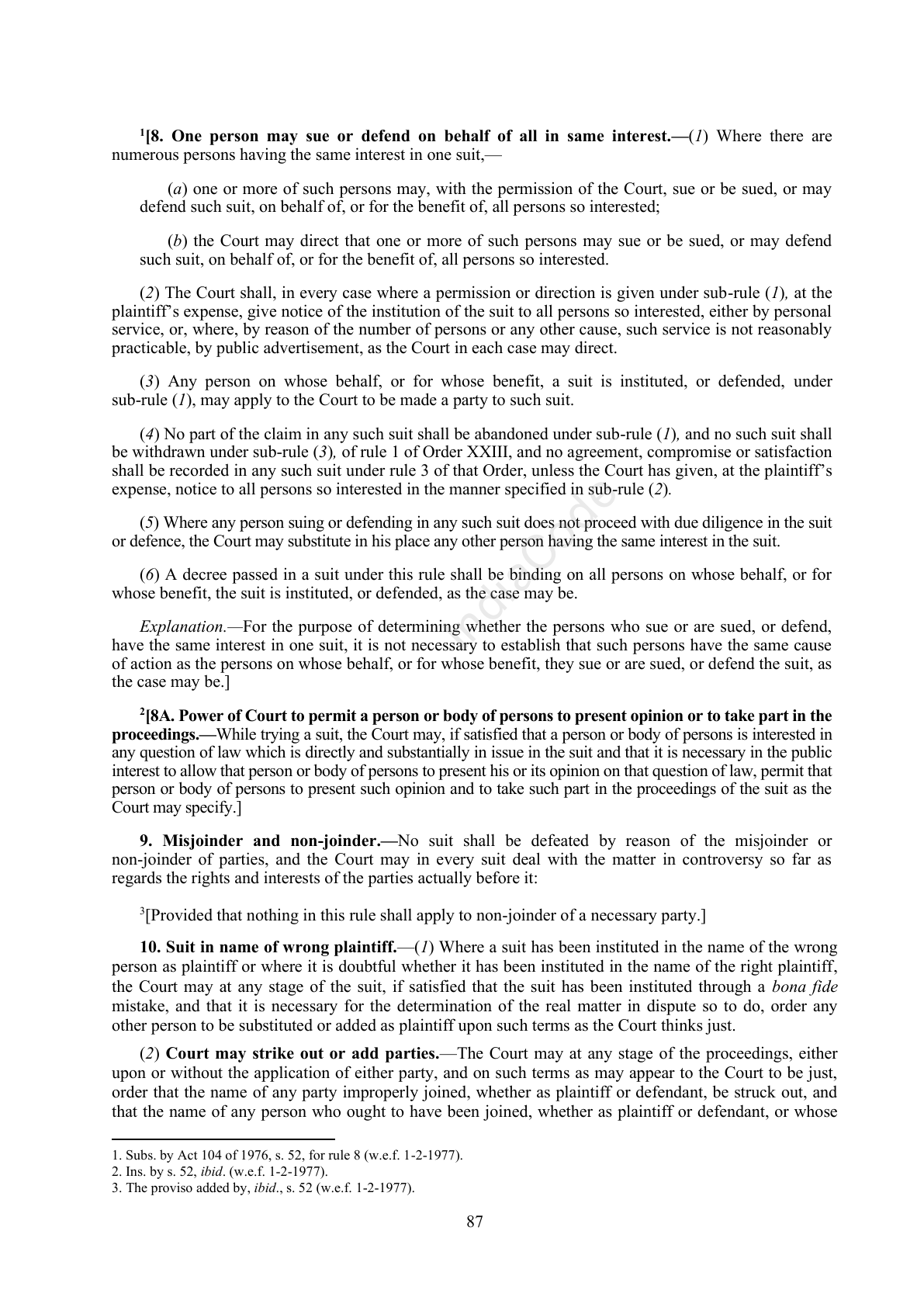
Full physical source page · unreviewed extraction
The Code of Civil Procedure, 1908: page 87
The Code of Civil Procedure, 1908, India Code delivered snapshot 393b8848fdfc476a, physical page 87, typed edition 77428589d4e341672ed6a3e5f663be7dec530c42d0600064ac1314302939267d. Unreviewed extraction.
Source: official India Code PDF · catalog record. Fetched 2026-10-19T23:06:46Z. SHA-256 393b8848fdfc476a21cc3abf4f0d3f510557e2dff6fc6914b1f379bea1730614.
Legal currency, territorial applicability and extraction fidelity are unverified. Catalog checksum/size differs from the delivered PDF; both identities are retained. Sections, state notes and footnotes share these physical pages. Compare the full original image.
Retained layout text
     1
   [8. One person may sue or defend on behalf of all in same interest.—(1) Where there are
numerous persons having the same interest in one suit,—
         (a) one or more of such persons may, with the permission of the Court, sue or be sued, or may
     defend such suit, on behalf of, or for the benefit of, all persons so interested;
         (b) the Court may direct that one or more of such persons may sue or be sued, or may defend
     such suit, on behalf of, or for the benefit of, all persons so interested.
    (2) The Court shall, in every case where a permission or direction is given under sub-rule (1), at the
plaintiff’s expense, give notice of the institution of the suit to all persons so interested, either by personal
service, or, where, by reason of the number of persons or any other cause, such service is not reasonably
practicable, by public advertisement, as the Court in each case may direct.
    (3) Any person on whose behalf, or for whose benefit, a suit is instituted, or defended, under
sub-rule (1), may apply to the Court to be made a party to such suit.
    (4) No part of the claim in any such suit shall be abandoned under sub-rule (1), and no such suit shall
be withdrawn under sub-rule (3), of rule 1 of Order XXIII, and no agreement, compromise or satisfaction
shall be recorded in any such suit under rule 3 of that Order, unless the Court has given, at the plaintiff’s
expense, notice to all persons so interested in the manner specified in sub-rule (2).
                                                                              e
                                                                          od
    (5) Where any person suing or defending in any such suit does not proceed with due diligence in the suit
or defence, the Court may substitute in his place any other person having the same interest in the suit.
                                                                         aC
   (6) A decree passed in a suit under this rule shall be binding on all persons on whose behalf, or for
whose benefit, the suit is instituted, or defended, as the case may be.
                                                               di
    Explanation.—For the purpose of determining whether the persons who sue or are sued, or defend,
                                                          In
have the same interest in one suit, it is not necessary to establish that such persons have the same cause
of action as the persons on whose behalf, or for whose benefit, they sue or are sued, or defend the suit, as
the case may be.]
     2
     [8A. Power of Court to permit a person or body of persons to present opinion or to take part in the
proceedings.—While trying a suit, the Court may, if satisfied that a person or body of persons is interested in
any question of law which is directly and substantially in issue in the suit and that it is necessary in the public
interest to allow that person or body of persons to present his or its opinion on that question of law, permit that
person or body of persons to present such opinion and to take such part in the proceedings of the suit as the
Court may specify.]
    9. Misjoinder and non-joinder.—No suit shall be defeated by reason of the misjoinder or
non-joinder of parties, and the Court may in every suit deal with the matter in controversy so far as
regards the rights and interests of the parties actually before it:
     3
      [Provided that nothing in this rule shall apply to non-joinder of a necessary party.]
    10. Suit in name of wrong plaintiff.—(1) Where a suit has been instituted in the name of the wrong
person as plaintiff or where it is doubtful whether it has been instituted in the name of the right plaintiff,
the Court may at any stage of the suit, if satisfied that the suit has been instituted through a bona fide
mistake, and that it is necessary for the determination of the real matter in dispute so to do, order any
other person to be substituted or added as plaintiff upon such terms as the Court thinks just.
    (2) Court may strike out or add parties.—The Court may at any stage of the proceedings, either
upon or without the application of either party, and on such terms as may appear to the Court to be just,
order that the name of any party improperly joined, whether as plaintiff or defendant, be struck out, and
that the name of any person who ought to have been joined, whether as plaintiff or defendant, or whose

1. Subs. by Act 104 of 1976, s. 52, for rule 8 (w.e.f. 1-2-1977).
2. Ins. by s. 52, ibid. (w.e.f. 1-2-1977).
3. The proviso added by, ibid., s. 52 (w.e.f. 1-2-1977).

                                                                    87
Compare original page image