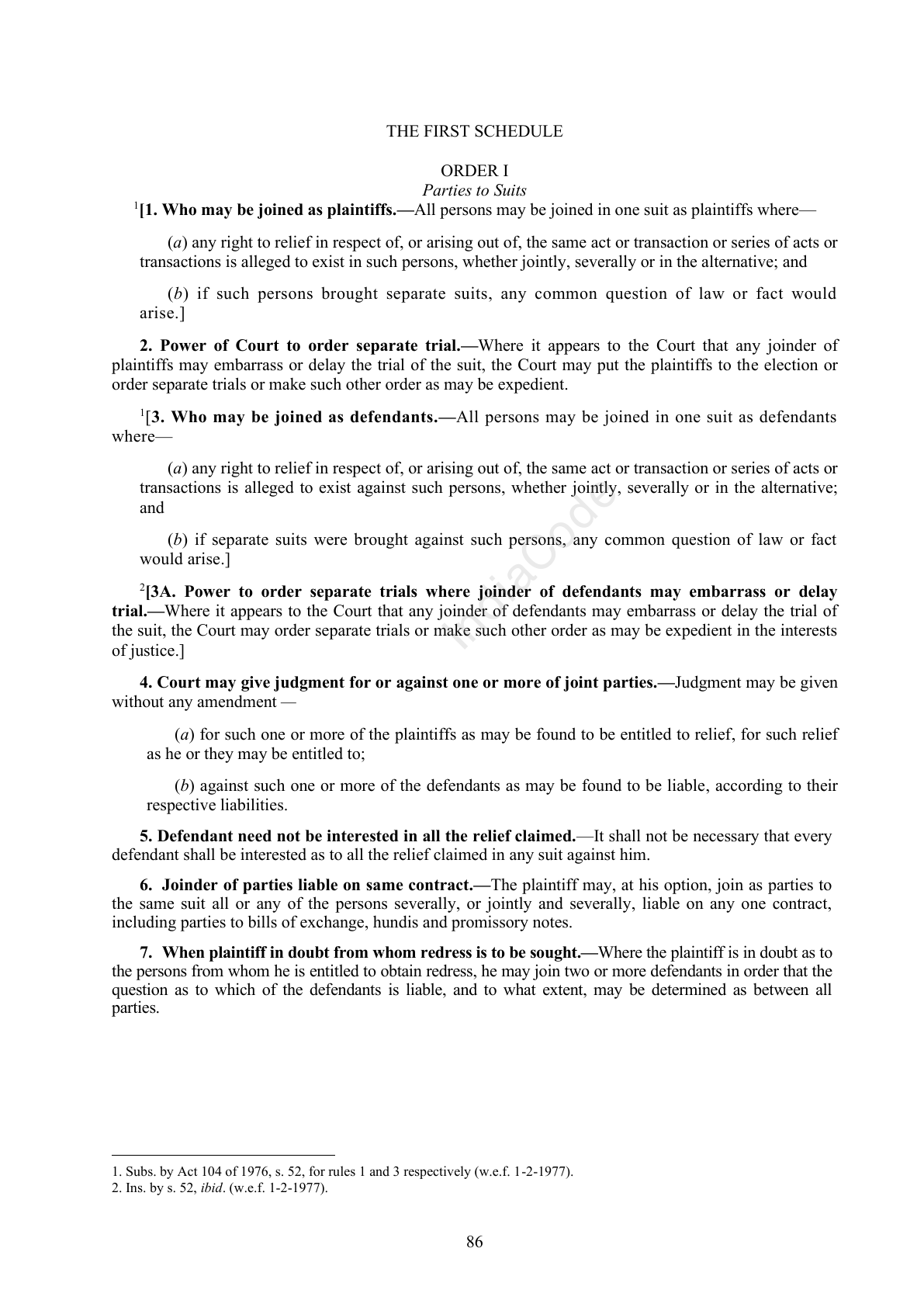
Full physical source page · unreviewed extraction
The Code of Civil Procedure, 1908: page 86
The Code of Civil Procedure, 1908, India Code delivered snapshot 393b8848fdfc476a, physical page 86, typed edition 77428589d4e341672ed6a3e5f663be7dec530c42d0600064ac1314302939267d. Unreviewed extraction.
Source: official India Code PDF · catalog record. Fetched 2026-10-19T23:06:46Z. SHA-256 393b8848fdfc476a21cc3abf4f0d3f510557e2dff6fc6914b1f379bea1730614.
Legal currency, territorial applicability and extraction fidelity are unverified. Catalog checksum/size differs from the delivered PDF; both identities are retained. Sections, state notes and footnotes share these physical pages. Compare the full original image.
Retained layout text
                                                  THE FIRST SCHEDULE

                                               ORDER I
                                            Parties to Suits
    1
      [1. Who may be joined as plaintiffs.—All persons may be joined in one suit as plaintiffs where—
         (a) any right to relief in respect of, or arising out of, the same act or transaction or series of acts or
     transactions is alleged to exist in such persons, whether jointly, severally or in the alternative; and
         (b) if such persons brought separate suits, any common question of law or fact would
     arise.]
    2. Power of Court to order separate trial.—Where it appears to the Court that any joinder of
plaintiffs may embarrass or delay the trial of the suit, the Court may put the plaintiffs to the election or
order separate trials or make such other order as may be expedient.
     1
    [3. Who may be joined as defendants.—All persons may be joined in one suit as defendants
where—
         (a) any right to relief in respect of, or arising out of, the same act or transaction or series of acts or
     transactions is alleged to exist against such persons, whether jointly, severally or in the alternative;
     and                                                                            e
                                                                            od
        (b) if separate suits were brought against such persons, any common question of law or fact
     would arise.]
     2
                                                                      aC
     [3A. Power to order separate trials where joinder of defendants may embarrass or delay
                                                               di
trial.—Where it appears to the Court that any joinder of defendants may embarrass or delay the trial of
the suit, the Court may order separate trials or make such other order as may be expedient in the interests
                                                          In
of justice.]
    4. Court may give judgment for or against one or more of joint parties.—Judgment may be given
without any amendment —
             (a) for such one or more of the plaintiffs as may be found to be entitled to relief, for such relief
         as he or they may be entitled to;
             (b) against such one or more of the defendants as may be found to be liable, according to their
         respective liabilities.
    5. Defendant need not be interested in all the relief claimed.—It shall not be necessary that every
defendant shall be interested as to all the relief claimed in any suit against him.
    6. Joinder of parties liable on same contract.—The plaintiff may, at his option, join as parties to
the same suit all or any of the persons severally, or jointly and severally, liable on any one contract,
including parties to bills of exchange, hundis and promissory notes.
    7. When plaintiff in doubt from whom redress is to be sought.—Where the plaintiff is in doubt as to
the persons from whom he is entitled to obtain redress, he may join two or more defendants in order that the
question as to which of the defendants is liable, and to what extent, may be determined as between all
parties.


1. Subs. by Act 104 of 1976, s. 52, for rules 1 and 3 respectively (w.e.f. 1-2-1977).
2. Ins. by s. 52, ibid. (w.e.f. 1-2-1977).


                                                                 86
Compare original page image