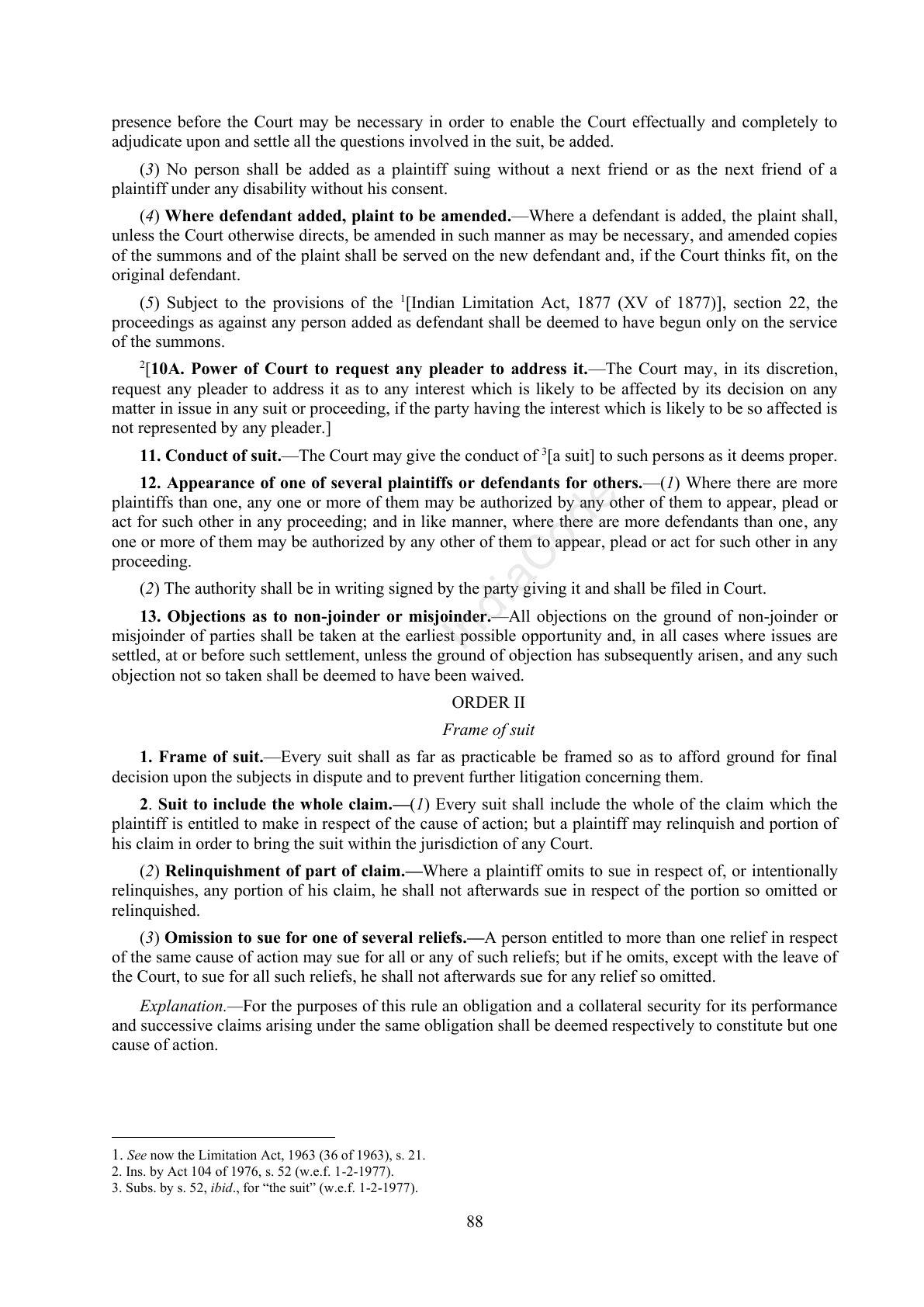
Full physical source page · unreviewed extraction
The Code of Civil Procedure, 1908: page 88
The Code of Civil Procedure, 1908, India Code delivered snapshot 393b8848fdfc476a, physical page 88, typed edition 77428589d4e341672ed6a3e5f663be7dec530c42d0600064ac1314302939267d. Unreviewed extraction.
Source: official India Code PDF · catalog record. Fetched 2026-10-19T23:06:46Z. SHA-256 393b8848fdfc476a21cc3abf4f0d3f510557e2dff6fc6914b1f379bea1730614.
Legal currency, territorial applicability and extraction fidelity are unverified. Catalog checksum/size differs from the delivered PDF; both identities are retained. Sections, state notes and footnotes share these physical pages. Compare the full original image.
Retained layout text
presence before the Court may be necessary in order to enable the Court effectually and completely to
adjudicate upon and settle all the questions involved in the suit, be added.
    (3) No person shall be added as a plaintiff suing without a next friend or as the next friend of a
plaintiff under any disability without his consent.
    (4) Where defendant added, plaint to be amended.—Where a defendant is added, the plaint shall,
unless the Court otherwise directs, be amended in such manner as may be necessary, and amended copies
of the summons and of the plaint shall be served on the new defendant and, if the Court thinks fit, on the
original defendant.
     (5) Subject to the provisions of the 1[Indian Limitation Act, 1877 (XV of 1877)], section 22, the
proceedings as against any person added as defendant shall be deemed to have begun only on the service
of the summons.
     2
     [10A. Power of Court to request any pleader to address it.—The Court may, in its discretion,
request any pleader to address it as to any interest which is likely to be affected by its decision on any
matter in issue in any suit or proceeding, if the party having the interest which is likely to be so affected is
not represented by any pleader.]
     11. Conduct of suit.—The Court may give the conduct of 3[a suit] to such persons as it deems proper.
    12. Appearance of one of several plaintiffs or defendants for others.—(1) Where there are more
plaintiffs than one, any one or more of them may be authorized by any other of them to appear, plead or
                                                                              e
act for such other in any proceeding; and in like manner, where there are more defendants than one, any
                                                                          od
one or more of them may be authorized by any other of them to appear, plead or act for such other in any
proceeding.
                                                                      aC
     (2) The authority shall be in writing signed by the party giving it and shall be filed in Court.
                                                                di
     13. Objections as to non-joinder or misjoinder.—All objections on the ground of non-joinder or
                                                              In
misjoinder of parties shall be taken at the earliest possible opportunity and, in all cases where issues are
settled, at or before such settlement, unless the ground of objection has subsequently arisen, and any such
objection not so taken shall be deemed to have been waived.
                                                               ORDER II
                                                              Frame of suit
    1. Frame of suit.—Every suit shall as far as practicable be framed so as to afford ground for final
decision upon the subjects in dispute and to prevent further litigation concerning them.
    2. Suit to include the whole claim.—(1) Every suit shall include the whole of the claim which the
plaintiff is entitled to make in respect of the cause of action; but a plaintiff may relinquish and portion of
his claim in order to bring the suit within the jurisdiction of any Court.
     (2) Relinquishment of part of claim.—Where a plaintiff omits to sue in respect of, or intentionally
relinquishes, any portion of his claim, he shall not afterwards sue in respect of the portion so omitted or
relinquished.
     (3) Omission to sue for one of several reliefs.—A person entitled to more than one relief in respect
of the same cause of action may sue for all or any of such reliefs; but if he omits, except with the leave of
the Court, to sue for all such reliefs, he shall not afterwards sue for any relief so omitted.
    Explanation.—For the purposes of this rule an obligation and a collateral security for its performance
and successive claims arising under the same obligation shall be deemed respectively to constitute but one
cause of action.


1. See now the Limitation Act, 1963 (36 of 1963), s. 21.
2. Ins. by Act 104 of 1976, s. 52 (w.e.f. 1-2-1977).
3. Subs. by s. 52, ibid., for “the suit” (w.e.f. 1-2-1977).

                                                                 88
Compare original page image