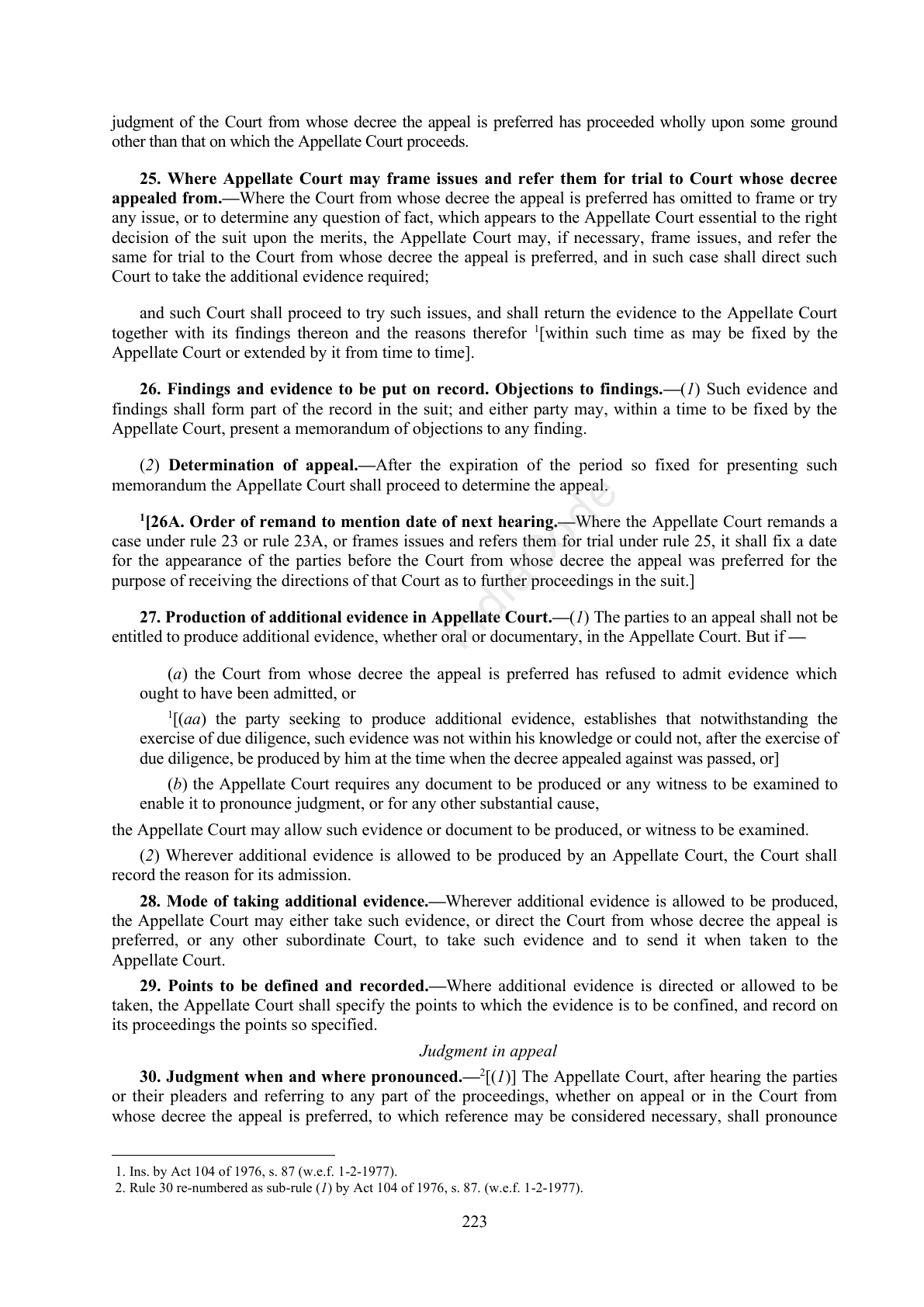
Full physical source page · unreviewed extraction
The Code of Civil Procedure, 1908: page 223
The Code of Civil Procedure, 1908, India Code delivered snapshot 393b8848fdfc476a, physical page 223, typed edition 77428589d4e341672ed6a3e5f663be7dec530c42d0600064ac1314302939267d. Unreviewed extraction.
Source: official India Code PDF · catalog record. Fetched 2026-10-19T23:06:46Z. SHA-256 393b8848fdfc476a21cc3abf4f0d3f510557e2dff6fc6914b1f379bea1730614.
Legal currency, territorial applicability and extraction fidelity are unverified. Catalog checksum/size differs from the delivered PDF; both identities are retained. Sections, state notes and footnotes share these physical pages. Compare the full original image.
Retained layout text
judgment of the Court from whose decree the appeal is preferred has proceeded wholly upon some ground
other than that on which the Appellate Court proceeds.

    25. Where Appellate Court may frame issues and refer them for trial to Court whose decree
appealed from.—Where the Court from whose decree the appeal is preferred has omitted to frame or try
any issue, or to determine any question of fact, which appears to the Appellate Court essential to the right
decision of the suit upon the merits, the Appellate Court may, if necessary, frame issues, and refer the
same for trial to the Court from whose decree the appeal is preferred, and in such case shall direct such
Court to take the additional evidence required;

    and such Court shall proceed to try such issues, and shall return the evidence to the Appellate Court
together with its findings thereon and the reasons therefor 1[within such time as may be fixed by the
Appellate Court or extended by it from time to time].

    26. Findings and evidence to be put on record. Objections to findings.—(1) Such evidence and
findings shall form part of the record in the suit; and either party may, within a time to be fixed by the
Appellate Court, present a memorandum of objections to any finding.

   (2) Determination of appeal.—After the expiration of the period so fixed for presenting such
memorandum the Appellate Court shall proceed to determine the appeal.
    1
                                                                                 e
     [26A. Order of remand to mention date of next hearing.—Where the Appellate Court remands a
                                                                          od
case under rule 23 or rule 23A, or frames issues and refers them for trial under rule 25, it shall fix a date
for the appearance of the parties before the Court from whose decree the appeal was preferred for the
                                                                  aC
purpose of receiving the directions of that Court as to further proceedings in the suit.]
                                                             di
     27. Production of additional evidence in Appellate Court.—(1) The parties to an appeal shall not be
                                                        In
entitled to produce additional evidence, whether oral or documentary, in the Appellate Court. But if —

       (a) the Court from whose decree the appeal is preferred has refused to admit evidence which
    ought to have been admitted, or
         1
         [(aa) the party seeking to produce additional evidence, establishes that notwithstanding the
    exercise of due diligence, such evidence was not within his knowledge or could not, after the exercise of
    due diligence, be produced by him at the time when the decree appealed against was passed, or]
       (b) the Appellate Court requires any document to be produced or any witness to be examined to
    enable it to pronounce judgment, or for any other substantial cause,
the Appellate Court may allow such evidence or document to be produced, or witness to be examined.
    (2) Wherever additional evidence is allowed to be produced by an Appellate Court, the Court shall
record the reason for its admission.
    28. Mode of taking additional evidence.—Wherever additional evidence is allowed to be produced,
the Appellate Court may either take such evidence, or direct the Court from whose decree the appeal is
preferred, or any other subordinate Court, to take such evidence and to send it when taken to the
Appellate Court.
     29. Points to be defined and recorded.—Where additional evidence is directed or allowed to be
taken, the Appellate Court shall specify the points to which the evidence is to be confined, and record on
its proceedings the points so specified.
                                                      Judgment in appeal
    30. Judgment when and where pronounced.—2[(1)] The Appellate Court, after hearing the parties
or their pleaders and referring to any part of the proceedings, whether on appeal or in the Court from
whose decree the appeal is preferred, to which reference may be considered necessary, shall pronounce


1. Ins. by Act 104 of 1976, s. 87 (w.e.f. 1-2-1977).
2. Rule 30 re-numbered as sub-rule (1) by Act 104 of 1976, s. 87. (w.e.f. 1-2-1977).

                                                              223
Compare original page image