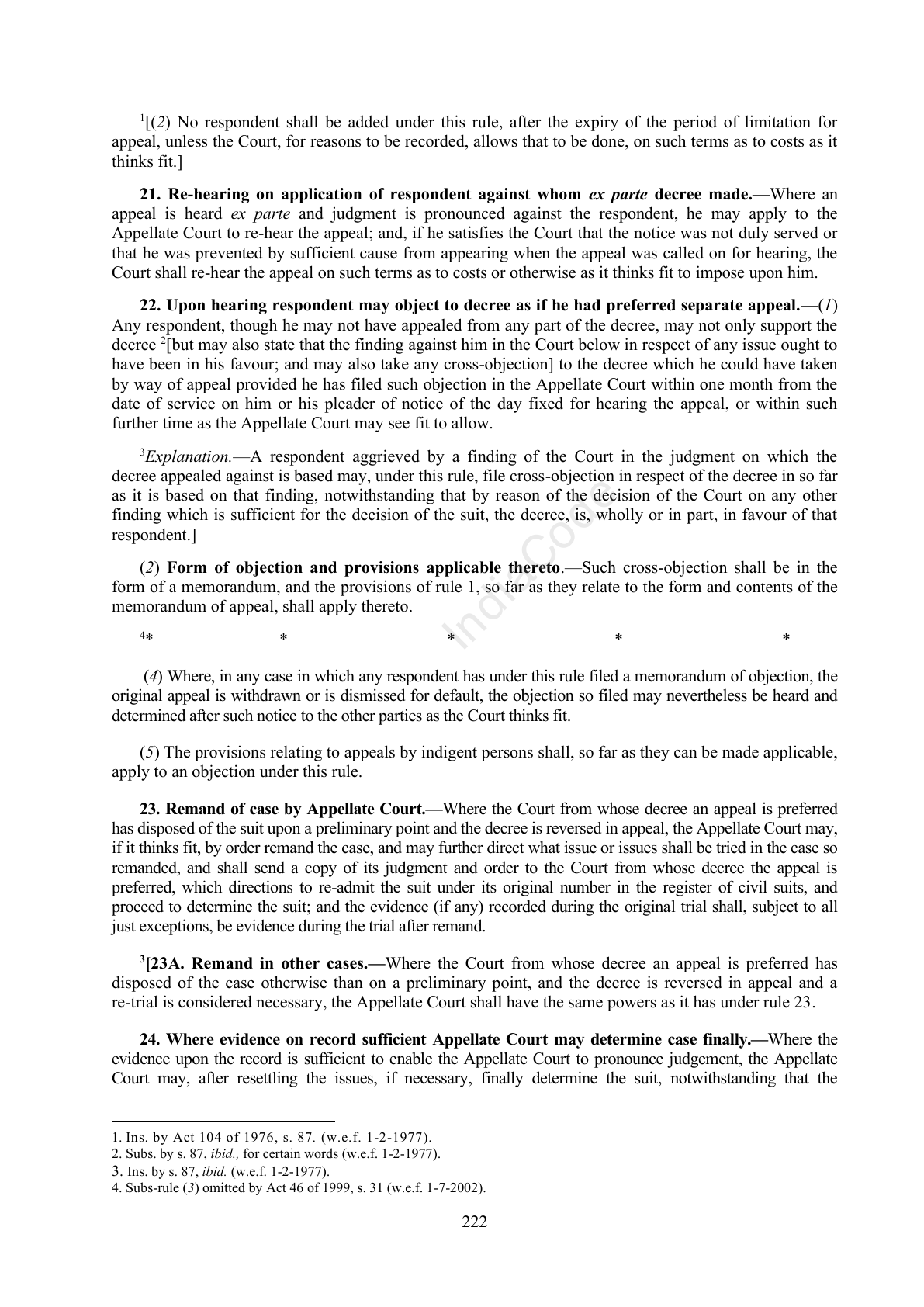
Full physical source page · unreviewed extraction
The Code of Civil Procedure, 1908: page 222
The Code of Civil Procedure, 1908, India Code delivered snapshot 393b8848fdfc476a, physical page 222, typed edition 77428589d4e341672ed6a3e5f663be7dec530c42d0600064ac1314302939267d. Unreviewed extraction.
Source: official India Code PDF · catalog record. Fetched 2026-10-19T23:06:46Z. SHA-256 393b8848fdfc476a21cc3abf4f0d3f510557e2dff6fc6914b1f379bea1730614.
Legal currency, territorial applicability and extraction fidelity are unverified. Catalog checksum/size differs from the delivered PDF; both identities are retained. Sections, state notes and footnotes share these physical pages. Compare the full original image.
Retained layout text
     1
     [(2) No respondent shall be added under this rule, after the expiry of the period of limitation for
appeal, unless the Court, for reasons to be recorded, allows that to be done, on such terms as to costs as it
thinks fit.]
    21. Re-hearing on application of respondent against whom ex parte decree made.—Where an
appeal is heard ex parte and judgment is pronounced against the respondent, he may apply to the
Appellate Court to re-hear the appeal; and, if he satisfies the Court that the notice was not duly served or
that he was prevented by sufficient cause from appearing when the appeal was called on for hearing, the
Court shall re-hear the appeal on such terms as to costs or otherwise as it thinks fit to impose upon him.
    22. Upon hearing respondent may object to decree as if he had preferred separate appeal.—(1)
Any respondent, though he may not have appealed from any part of the decree, may not only support the
decree 2[but may also state that the finding against him in the Court below in respect of any issue ought to
have been in his favour; and may also take any cross-objection] to the decree which he could have taken
by way of appeal provided he has filed such objection in the Appellate Court within one month from the
date of service on him or his pleader of notice of the day fixed for hearing the appeal, or within such
further time as the Appellate Court may see fit to allow.
     3
      Explanation.—A respondent aggrieved by a finding of the Court in the judgment on which the
decree appealed against is based may, under this rule, file cross-objection in respect of the decree in so far
as it is based on that finding, notwithstanding that by reason of the decision of the Court on any other
                                                                            e
finding which is sufficient for the decision of the suit, the decree, is, wholly or in part, in favour of that
respondent.]                                                            od
                                                                       aC
    (2) Form of objection and provisions applicable thereto.—Such cross-objection shall be in the
form of a memorandum, and the provisions of rule 1, so far as they relate to the form and contents of the
memorandum of appeal, shall apply thereto.                      di
     4
      *                       *                          In *                   *                           *

     (4) Where, in any case in which any respondent has under this rule filed a memorandum of objection, the
original appeal is withdrawn or is dismissed for default, the objection so filed may nevertheless be heard and
determined after such notice to the other parties as the Court thinks fit.

    (5) The provisions relating to appeals by indigent persons shall, so far as they can be made applicable,
apply to an objection under this rule.

      23. Remand of case by Appellate Court.—Where the Court from whose decree an appeal is preferred
has disposed of the suit upon a preliminary point and the decree is reversed in appeal, the Appellate Court may,
if it thinks fit, by order remand the case, and may further direct what issue or issues shall be tried in the case so
remanded, and shall send a copy of its judgment and order to the Court from whose decree the appeal is
preferred, which directions to re-admit the suit under its original number in the register of civil suits, and
proceed to determine the suit; and the evidence (if any) recorded during the original trial shall, subject to all
just exceptions, be evidence during the trial after remand.
     3
      [23A. Remand in other cases.—Where the Court from whose decree an appeal is preferred has
disposed of the case otherwise than on a preliminary point, and the decree is reversed in appeal and a
re-trial is considered necessary, the Appellate Court shall have the same powers as it has under rule 23.

    24. Where evidence on record sufficient Appellate Court may determine case finally.—Where the
evidence upon the record is sufficient to enable the Appellate Court to pronounce judgement, the Appellate
Court may, after resettling the issues, if necessary, finally determine the suit, notwithstanding that the


1. Ins. by Act 104 of 1976, s. 87. (w.e.f. 1-2-1977).
2. Subs. by s. 87, ibid., for certain words (w.e.f. 1-2-1977).
3. Ins. by s. 87, ibid. (w.e.f. 1-2-1977).
4. Subs-rule (3) omitted by Act 46 of 1999, s. 31 (w.e.f. 1-7-2002).

                                                                222
Compare original page image