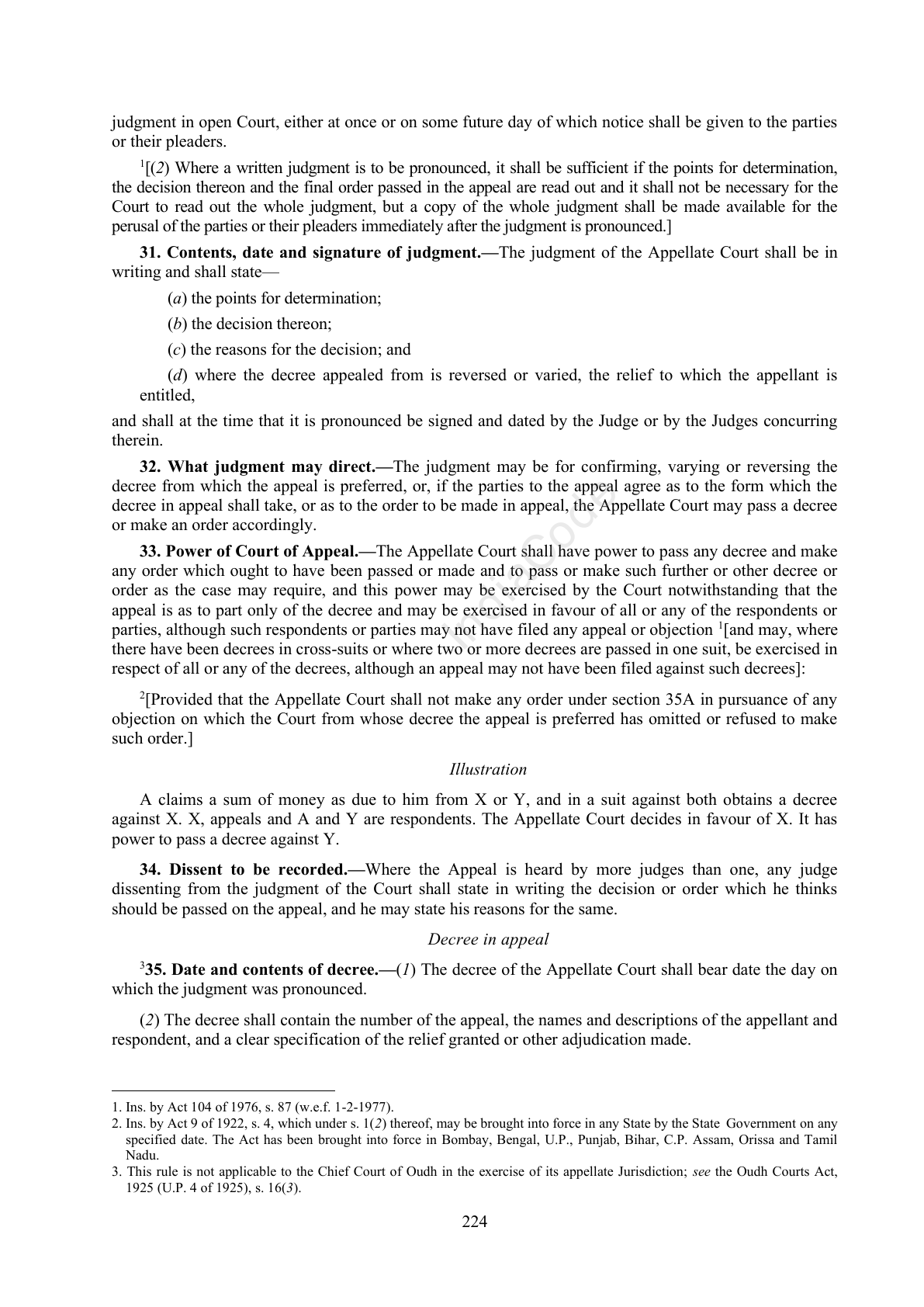
Full physical source page · unreviewed extraction
The Code of Civil Procedure, 1908: page 224
The Code of Civil Procedure, 1908, India Code delivered snapshot 393b8848fdfc476a, physical page 224, typed edition 77428589d4e341672ed6a3e5f663be7dec530c42d0600064ac1314302939267d. Unreviewed extraction.
Source: official India Code PDF · catalog record. Fetched 2026-10-19T23:06:46Z. SHA-256 393b8848fdfc476a21cc3abf4f0d3f510557e2dff6fc6914b1f379bea1730614.
Legal currency, territorial applicability and extraction fidelity are unverified. Catalog checksum/size differs from the delivered PDF; both identities are retained. Sections, state notes and footnotes share these physical pages. Compare the full original image.
Retained layout text
judgment in open Court, either at once or on some future day of which notice shall be given to the parties
or their pleaders.
     1
     [(2) Where a written judgment is to be pronounced, it shall be sufficient if the points for determination,
the decision thereon and the final order passed in the appeal are read out and it shall not be necessary for the
Court to read out the whole judgment, but a copy of the whole judgment shall be made available for the
perusal of the parties or their pleaders immediately after the judgment is pronounced.]
    31. Contents, date and signature of judgment.—The judgment of the Appellate Court shall be in
writing and shall state—
         (a) the points for determination;
         (b) the decision thereon;
         (c) the reasons for the decision; and
         (d) where the decree appealed from is reversed or varied, the relief to which the appellant is
     entitled,
and shall at the time that it is pronounced be signed and dated by the Judge or by the Judges concurring
therein.
    32. What judgment may direct.—The judgment may be for confirming, varying or reversing the
decree from which the appeal is preferred, or, if the parties to the appeal agree as to the form which the
                                                                                 e
decree in appeal shall take, or as to the order to be made in appeal, the Appellate Court may pass a decree
or make an order accordingly.                                              od
    33. Power of Court of Appeal.—The Appellate Court shall have power to pass any decree and make
                                                                   aC
any order which ought to have been passed or made and to pass or make such further or other decree or
order as the case may require, and this power may be exercised by the Court notwithstanding that the
                                                             di
appeal is as to part only of the decree and may be exercised in favour of all or any of the respondents or
parties, although such respondents or parties may not have filed any appeal or objection 1[and may, where
                                                        In
there have been decrees in cross-suits or where two or more decrees are passed in one suit, be exercised in
respect of all or any of the decrees, although an appeal may not have been filed against such decrees]:
     2
     [Provided that the Appellate Court shall not make any order under section 35A in pursuance of any
objection on which the Court from whose decree the appeal is preferred has omitted or refused to make
such order.]
                                                            Illustration
    A claims a sum of money as due to him from X or Y, and in a suit against both obtains a decree
against X. X, appeals and A and Y are respondents. The Appellate Court decides in favour of X. It has
power to pass a decree against Y.
    34. Dissent to be recorded.—Where the Appeal is heard by more judges than one, any judge
dissenting from the judgment of the Court shall state in writing the decision or order which he thinks
should be passed on the appeal, and he may state his reasons for the same.
                                                        Decree in appeal
     3
    35. Date and contents of decree.—(1) The decree of the Appellate Court shall bear date the day on
which the judgment was pronounced.
    (2) The decree shall contain the number of the appeal, the names and descriptions of the appellant and
respondent, and a clear specification of the relief granted or other adjudication made.


1. Ins. by Act 104 of 1976, s. 87 (w.e.f. 1-2-1977).
2. Ins. by Act 9 of 1922, s. 4, which under s. 1(2) thereof, may be brought into force in any State by the State Government on any
   specified date. The Act has been brought into force in Bombay, Bengal, U.P., Punjab, Bihar, C.P. Assam, Orissa and Tamil
   Nadu.
3. This rule is not applicable to the Chief Court of Oudh in the exercise of its appellate Jurisdiction; see the Oudh Courts Act,
   1925 (U.P. 4 of 1925), s. 16(3).

                                                              224
Compare original page image