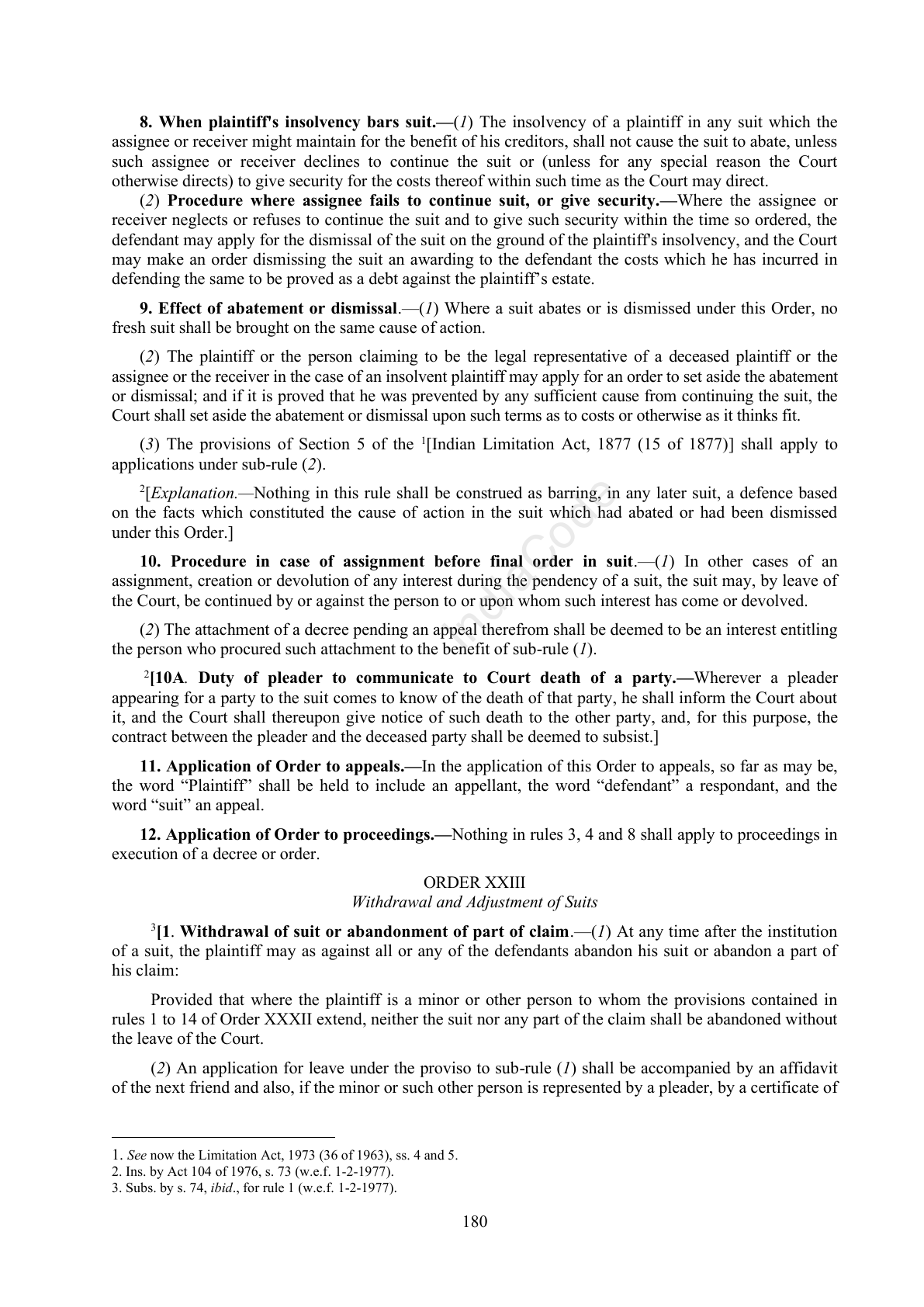
Full physical source page · unreviewed extraction
The Code of Civil Procedure, 1908: page 180
The Code of Civil Procedure, 1908, India Code delivered snapshot 393b8848fdfc476a, physical page 180, typed edition 77428589d4e341672ed6a3e5f663be7dec530c42d0600064ac1314302939267d. Unreviewed extraction.
Source: official India Code PDF · catalog record. Fetched 2026-10-19T23:06:46Z. SHA-256 393b8848fdfc476a21cc3abf4f0d3f510557e2dff6fc6914b1f379bea1730614.
Legal currency, territorial applicability and extraction fidelity are unverified. Catalog checksum/size differs from the delivered PDF; both identities are retained. Sections, state notes and footnotes share these physical pages. Compare the full original image.
Retained layout text
    8. When plaintiff's insolvency bars suit.—(1) The insolvency of a plaintiff in any suit which the
assignee or receiver might maintain for the benefit of his creditors, shall not cause the suit to abate, unless
such assignee or receiver declines to continue the suit or (unless for any special reason the Court
otherwise directs) to give security for the costs thereof within such time as the Court may direct.
    (2) Procedure where assignee fails to continue suit, or give security.—Where the assignee or
receiver neglects or refuses to continue the suit and to give such security within the time so ordered, the
defendant may apply for the dismissal of the suit on the ground of the plaintiff's insolvency, and the Court
may make an order dismissing the suit an awarding to the defendant the costs which he has incurred in
defending the same to be proved as a debt against the plaintiff’s estate.
    9. Effect of abatement or dismissal.—(1) Where a suit abates or is dismissed under this Order, no
fresh suit shall be brought on the same cause of action.
    (2) The plaintiff or the person claiming to be the legal representative of a deceased plaintiff or the
assignee or the receiver in the case of an insolvent plaintiff may apply for an order to set aside the abatement
or dismissal; and if it is proved that he was prevented by any sufficient cause from continuing the suit, the
Court shall set aside the abatement or dismissal upon such terms as to costs or otherwise as it thinks fit.
    (3) The provisions of Section 5 of the 1[Indian Limitation Act, 1877 (15 of 1877)] shall apply to
applications under sub-rule (2).
     2
     [Explanation.—Nothing in this rule shall be construed as barring, in any later suit, a defence based
                                                                            e
on the facts which constituted the cause of action in the suit which had abated or had been dismissed
under this Order.]                                                     od
    10. Procedure in case of assignment before final order in suit.—(1) In other cases of an
                                                                   aC
assignment, creation or devolution of any interest during the pendency of a suit, the suit may, by leave of
the Court, be continued by or against the person to or upon whom such interest has come or devolved.
                                                             di
    (2) The attachment of a decree pending an appeal therefrom shall be deemed to be an interest entitling
                                                          In
the person who procured such attachment to the benefit of sub-rule (1).
      2
      [10A. Duty of pleader to communicate to Court death of a party.—Wherever a pleader
appearing for a party to the suit comes to know of the death of that party, he shall inform the Court about
it, and the Court shall thereupon give notice of such death to the other party, and, for this purpose, the
contract between the pleader and the deceased party shall be deemed to subsist.]
    11. Application of Order to appeals.—In the application of this Order to appeals, so far as may be,
the word “Plaintiff” shall be held to include an appellant, the word “defendant” a respondant, and the
word “suit” an appeal.
    12. Application of Order to proceedings.—Nothing in rules 3, 4 and 8 shall apply to proceedings in
execution of a decree or order.
                                                       ORDER XXIII
                                              Withdrawal and Adjustment of Suits
          3
       [1. Withdrawal of suit or abandonment of part of claim.—(1) At any time after the institution
of a suit, the plaintiff may as against all or any of the defendants abandon his suit or abandon a part of
his claim:
      Provided that where the plaintiff is a minor or other person to whom the provisions contained in
rules 1 to 14 of Order XXXII extend, neither the suit nor any part of the claim shall be abandoned without
the leave of the Court.
      (2) An application for leave under the proviso to sub-rule (1) shall be accompanied by an affidavit
of the next friend and also, if the minor or such other person is represented by a pleader, by a certificate of


1. See now the Limitation Act, 1973 (36 of 1963), ss. 4 and 5.
2. Ins. by Act 104 of 1976, s. 73 (w.e.f. 1-2-1977).
3. Subs. by s. 74, ibid., for rule 1 (w.e.f. 1-2-1977).

                                                                 180
Compare original page image