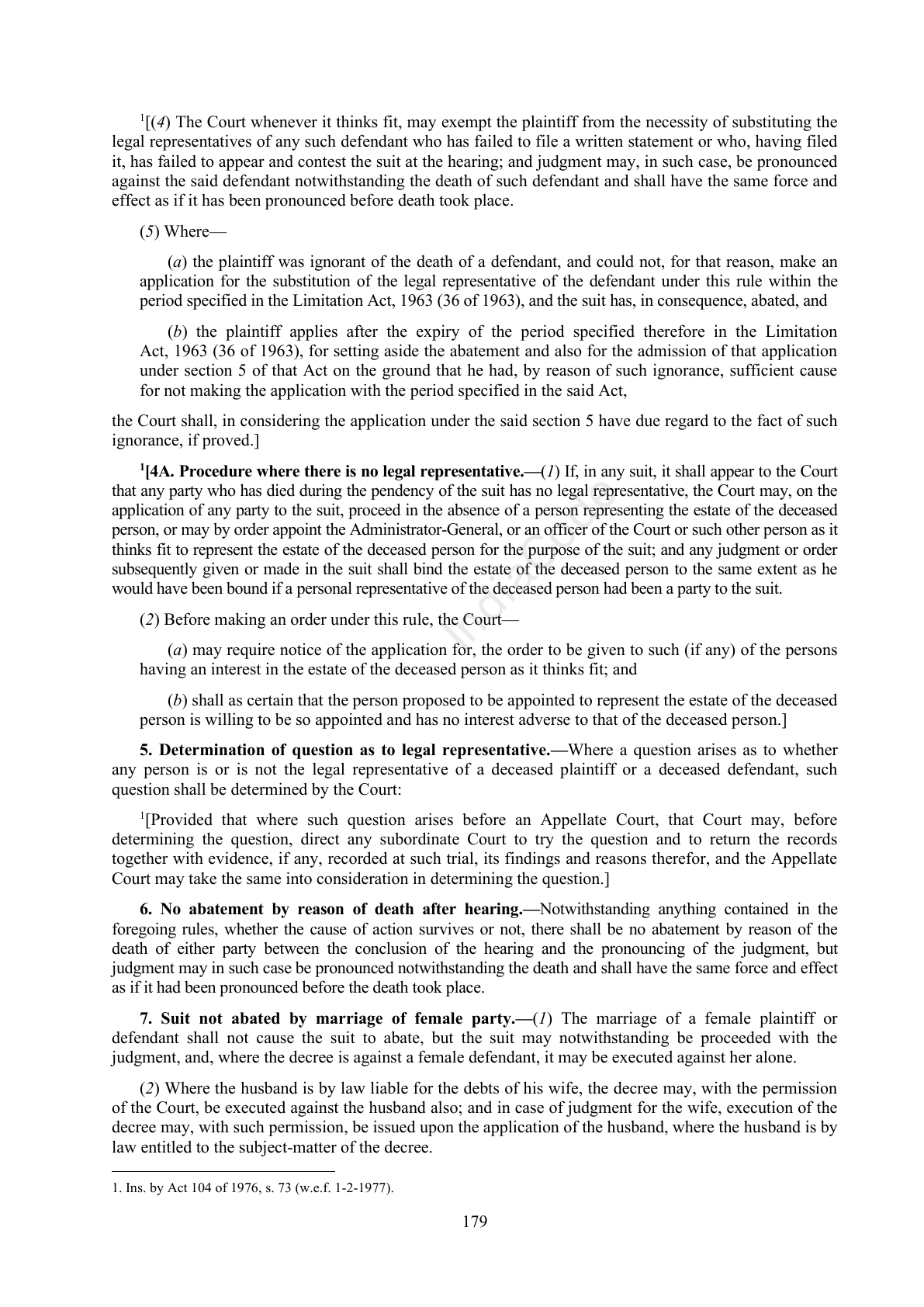
Full physical source page · unreviewed extraction
The Code of Civil Procedure, 1908: page 179
The Code of Civil Procedure, 1908, India Code delivered snapshot 393b8848fdfc476a, physical page 179, typed edition 77428589d4e341672ed6a3e5f663be7dec530c42d0600064ac1314302939267d. Unreviewed extraction.
Source: official India Code PDF · catalog record. Fetched 2026-10-19T23:06:46Z. SHA-256 393b8848fdfc476a21cc3abf4f0d3f510557e2dff6fc6914b1f379bea1730614.
Legal currency, territorial applicability and extraction fidelity are unverified. Catalog checksum/size differs from the delivered PDF; both identities are retained. Sections, state notes and footnotes share these physical pages. Compare the full original image.
Retained layout text
     1
      [(4) The Court whenever it thinks fit, may exempt the plaintiff from the necessity of substituting the
legal representatives of any such defendant who has failed to file a written statement or who, having filed
it, has failed to appear and contest the suit at the hearing; and judgment may, in such case, be pronounced
against the said defendant notwithstanding the death of such defendant and shall have the same force and
effect as if it has been pronounced before death took place.
     (5) Where—
         (a) the plaintiff was ignorant of the death of a defendant, and could not, for that reason, make an
     application for the substitution of the legal representative of the defendant under this rule within the
     period specified in the Limitation Act, 1963 (36 of 1963), and the suit has, in consequence, abated, and
         (b) the plaintiff applies after the expiry of the period specified therefore in the Limitation
     Act, 1963 (36 of 1963), for setting aside the abatement and also for the admission of that application
     under section 5 of that Act on the ground that he had, by reason of such ignorance, sufficient cause
     for not making the application with the period specified in the said Act,
the Court shall, in considering the application under the said section 5 have due regard to the fact of such
ignorance, if proved.]
     1
      [4A. Procedure where there is no legal representative.—(1) If, in any suit, it shall appear to the Court
that any party who has died during the pendency of the suit has no legal representative, the Court may, on the
                                                                      e
application of any party to the suit, proceed in the absence of a person representing the estate of the deceased
                                                                od
person, or may by order appoint the Administrator-General, or an officer of the Court or such other person as it
thinks fit to represent the estate of the deceased person for the purpose of the suit; and any judgment or order
                                                            aC
subsequently given or made in the suit shall bind the estate of the deceased person to the same extent as he
would have been bound if a personal representative of the deceased person had been a party to the suit.
                                                        di
     (2) Before making an order under this rule, the Court—
                                                       In
         (a) may require notice of the application for, the order to be given to such (if any) of the persons
     having an interest in the estate of the deceased person as it thinks fit; and
         (b) shall as certain that the person proposed to be appointed to represent the estate of the deceased
     person is willing to be so appointed and has no interest adverse to that of the deceased person.]
   5. Determination of question as to legal representative.—Where a question arises as to whether
any person is or is not the legal representative of a deceased plaintiff or a deceased defendant, such
question shall be determined by the Court:
     1
     [Provided that where such question arises before an Appellate Court, that Court may, before
determining the question, direct any subordinate Court to try the question and to return the records
together with evidence, if any, recorded at such trial, its findings and reasons therefor, and the Appellate
Court may take the same into consideration in determining the question.]
     6. No abatement by reason of death after hearing.—Notwithstanding anything contained in the
foregoing rules, whether the cause of action survives or not, there shall be no abatement by reason of the
death of either party between the conclusion of the hearing and the pronouncing of the judgment, but
judgment may in such case be pronounced notwithstanding the death and shall have the same force and effect
as if it had been pronounced before the death took place.
    7. Suit not abated by marriage of female party.—(1) The marriage of a female plaintiff or
defendant shall not cause the suit to abate, but the suit may notwithstanding be proceeded with the
judgment, and, where the decree is against a female defendant, it may be executed against her alone.
    (2) Where the husband is by law liable for the debts of his wife, the decree may, with the permission
of the Court, be executed against the husband also; and in case of judgment for the wife, execution of the
decree may, with such permission, be issued upon the application of the husband, where the husband is by
law entitled to the subject-matter of the decree.

1. Ins. by Act 104 of 1976, s. 73 (w.e.f. 1-2-1977).

                                                        179
Compare original page image