Full physical source page · unreviewed extraction
The Code of Civil Procedure, 1908: page 181
The Code of Civil Procedure, 1908, India Code delivered snapshot 393b8848fdfc476a, physical page 181, typed edition 77428589d4e341672ed6a3e5f663be7dec530c42d0600064ac1314302939267d. Unreviewed extraction.
Source: official India Code PDF · catalog record. Fetched 2026-10-19T23:06:46Z. SHA-256 393b8848fdfc476a21cc3abf4f0d3f510557e2dff6fc6914b1f379bea1730614.
Legal currency, territorial applicability and extraction fidelity are unverified. Catalog checksum/size differs from the delivered PDF; both identities are retained. Sections, state notes and footnotes share these physical pages. Compare the full original image.
Retained layout text
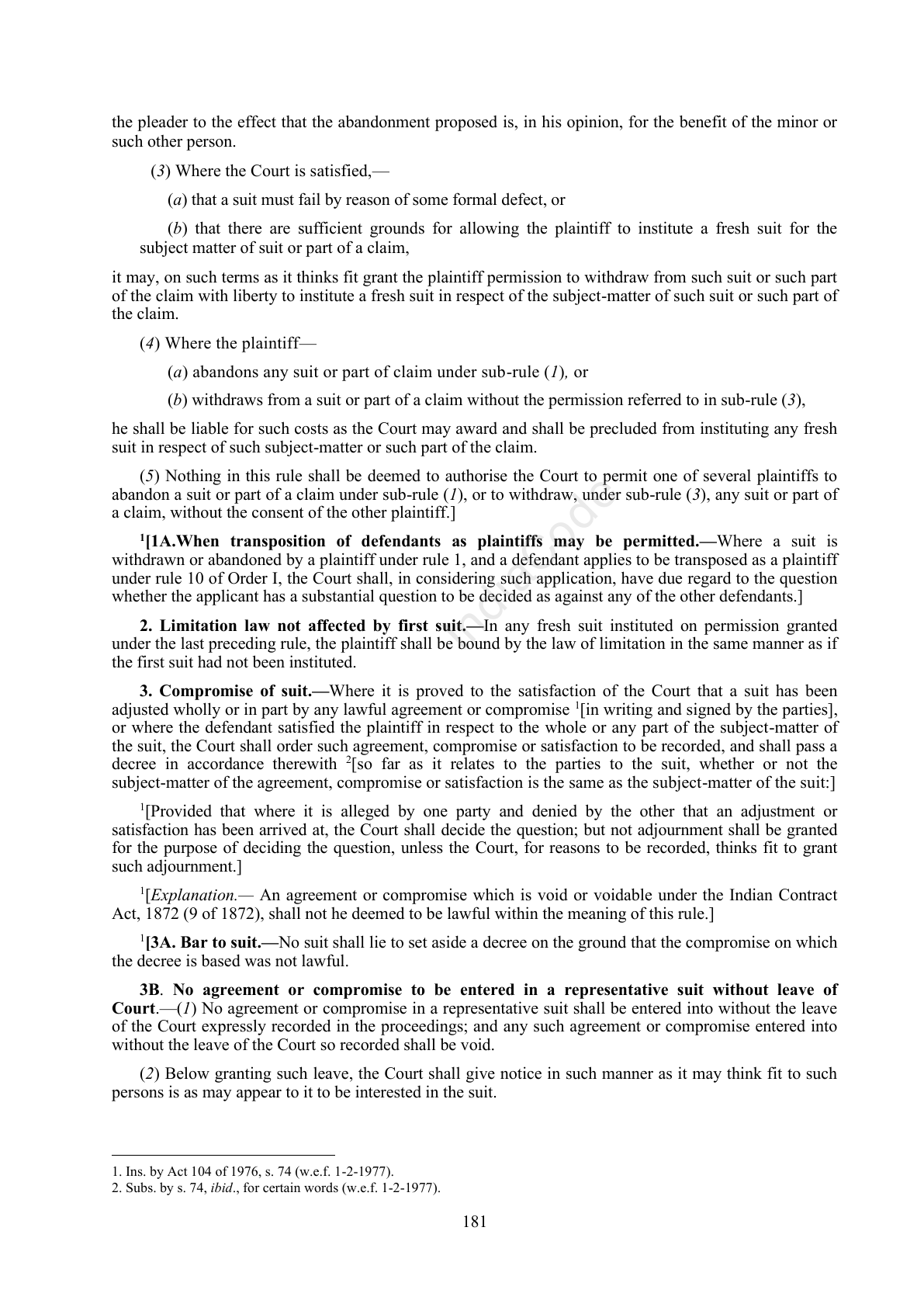
the pleader to the effect that the abandonment proposed is, in his opinion, for the benefit of the minor or
such other person.
         (3) Where the Court is satisfied,—
           (a) that a suit must fail by reason of some formal defect, or
         (b) that there are sufficient grounds for allowing the plaintiff to institute a fresh suit for the
     subject matter of suit or part of a claim,
it may, on such terms as it thinks fit grant the plaintiff permission to withdraw from such suit or such part
of the claim with liberty to institute a fresh suit in respect of the subject-matter of such suit or such part of
the claim.
     (4) Where the plaintiff—
           (a) abandons any suit or part of claim under sub-rule (1), or
           (b) withdraws from a suit or part of a claim without the permission referred to in sub-rule (3),
he shall be liable for such costs as the Court may award and shall be precluded from instituting any fresh
suit in respect of such subject-matter or such part of the claim.
    (5) Nothing in this rule shall be deemed to authorise the Court to permit one of several plaintiffs to
abandon a suit or part of a claim under sub-rule (1), or to withdraw, under sub-rule (3), any suit or part of
                                                                           e
a claim, without the consent of the other plaintiff.]
     1
                                                                       od
    [1A.When transposition of defendants as plaintiffs may be permitted.—Where a suit is
withdrawn or abandoned by a plaintiff under rule 1, and a defendant applies to be transposed as a plaintiff
                                                                   aC
under rule 10 of Order I, the Court shall, in considering such application, have due regard to the question
whether the applicant has a substantial question to be decided as against any of the other defendants.]
                                                                 di
    2. Limitation law not affected by first suit.—In any fresh suit instituted on permission granted
                                                           In
under the last preceding rule, the plaintiff shall be bound by the law of limitation in the same manner as if
the first suit had not been instituted.
    3. Compromise of suit.—Where it is proved to the satisfaction of the Court that a suit has been
adjusted wholly or in part by any lawful agreement or compromise 1[in writing and signed by the parties],
or where the defendant satisfied the plaintiff in respect to the whole or any part of the subject-matter of
the suit, the Court shall order such agreement, compromise or satisfaction to be recorded, and shall pass a
decree in accordance therewith 2[so far as it relates to the parties to the suit, whether or not the
subject-matter of the agreement, compromise or satisfaction is the same as the subject-matter of the suit:]
     1
      [Provided that where it is alleged by one party and denied by the other that an adjustment or
satisfaction has been arrived at, the Court shall decide the question; but not adjournment shall be granted
for the purpose of deciding the question, unless the Court, for reasons to be recorded, thinks fit to grant
such adjournment.]
     1
     [Explanation.— An agreement or compromise which is void or voidable under the Indian Contract
Act, 1872 (9 of 1872), shall not he deemed to be lawful within the meaning of this rule.]
     1
     [3A. Bar to suit.—No suit shall lie to set aside a decree on the ground that the compromise on which
the decree is based was not lawful.
    3B. No agreement or compromise to be entered in a representative suit without leave of
Court.—(1) No agreement or compromise in a representative suit shall be entered into without the leave
of the Court expressly recorded in the proceedings; and any such agreement or compromise entered into
without the leave of the Court so recorded shall be void.
    (2) Below granting such leave, the Court shall give notice in such manner as it may think fit to such
persons is as may appear to it to be interested in the suit.


1. Ins. by Act 104 of 1976, s. 74 (w.e.f. 1-2-1977).
2. Subs. by s. 74, ibid., for certain words (w.e.f. 1-2-1977).

                                                                 181
Compare original page image