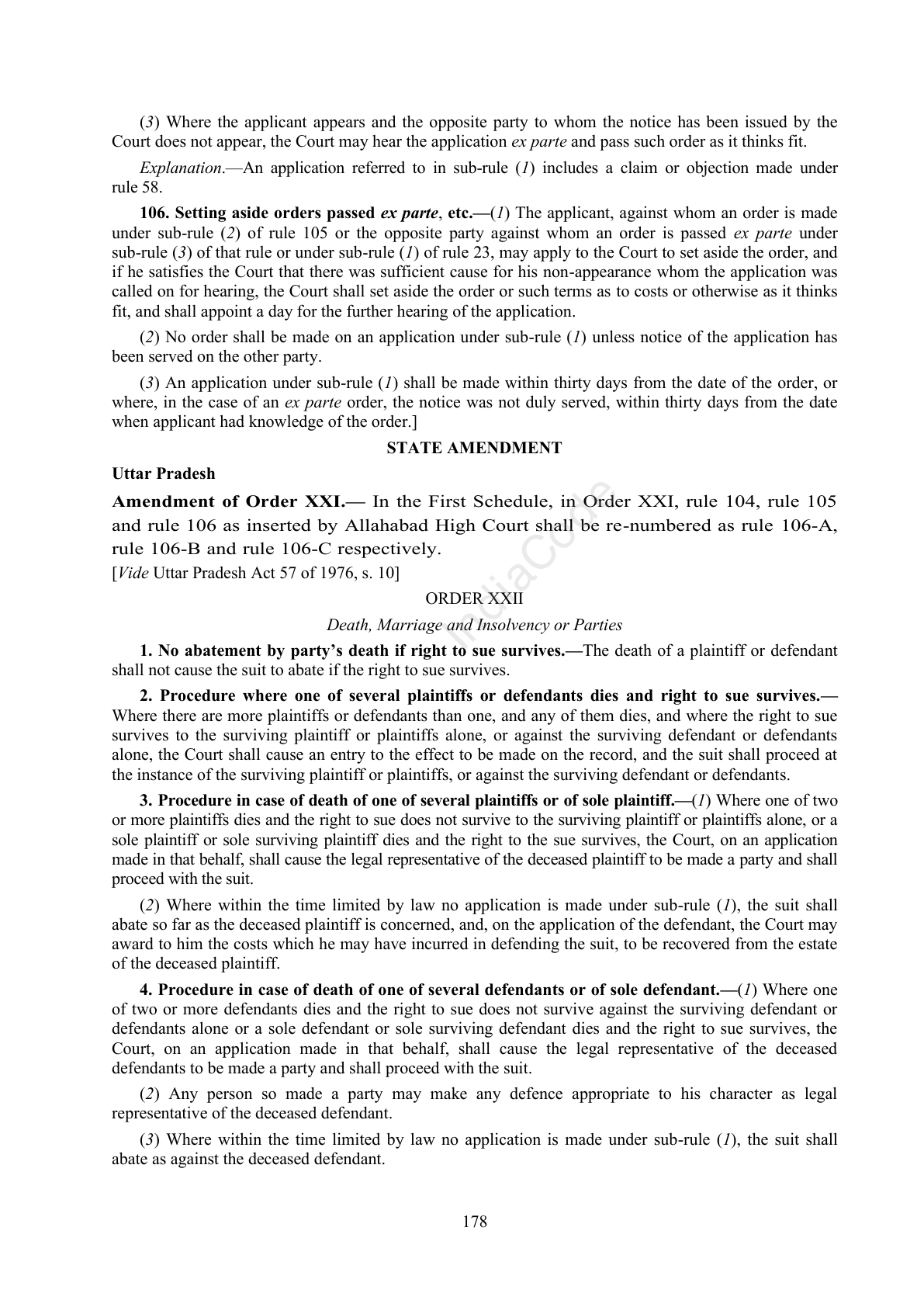
Full physical source page · unreviewed extraction
The Code of Civil Procedure, 1908: page 178
The Code of Civil Procedure, 1908, India Code delivered snapshot 393b8848fdfc476a, physical page 178, typed edition 77428589d4e341672ed6a3e5f663be7dec530c42d0600064ac1314302939267d. Unreviewed extraction.
Source: official India Code PDF · catalog record. Fetched 2026-10-19T23:06:46Z. SHA-256 393b8848fdfc476a21cc3abf4f0d3f510557e2dff6fc6914b1f379bea1730614.
Legal currency, territorial applicability and extraction fidelity are unverified. Catalog checksum/size differs from the delivered PDF; both identities are retained. Sections, state notes and footnotes share these physical pages. Compare the full original image.
Retained layout text
   (3) Where the applicant appears and the opposite party to whom the notice has been issued by the
Court does not appear, the Court may hear the application ex parte and pass such order as it thinks fit.
    Explanation.—An application referred to in sub-rule (1) includes a claim or objection made under
rule 58.
      106. Setting aside orders passed ex parte, etc.—(1) The applicant, against whom an order is made
under sub-rule (2) of rule 105 or the opposite party against whom an order is passed ex parte under
sub-rule (3) of that rule or under sub-rule (1) of rule 23, may apply to the Court to set aside the order, and
if he satisfies the Court that there was sufficient cause for his non-appearance whom the application was
called on for hearing, the Court shall set aside the order or such terms as to costs or otherwise as it thinks
fit, and shall appoint a day for the further hearing of the application.
   (2) No order shall be made on an application under sub-rule (1) unless notice of the application has
been served on the other party.
   (3) An application under sub-rule (1) shall be made within thirty days from the date of the order, or
where, in the case of an ex parte order, the notice was not duly served, within thirty days from the date
when applicant had knowledge of the order.]
                                           STATE AMENDMENT
Uttar Pradesh
Amendment of Order XXI.— In the First Schedule, in Order XXI, rule 104, rule 105
                                                                       e
                                                                 od
and rule 106 as inserted by Allahabad High Court shall be re-numbered as rule 106-A,
rule 106-B and rule 106-C respectively.
[Vide Uttar Pradesh Act 57 of 1976, s. 10]                aC
                                                 ORDER XXII
                                                      di
                                 Death, Marriage and Insolvency or Parties
                                                 In
    1. No abatement by party’s death if right to sue survives.—The death of a plaintiff or defendant
shall not cause the suit to abate if the right to sue survives.
     2. Procedure where one of several plaintiffs or defendants dies and right to sue survives.—
Where there are more plaintiffs or defendants than one, and any of them dies, and where the right to sue
survives to the surviving plaintiff or plaintiffs alone, or against the surviving defendant or defendants
alone, the Court shall cause an entry to the effect to be made on the record, and the suit shall proceed at
the instance of the surviving plaintiff or plaintiffs, or against the surviving defendant or defendants.
    3. Procedure in case of death of one of several plaintiffs or of sole plaintiff.—(1) Where one of two
or more plaintiffs dies and the right to sue does not survive to the surviving plaintiff or plaintiffs alone, or a
sole plaintiff or sole surviving plaintiff dies and the right to the sue survives, the Court, on an application
made in that behalf, shall cause the legal representative of the deceased plaintiff to be made a party and shall
proceed with the suit.
     (2) Where within the time limited by law no application is made under sub-rule (1), the suit shall
abate so far as the deceased plaintiff is concerned, and, on the application of the defendant, the Court may
award to him the costs which he may have incurred in defending the suit, to be recovered from the estate
of the deceased plaintiff.
    4. Procedure in case of death of one of several defendants or of sole defendant.—(1) Where one
of two or more defendants dies and the right to sue does not survive against the surviving defendant or
defendants alone or a sole defendant or sole surviving defendant dies and the right to sue survives, the
Court, on an application made in that behalf, shall cause the legal representative of the deceased
defendants to be made a party and shall proceed with the suit.
    (2) Any person so made a party may make any defence appropriate to his character as legal
representative of the deceased defendant.
    (3) Where within the time limited by law no application is made under sub-rule (1), the suit shall
abate as against the deceased defendant.


                                                      178
Compare original page image