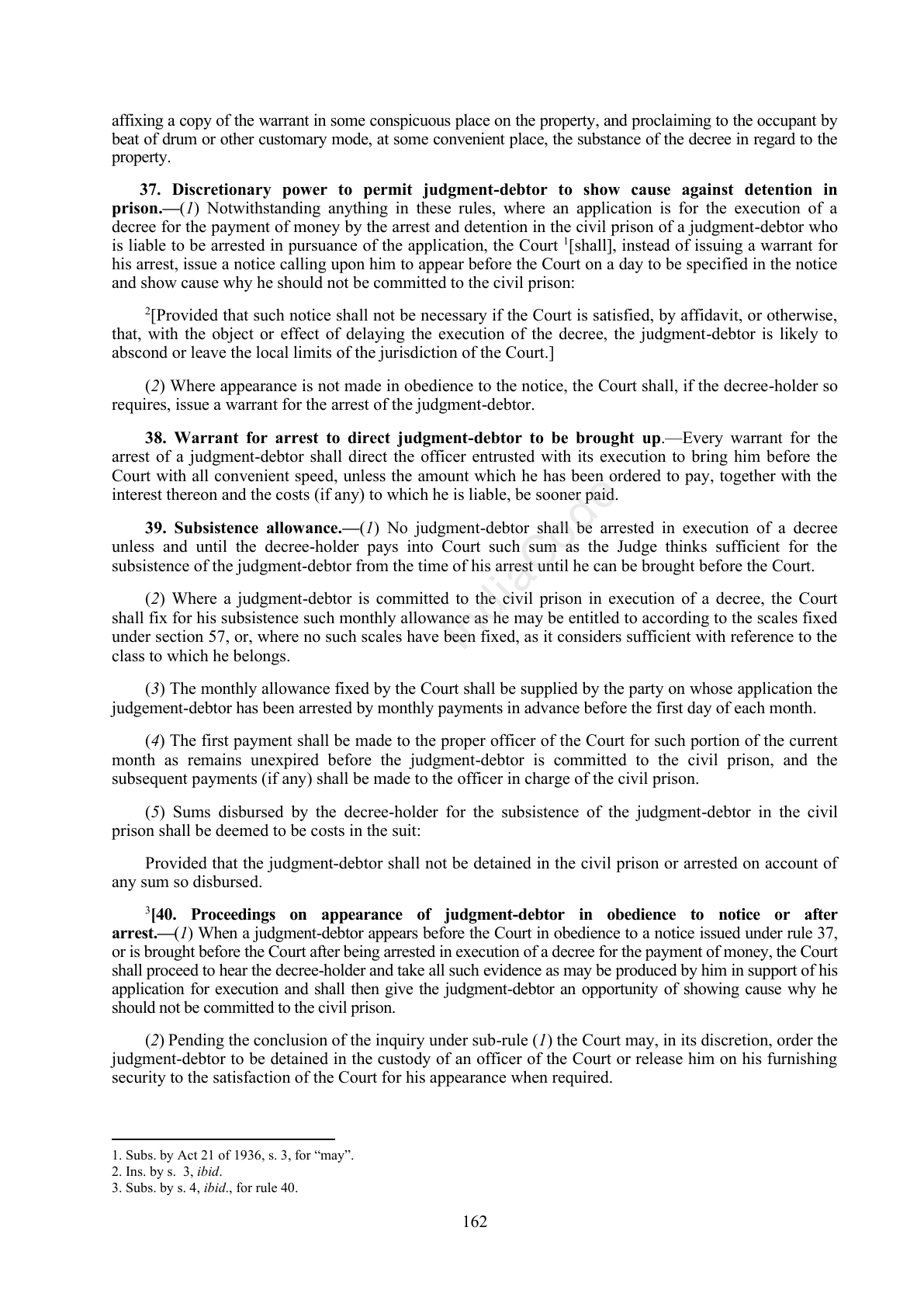
Full physical source page · unreviewed extraction
The Code of Civil Procedure, 1908: page 162
The Code of Civil Procedure, 1908, India Code delivered snapshot 393b8848fdfc476a, physical page 162, typed edition 77428589d4e341672ed6a3e5f663be7dec530c42d0600064ac1314302939267d. Unreviewed extraction.
Source: official India Code PDF · catalog record. Fetched 2026-10-19T23:06:46Z. SHA-256 393b8848fdfc476a21cc3abf4f0d3f510557e2dff6fc6914b1f379bea1730614.
Legal currency, territorial applicability and extraction fidelity are unverified. Catalog checksum/size differs from the delivered PDF; both identities are retained. Sections, state notes and footnotes share these physical pages. Compare the full original image.
Retained layout text
affixing a copy of the warrant in some conspicuous place on the property, and proclaiming to the occupant by
beat of drum or other customary mode, at some convenient place, the substance of the decree in regard to the
property.
     37. Discretionary power to permit judgment-debtor to show cause against detention in
prison.—(1) Notwithstanding anything in these rules, where an application is for the execution of a
decree for the payment of money by the arrest and detention in the civil prison of a judgment-debtor who
is liable to be arrested in pursuance of the application, the Court 1[shall], instead of issuing a warrant for
his arrest, issue a notice calling upon him to appear before the Court on a day to be specified in the notice
and show cause why he should not be committed to the civil prison:
      2
      [Provided that such notice shall not be necessary if the Court is satisfied, by affidavit, or otherwise,
that, with the object or effect of delaying the execution of the decree, the judgment-debtor is likely to
abscond or leave the local limits of the jurisdiction of the Court.]
     (2) Where appearance is not made in obedience to the notice, the Court shall, if the decree-holder so
requires, issue a warrant for the arrest of the judgment-debtor.
     38. Warrant for arrest to direct judgment-debtor to be brought up.—Every warrant for the
arrest of a judgment-debtor shall direct the officer entrusted with its execution to bring him before the
Court with all convenient speed, unless the amount which he has been ordered to pay, together with the
interest thereon and the costs (if any) to which he is liable, be sooner paid.
                                                                      e
                                                                od
     39. Subsistence allowance.—(1) No judgment-debtor shall be arrested in execution of a decree
unless and until the decree-holder pays into Court such sum as the Judge thinks sufficient for the
                                                         aC
subsistence of the judgment-debtor from the time of his arrest until he can be brought before the Court.
     (2) Where a judgment-debtor is committed to the civil prison in execution of a decree, the Court
                                                     di
shall fix for his subsistence such monthly allowance as he may be entitled to according to the scales fixed
                                                In
under section 57, or, where no such scales have been fixed, as it considers sufficient with reference to the
class to which he belongs.
    (3) The monthly allowance fixed by the Court shall be supplied by the party on whose application the
judgement-debtor has been arrested by monthly payments in advance before the first day of each month.
    (4) The first payment shall be made to the proper officer of the Court for such portion of the current
month as remains unexpired before the judgment-debtor is committed to the civil prison, and the
subsequent payments (if any) shall be made to the officer in charge of the civil prison.
     (5) Sums disbursed by the decree-holder for the subsistence of the judgment-debtor in the civil
prison shall be deemed to be costs in the suit:
     Provided that the judgment-debtor shall not be detained in the civil prison or arrested on account of
any sum so disbursed.
      3
       [40. Proceedings on appearance of judgment-debtor in obedience to notice or after
arrest.—(1) When a judgment-debtor appears before the Court in obedience to a notice issued under rule 37,
or is brought before the Court after being arrested in execution of a decree for the payment of money, the Court
shall proceed to hear the decree-holder and take all such evidence as may be produced by him in support of his
application for execution and shall then give the judgment-debtor an opportunity of showing cause why he
should not be committed to the civil prison.
     (2) Pending the conclusion of the inquiry under sub-rule (1) the Court may, in its discretion, order the
judgment-debtor to be detained in the custody of an officer of the Court or release him on his furnishing
security to the satisfaction of the Court for his appearance when required.


1. Subs. by Act 21 of 1936, s. 3, for “may”.
2. Ins. by s. 3, ibid.
3. Subs. by s. 4, ibid., for rule 40.

                                                      162
Compare original page image