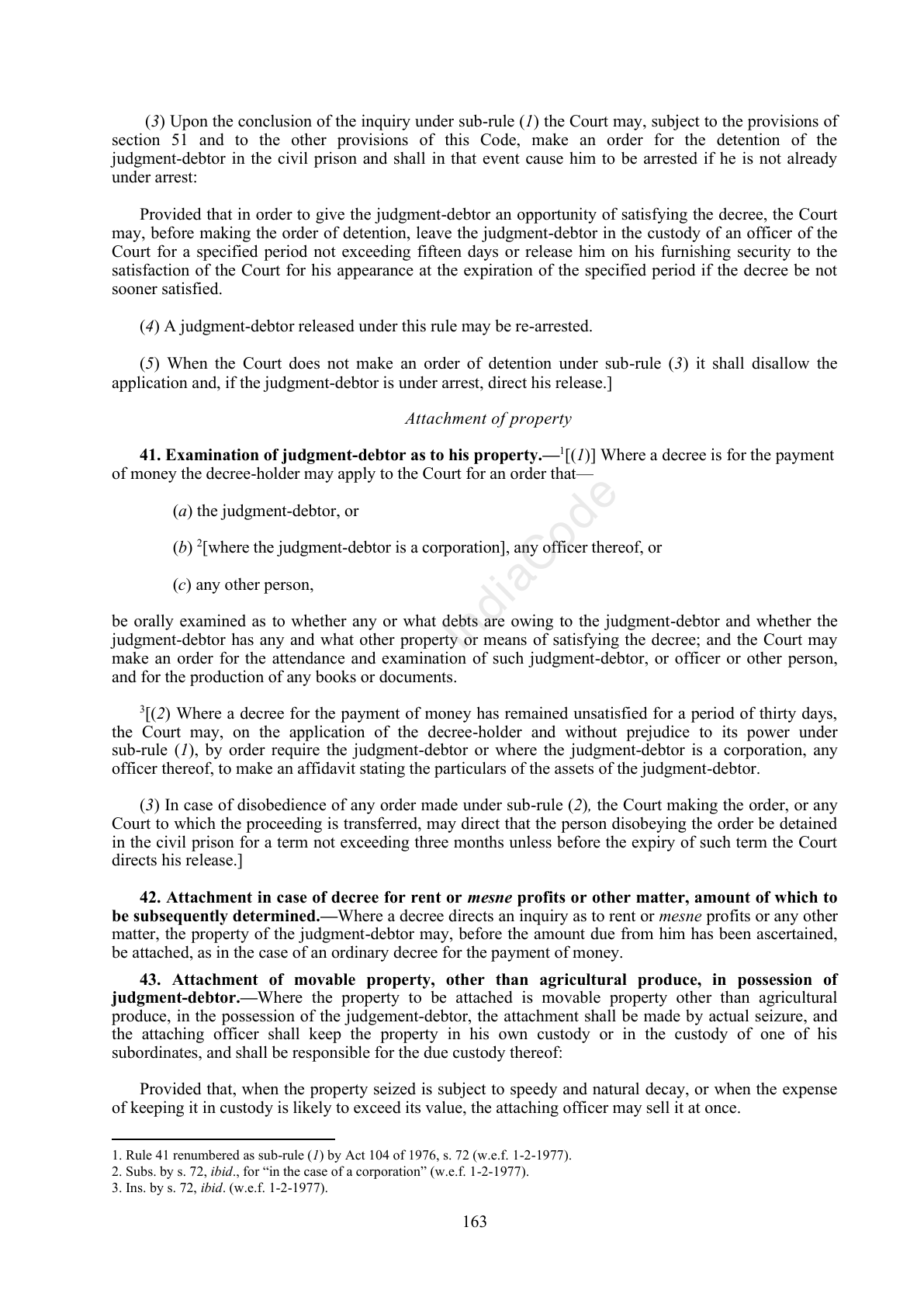
Full physical source page · unreviewed extraction
The Code of Civil Procedure, 1908: page 163
The Code of Civil Procedure, 1908, India Code delivered snapshot 393b8848fdfc476a, physical page 163, typed edition 77428589d4e341672ed6a3e5f663be7dec530c42d0600064ac1314302939267d. Unreviewed extraction.
Source: official India Code PDF · catalog record. Fetched 2026-10-19T23:06:46Z. SHA-256 393b8848fdfc476a21cc3abf4f0d3f510557e2dff6fc6914b1f379bea1730614.
Legal currency, territorial applicability and extraction fidelity are unverified. Catalog checksum/size differs from the delivered PDF; both identities are retained. Sections, state notes and footnotes share these physical pages. Compare the full original image.
Retained layout text
     (3) Upon the conclusion of the inquiry under sub-rule (1) the Court may, subject to the provisions of
section 51 and to the other provisions of this Code, make an order for the detention of the
judgment-debtor in the civil prison and shall in that event cause him to be arrested if he is not already
under arrest:

     Provided that in order to give the judgment-debtor an opportunity of satisfying the decree, the Court
may, before making the order of detention, leave the judgment-debtor in the custody of an officer of the
Court for a specified period not exceeding fifteen days or release him on his furnishing security to the
satisfaction of the Court for his appearance at the expiration of the specified period if the decree be not
sooner satisfied.

    (4) A judgment-debtor released under this rule may be re-arrested.

    (5) When the Court does not make an order of detention under sub-rule (3) it shall disallow the
application and, if the judgment-debtor is under arrest, direct his release.]

                                                    Attachment of property

    41. Examination of judgment-debtor as to his property.—1[(1)] Where a decree is for the payment
of money the decree-holder may apply to the Court for an order that—

          (a) the judgment-debtor, or                                            e
                                                                          od
          (b) 2[where the judgment-debtor is a corporation], any officer thereof, or

          (c) any other person,
                                                                  aC
                                                             di
be orally examined as to whether any or what debts are owing to the judgment-debtor and whether the
                                                        In
judgment-debtor has any and what other property or means of satisfying the decree; and the Court may
make an order for the attendance and examination of such judgment-debtor, or officer or other person,
and for the production of any books or documents.
    3
     [(2) Where a decree for the payment of money has remained unsatisfied for a period of thirty days,
the Court may, on the application of the decree-holder and without prejudice to its power under
sub-rule (1), by order require the judgment-debtor or where the judgment-debtor is a corporation, any
officer thereof, to make an affidavit stating the particulars of the assets of the judgment-debtor.

     (3) In case of disobedience of any order made under sub-rule (2), the Court making the order, or any
Court to which the proceeding is transferred, may direct that the person disobeying the order be detained
in the civil prison for a term not exceeding three months unless before the expiry of such term the Court
directs his release.]

    42. Attachment in case of decree for rent or mesne profits or other matter, amount of which to
be subsequently determined.—Where a decree directs an inquiry as to rent or mesne profits or any other
matter, the property of the judgment-debtor may, before the amount due from him has been ascertained,
be attached, as in the case of an ordinary decree for the payment of money.
    43. Attachment of movable property, other than agricultural produce, in possession of
judgment-debtor.—Where the property to be attached is movable property other than agricultural
produce, in the possession of the judgement-debtor, the attachment shall be made by actual seizure, and
the attaching officer shall keep the property in his own custody or in the custody of one of his
subordinates, and shall be responsible for the due custody thereof:

    Provided that, when the property seized is subject to speedy and natural decay, or when the expense
of keeping it in custody is likely to exceed its value, the attaching officer may sell it at once.

1. Rule 41 renumbered as sub-rule (1) by Act 104 of 1976, s. 72 (w.e.f. 1-2-1977).
2. Subs. by s. 72, ibid., for “in the case of a corporation” (w.e.f. 1-2-1977).
3. Ins. by s. 72, ibid. (w.e.f. 1-2-1977).

                                                              163
Compare original page image