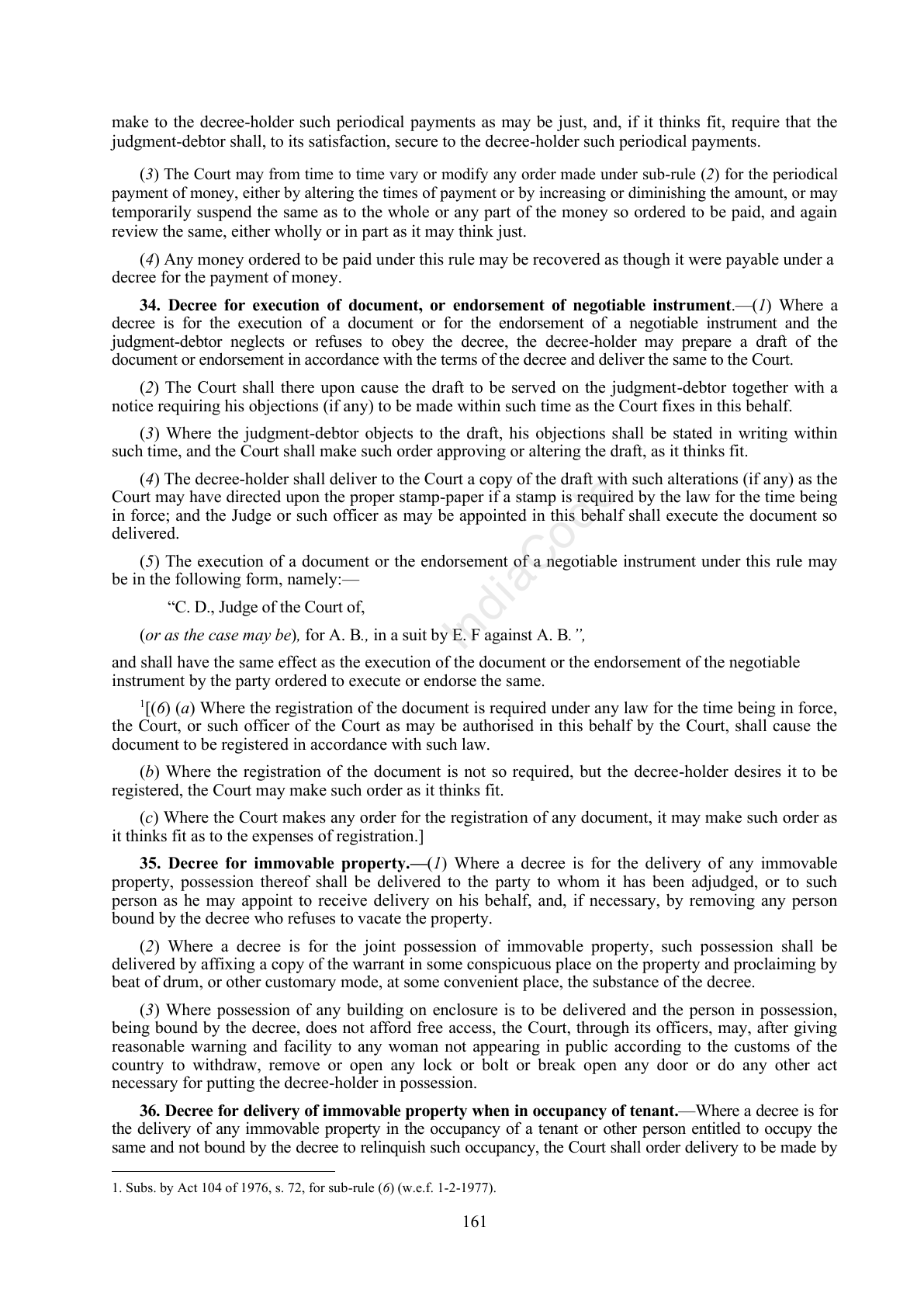
Full physical source page · unreviewed extraction
The Code of Civil Procedure, 1908: page 161
The Code of Civil Procedure, 1908, India Code delivered snapshot 393b8848fdfc476a, physical page 161, typed edition 77428589d4e341672ed6a3e5f663be7dec530c42d0600064ac1314302939267d. Unreviewed extraction.
Source: official India Code PDF · catalog record. Fetched 2026-10-19T23:06:46Z. SHA-256 393b8848fdfc476a21cc3abf4f0d3f510557e2dff6fc6914b1f379bea1730614.
Legal currency, territorial applicability and extraction fidelity are unverified. Catalog checksum/size differs from the delivered PDF; both identities are retained. Sections, state notes and footnotes share these physical pages. Compare the full original image.
Retained layout text
make to the decree-holder such periodical payments as may be just, and, if it thinks fit, require that the
judgment-debtor shall, to its satisfaction, secure to the decree-holder such periodical payments.
    (3) The Court may from time to time vary or modify any order made under sub-rule (2) for the periodical
payment of money, either by altering the times of payment or by increasing or diminishing the amount, or may
temporarily suspend the same as to the whole or any part of the money so ordered to be paid, and again
review the same, either wholly or in part as it may think just.
    (4) Any money ordered to be paid under this rule may be recovered as though it were payable under a
decree for the payment of money.
    34. Decree for execution of document, or endorsement of negotiable instrument.—(1) Where a
decree is for the execution of a document or for the endorsement of a negotiable instrument and the
judgment-debtor neglects or refuses to obey the decree, the decree-holder may prepare a draft of the
document or endorsement in accordance with the terms of the decree and deliver the same to the Court.
    (2) The Court shall there upon cause the draft to be served on the judgment-debtor together with a
notice requiring his objections (if any) to be made within such time as the Court fixes in this behalf.
    (3) Where the judgment-debtor objects to the draft, his objections shall be stated in writing within
such time, and the Court shall make such order approving or altering the draft, as it thinks fit.
    (4) The decree-holder shall deliver to the Court a copy of the draft with such alterations (if any) as the
Court may have directed upon the proper stamp-paper if a stamp is required by the law for the time being
                                                                           e
in force; and the Judge or such officer as may be appointed in this behalf shall execute the document so
delivered.                                                                od
    (5) The execution of a document or the endorsement of a negotiable instrument under this rule may
be in the following form, namely:—
                                                                     aC
          “C. D., Judge of the Court of,                       di
                                                          In
     (or as the case may be), for A. B., in a suit by E. F against A. B.”,
and shall have the same effect as the execution of the document or the endorsement of the negotiable
instrument by the party ordered to execute or endorse the same.
     1
     [(6) (a) Where the registration of the document is required under any law for the time being in force,
the Court, or such officer of the Court as may be authorised in this behalf by the Court, shall cause the
document to be registered in accordance with such law.
    (b) Where the registration of the document is not so required, but the decree-holder desires it to be
registered, the Court may make such order as it thinks fit.
     (c) Where the Court makes any order for the registration of any document, it may make such order as
it thinks fit as to the expenses of registration.]
    35. Decree for immovable property.—(1) Where a decree is for the delivery of any immovable
property, possession thereof shall be delivered to the party to whom it has been adjudged, or to such
person as he may appoint to receive delivery on his behalf, and, if necessary, by removing any person
bound by the decree who refuses to vacate the property.
    (2) Where a decree is for the joint possession of immovable property, such possession shall be
delivered by affixing a copy of the warrant in some conspicuous place on the property and proclaiming by
beat of drum, or other customary mode, at some convenient place, the substance of the decree.
    (3) Where possession of any building on enclosure is to be delivered and the person in possession,
being bound by the decree, does not afford free access, the Court, through its officers, may, after giving
reasonable warning and facility to any woman not appearing in public according to the customs of the
country to withdraw, remove or open any lock or bolt or break open any door or do any other act
necessary for putting the decree-holder in possession.
    36. Decree for delivery of immovable property when in occupancy of tenant.—Where a decree is for
the delivery of any immovable property in the occupancy of a tenant or other person entitled to occupy the
same and not bound by the decree to relinquish such occupancy, the Court shall order delivery to be made by

1. Subs. by Act 104 of 1976, s. 72, for sub-rule (6) (w.e.f. 1-2-1977).

                                                                161
Compare original page image