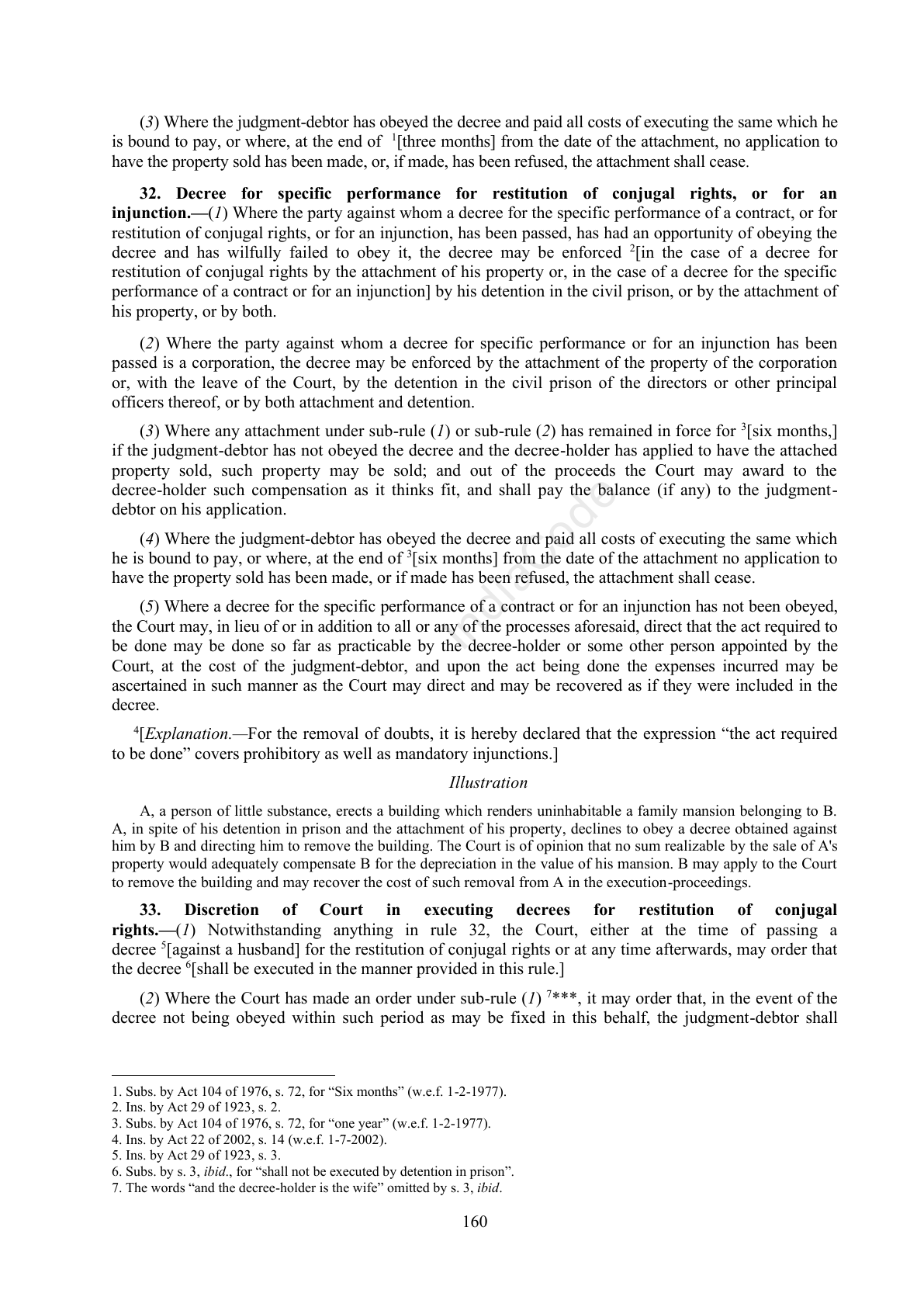
Full physical source page · unreviewed extraction
The Code of Civil Procedure, 1908: page 160
The Code of Civil Procedure, 1908, India Code delivered snapshot 393b8848fdfc476a, physical page 160, typed edition 77428589d4e341672ed6a3e5f663be7dec530c42d0600064ac1314302939267d. Unreviewed extraction.
Source: official India Code PDF · catalog record. Fetched 2026-10-19T23:06:46Z. SHA-256 393b8848fdfc476a21cc3abf4f0d3f510557e2dff6fc6914b1f379bea1730614.
Legal currency, territorial applicability and extraction fidelity are unverified. Catalog checksum/size differs from the delivered PDF; both identities are retained. Sections, state notes and footnotes share these physical pages. Compare the full original image.
Retained layout text
    (3) Where the judgment-debtor has obeyed the decree and paid all costs of executing the same which he
is bound to pay, or where, at the end of 1[three months] from the date of the attachment, no application to
have the property sold has been made, or, if made, has been refused, the attachment shall cease.
     32. Decree for specific performance for restitution of conjugal rights, or for an
injunction.—(1) Where the party against whom a decree for the specific performance of a contract, or for
restitution of conjugal rights, or for an injunction, has been passed, has had an opportunity of obeying the
decree and has wilfully failed to obey it, the decree may be enforced 2[in the case of a decree for
restitution of conjugal rights by the attachment of his property or, in the case of a decree for the specific
performance of a contract or for an injunction] by his detention in the civil prison, or by the attachment of
his property, or by both.
    (2) Where the party against whom a decree for specific performance or for an injunction has been
passed is a corporation, the decree may be enforced by the attachment of the property of the corporation
or, with the leave of the Court, by the detention in the civil prison of the directors or other principal
officers thereof, or by both attachment and detention.
     (3) Where any attachment under sub-rule (1) or sub-rule (2) has remained in force for 3[six months,]
if the judgment-debtor has not obeyed the decree and the decree-holder has applied to have the attached
property sold, such property may be sold; and out of the proceeds the Court may award to the
decree-holder such compensation as it thinks fit, and shall pay the balance (if any) to the judgment-
debtor on his application.                                                      e
                                                                               od
    (4) Where the judgment-debtor has obeyed the decree and paid all costs of executing the same which
he is bound to pay, or where, at the end of 3[six months] from the date of the attachment no application to
                                                                      aC
have the property sold has been made, or if made has been refused, the attachment shall cease.
                                                                 di
    (5) Where a decree for the specific performance of a contract or for an injunction has not been obeyed,
the Court may, in lieu of or in addition to all or any of the processes aforesaid, direct that the act required to
                                                           In
be done may be done so far as practicable by the decree-holder or some other person appointed by the
Court, at the cost of the judgment-debtor, and upon the act being done the expenses incurred may be
ascertained in such manner as the Court may direct and may be recovered as if they were included in the
decree.
    4
    [Explanation.—For the removal of doubts, it is hereby declared that the expression “the act required
to be done” covers prohibitory as well as mandatory injunctions.]
                                                               Illustration
     A, a person of little substance, erects a building which renders uninhabitable a family mansion belonging to B.
A, in spite of his detention in prison and the attachment of his property, declines to obey a decree obtained against
him by B and directing him to remove the building. The Court is of opinion that no sum realizable by the sale of A's
property would adequately compensate B for the depreciation in the value of his mansion. B may apply to the Court
to remove the building and may recover the cost of such removal from A in the execution-proceedings.
    33. Discretion of Court in executing decrees for restitution of conjugal
rights.—(1) Notwithstanding anything in rule 32, the Court, either at the time of passing a
decree 5[against a husband] for the restitution of conjugal rights or at any time afterwards, may order that
the decree 6[shall be executed in the manner provided in this rule.]
    (2) Where the Court has made an order under sub-rule (1) 7***, it may order that, in the event of the
decree not being obeyed within such period as may be fixed in this behalf, the judgment-debtor shall


1. Subs. by Act 104 of 1976, s. 72, for “Six months” (w.e.f. 1-2-1977).
2. Ins. by Act 29 of 1923, s. 2.
3. Subs. by Act 104 of 1976, s. 72, for “one year” (w.e.f. 1-2-1977).
4. Ins. by Act 22 of 2002, s. 14 (w.e.f. 1-7-2002).
5. Ins. by Act 29 of 1923, s. 3.
6. Subs. by s. 3, ibid., for “shall not be executed by detention in prison”.
7. The words “and the decree-holder is the wife” omitted by s. 3, ibid.

                                                                  160
Compare original page image