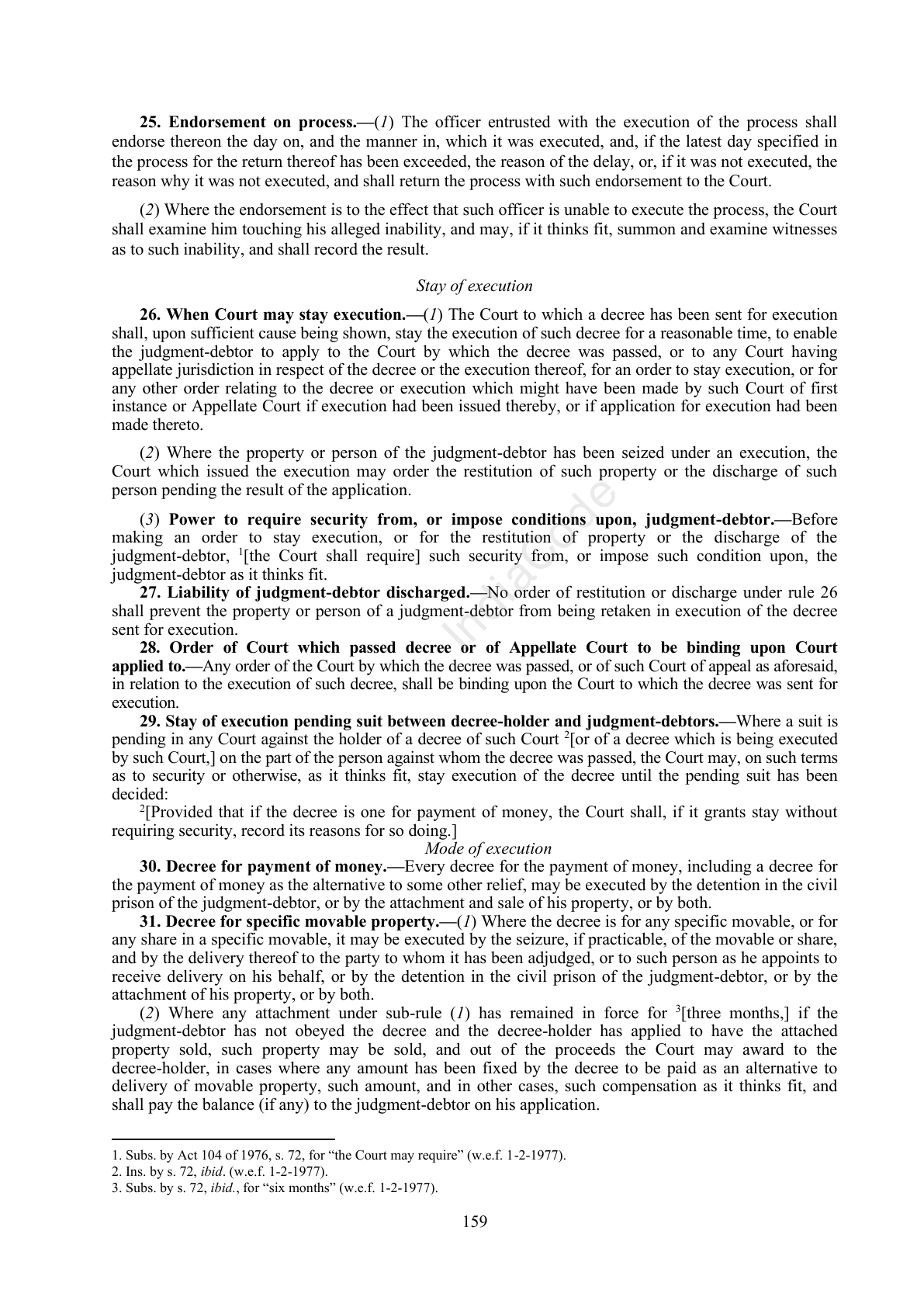
Full physical source page · unreviewed extraction
The Code of Civil Procedure, 1908: page 159
The Code of Civil Procedure, 1908, India Code delivered snapshot 393b8848fdfc476a, physical page 159, typed edition 77428589d4e341672ed6a3e5f663be7dec530c42d0600064ac1314302939267d. Unreviewed extraction.
Source: official India Code PDF · catalog record. Fetched 2026-10-19T23:06:46Z. SHA-256 393b8848fdfc476a21cc3abf4f0d3f510557e2dff6fc6914b1f379bea1730614.
Legal currency, territorial applicability and extraction fidelity are unverified. Catalog checksum/size differs from the delivered PDF; both identities are retained. Sections, state notes and footnotes share these physical pages. Compare the full original image.
Retained layout text
    25. Endorsement on process.—(1) The officer entrusted with the execution of the process shall
endorse thereon the day on, and the manner in, which it was executed, and, if the latest day specified in
the process for the return thereof has been exceeded, the reason of the delay, or, if it was not executed, the
reason why it was not executed, and shall return the process with such endorsement to the Court.
     (2) Where the endorsement is to the effect that such officer is unable to execute the process, the Court
shall examine him touching his alleged inability, and may, if it thinks fit, summon and examine witnesses
as to such inability, and shall record the result.

                                                      Stay of execution
    26. When Court may stay execution.—(1) The Court to which a decree has been sent for execution
shall, upon sufficient cause being shown, stay the execution of such decree for a reasonable time, to enable
the judgment-debtor to apply to the Court by which the decree was passed, or to any Court having
appellate jurisdiction in respect of the decree or the execution thereof, for an order to stay execution, or for
any other order relating to the decree or execution which might have been made by such Court of first
instance or Appellate Court if execution had been issued thereby, or if application for execution had been
made thereto.
    (2) Where the property or person of the judgment-debtor has been seized under an execution, the
Court which issued the execution may order the restitution of such property or the discharge of such
person pending the result of the application.
                                                                                     e
     (3) Power to require security from, or impose conditions upon, judgment-debtor.—Before
                                                                           od
making an order to stay execution, or for the restitution of property or the discharge of the
judgment-debtor, 1[the Court shall require] such security from, or impose such condition upon, the
judgment-debtor as it thinks fit.                                  aC
     27. Liability of judgment-debtor discharged.—No order of restitution or discharge under rule 26
                                                              di
shall prevent the property or person of a judgment-debtor from being retaken in execution of the decree
sent for execution.                                      In
     28. Order of Court which passed decree or of Appellate Court to be binding upon Court
applied to.—Any order of the Court by which the decree was passed, or of such Court of appeal as aforesaid,
in relation to the execution of such decree, shall be binding upon the Court to which the decree was sent for
execution.
     29. Stay of execution pending suit between decree-holder and judgment-debtors.—Where a suit is
pending in any Court against the holder of a decree of such Court 2[or of a decree which is being executed
by such Court,] on the part of the person against whom the decree was passed, the Court may, on such terms
as to security or otherwise, as it thinks fit, stay execution of the decree until the pending suit has been
decided:
     2
       [Provided that if the decree is one for payment of money, the Court shall, if it grants stay without
requiring security, record its reasons for so doing.]
                                                Mode of execution
     30. Decree for payment of money.—Every decree for the payment of money, including a decree for
the payment of money as the alternative to some other relief, may be executed by the detention in the civil
prison of the judgment-debtor, or by the attachment and sale of his property, or by both.
     31. Decree for specific movable property.—(1) Where the decree is for any specific movable, or for
any share in a specific movable, it may be executed by the seizure, if practicable, of the movable or share,
and by the delivery thereof to the party to whom it has been adjudged, or to such person as he appoints to
receive delivery on his behalf, or by the detention in the civil prison of the judgment-debtor, or by the
attachment of his property, or by both.
     (2) Where any attachment under sub-rule (1) has remained in force for 3[three months,] if the
judgment-debtor has not obeyed the decree and the decree-holder has applied to have the attached
property sold, such property may be sold, and out of the proceeds the Court may award to the
decree-holder, in cases where any amount has been fixed by the decree to be paid as an alternative to
delivery of movable property, such amount, and in other cases, such compensation as it thinks fit, and
shall pay the balance (if any) to the judgment-debtor on his application.

1. Subs. by Act 104 of 1976, s. 72, for “the Court may require” (w.e.f. 1-2-1977).
2. Ins. by s. 72, ibid. (w.e.f. 1-2-1977).
3. Subs. by s. 72, ibid., for “six months” (w.e.f. 1-2-1977).

                                                               159
Compare original page image