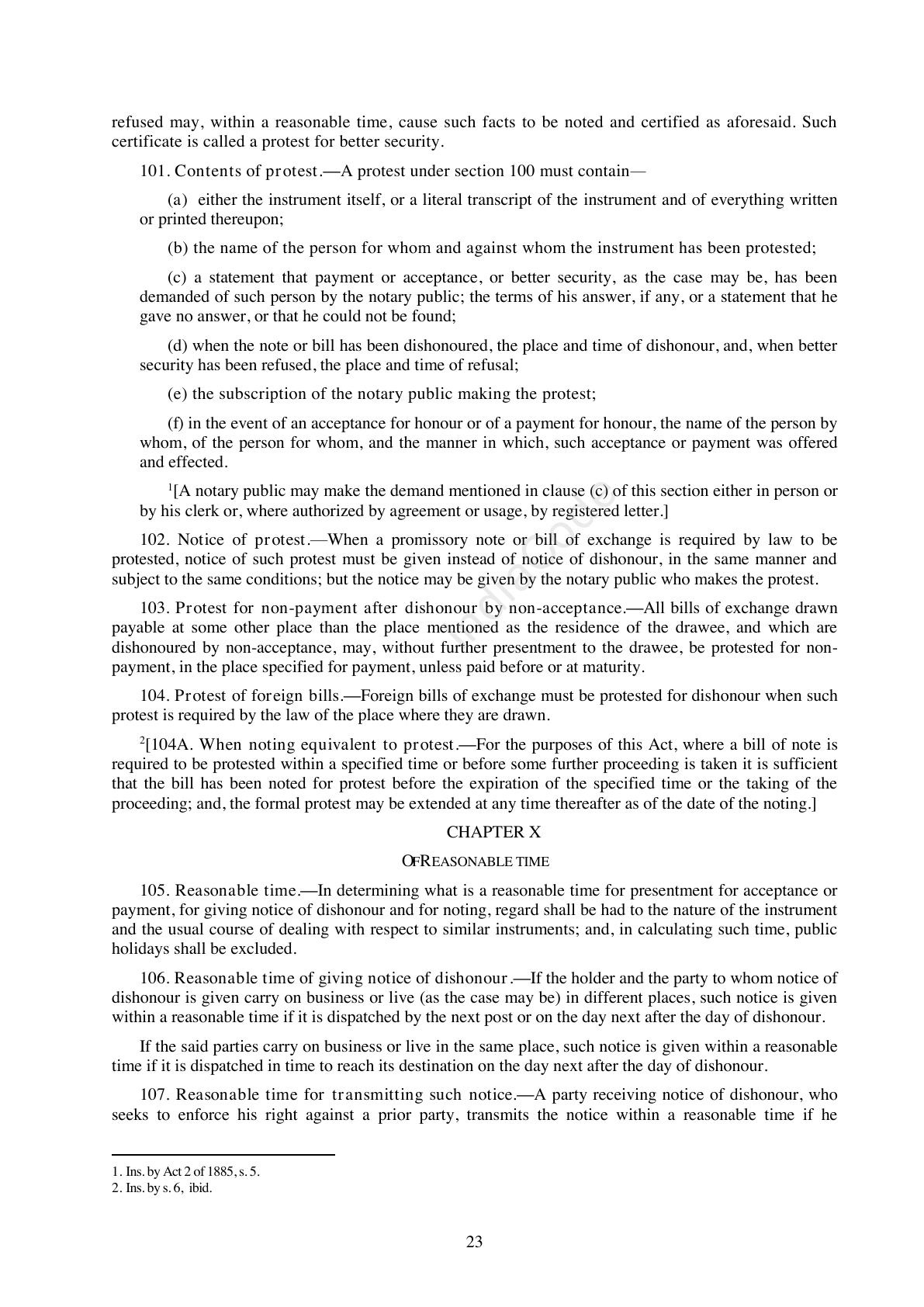
Full physical source page · unreviewed extraction
The Negotiable Instruments Act, 1881: page 23
The Negotiable Instruments Act, 1881, India Code delivered snapshot ed3e9db7f37052a1, physical page 23. Unreviewed extraction.
Source: official India Code PDF · catalog record. Fetched 2026-10-19T23:07:34Z. SHA-256 ed3e9db7f37052a1bc1cd665500910c5e123de888bce0375585e9a766bf38501.
Legal currency, territorial applicability and extraction fidelity are unverified. Catalog checksum/size differs from the delivered PDF; both identities are retained. Sections, state notes and footnotes share these physical pages. Compare the full original image.
Retained layout text
refused may, within a reasonable time, cause such facts to be noted and certified as aforesaid. Such
certificate is called a protest for better security.
     101. Contents of protest.—A protest under section 100 must contain—
         (a) either the instrument itself, or a literal transcript of the instrument and of everything written
     or printed thereupon;
           (b) the name of the person for whom and against whom the instrument has been protested;
        (c) a statement that payment or acceptance, or better security, as the case may be, has been
     demanded of such person by the notary public; the terms of his answer, if any, or a statement that he
     gave no answer, or that he could not be found;
         (d) when the note or bill has been dishonoured, the place and time of dishonour, and, when better
     security has been refused, the place and time of refusal;
           (e) the subscription of the notary public making the protest;
         (f) in the event of an acceptance for honour or of a payment for honour, the name of the person by
     whom, of the person for whom, and the manner in which, such acceptance or payment was offered
     and effected.
           1
          [A notary public may make the demand mentioned in clause (c) of this section either in person or
                                                                     e
     by his clerk or, where authorized by agreement or usage, by registered letter.]
                                                               od
    102. Notice of protest.—When a promissory note or bill of exchange is required by law to be
                                                           aC
protested, notice of such protest must be given instead of notice of dishonour, in the same manner and
subject to the same conditions; but the notice may be given by the notary public who makes the protest.
                                                    di
    103. Protest for non-payment after dishonour by non-acceptance.—All bills of exchange drawn
payable at some other place than the place mentioned as the residence of the drawee, and which are
                                                In
dishonoured by non-acceptance, may, without further presentment to the drawee, be protested for non-
payment, in the place specified for payment, unless paid before or at maturity.
    104. Protest of foreign bills.—Foreign bills of exchange must be protested for dishonour when such
protest is required by the law of the place where they are drawn.
     2
     [104A. When noting equivalent to protest.—For the purposes of this Act, where a bill of note is
required to be protested within a specified time or before some further proceeding is taken it is sufficient
that the bill has been noted for protest before the expiration of the specified time or the taking of the
proceeding; and, the formal protest may be extended at any time thereafter as of the date of the noting.]
                                                   CHAPTER X
                                            OFREASONABLE TIME
    105. Reasonable time.—In determining what is a reasonable time for presentment for acceptance or
payment, for giving notice of dishonour and for noting, regard shall be had to the nature of the instrument
and the usual course of dealing with respect to similar instruments; and, in calculating such time, public
holidays shall be excluded.
    106. Reasonable time of giving notice of dishonour.—If the holder and the party to whom notice of
dishonour is given carry on business or live (as the case may be) in different places, such notice is given
within a reasonable time if it is dispatched by the next post or on the day next after the day of dishonour.
    If the said parties carry on business or live in the same place, such notice is given within a reasonable
time if it is dispatched in time to reach its destination on the day next after the day of dishonour.
    107. Reasonable time for transmitting such notice.—A party receiving notice of dishonour, who
seeks to enforce his right against a prior party, transmits the notice within a reasonable time if he


1. Ins. by Act 2 of 1885, s. 5.
2. Ins. by s. 6, ibid.


                                                      23
Compare original page image