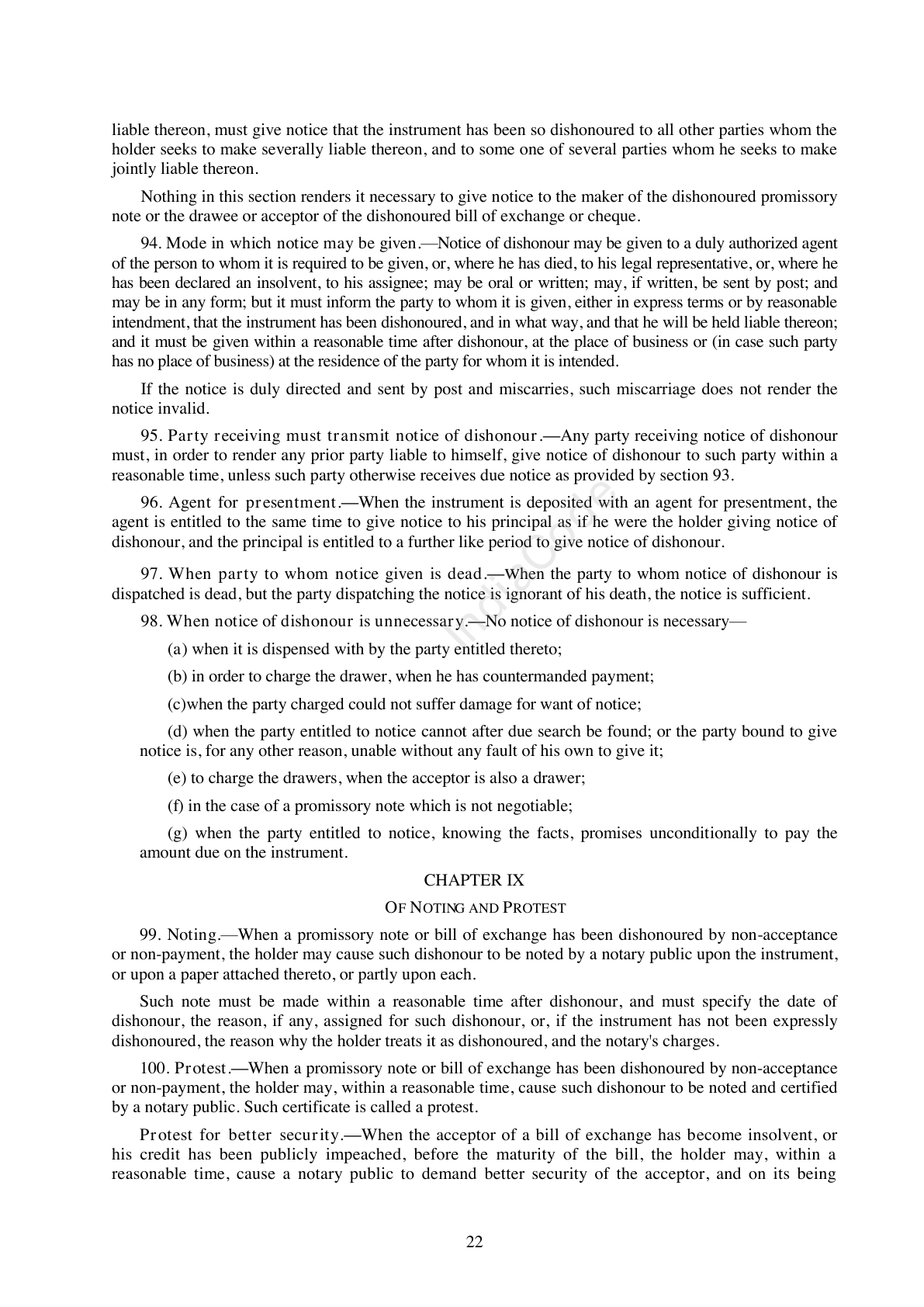
Full physical source page · unreviewed extraction
The Negotiable Instruments Act, 1881: page 22
The Negotiable Instruments Act, 1881, India Code delivered snapshot ed3e9db7f37052a1, physical page 22. Unreviewed extraction.
Source: official India Code PDF · catalog record. Fetched 2026-10-19T23:07:34Z. SHA-256 ed3e9db7f37052a1bc1cd665500910c5e123de888bce0375585e9a766bf38501.
Legal currency, territorial applicability and extraction fidelity are unverified. Catalog checksum/size differs from the delivered PDF; both identities are retained. Sections, state notes and footnotes share these physical pages. Compare the full original image.
Retained layout text
liable thereon, must give notice that the instrument has been so dishonoured to all other parties whom the
holder seeks to make severally liable thereon, and to some one of several parties whom he seeks to make
jointly liable thereon.
    Nothing in this section renders it necessary to give notice to the maker of the dishonoured promissory
note or the drawee or acceptor of the dishonoured bill of exchange or cheque.
     94. Mode in which notice may be given.—Notice of dishonour may be given to a duly authorized agent
of the person to whom it is required to be given, or, where he has died, to his legal representative, or, where he
has been declared an insolvent, to his assignee; may be oral or written; may, if written, be sent by post; and
may be in any form; but it must inform the party to whom it is given, either in express terms or by reasonable
intendment, that the instrument has been dishonoured, and in what way, and that he will be held liable thereon;
and it must be given within a reasonable time after dishonour, at the place of business or (in case such party
has no place of business) at the residence of the party for whom it is intended.
    If the notice is duly directed and sent by post and miscarries, such miscarriage does not render the
notice invalid.
    95. Party receiving must transmit notice of dishonour.—Any party receiving notice of dishonour
must, in order to render any prior party liable to himself, give notice of dishonour to such party within a
reasonable time, unless such party otherwise receives due notice as provided by section 93.
                                                                       e
    96. Agent for presentment.—When the instrument is deposited with an agent for presentment, the
                                                                 od
agent is entitled to the same time to give notice to his principal as if he were the holder giving notice of
dishonour, and the principal is entitled to a further like period to give notice of dishonour.
                                                            aC
    97. When party to whom notice given is dead.—when the party to whom notice of dishonour is
dispatched is dead, but the party dispatching the notice is ignorant of his death, the notice is sufficient.
                                                      di
    98. When notice of dishonour is unnecessary.—No notice of dishonour is necessary—
                                                 In
        (a) when it is dispensed with by the party entitled thereto;
        (b) in order to charge the drawer, when he has countermanded payment;
        (c)when the party charged could not suffer damage for want of notice;
        (d) when the party entitled to notice cannot after due search be found; or the party bound to give
    notice is, for any other reason, unable without any fault of his own to give it;
        (e) to charge the drawers, when the acceptor is also a drawer;
        (f) in the case of a promissory note which is not negotiable;
       (g) when the party entitled to notice, knowing the facts, promises unconditionally to pay the
    amount due on the instrument.
                                                 CHAPTER IX
                                          O F N OTING AND P ROTEST
    99. Noting.—When a promissory note or bill of exchange has been dishonoured by non-acceptance
or non-payment, the holder may cause such dishonour to be noted by a notary public upon the instrument,
or upon a paper attached thereto, or partly upon each.
    Such note must be made within a reasonable time after dishonour, and must specify the date of
dishonour, the reason, if any, assigned for such dishonour, or, if the instrument has not been expressly
dishonoured, the reason why the holder treats it as dishonoured, and the notary's charges.
    100. Protest.—When a promissory note or bill of exchange has been dishonoured by non-acceptance
or non-payment, the holder may, within a reasonable time, cause such dishonour to be noted and certified
by a notary public. Such certificate is called a protest.
    Protest for better security.—When the acceptor of a bill of exchange has become insolvent, or
his credit has been publicly impeached, before the maturity of the bill, the holder may, within a
reasonable time, cause a notary public to demand better security of the acceptor, and on its being


                                                       22
Compare original page image