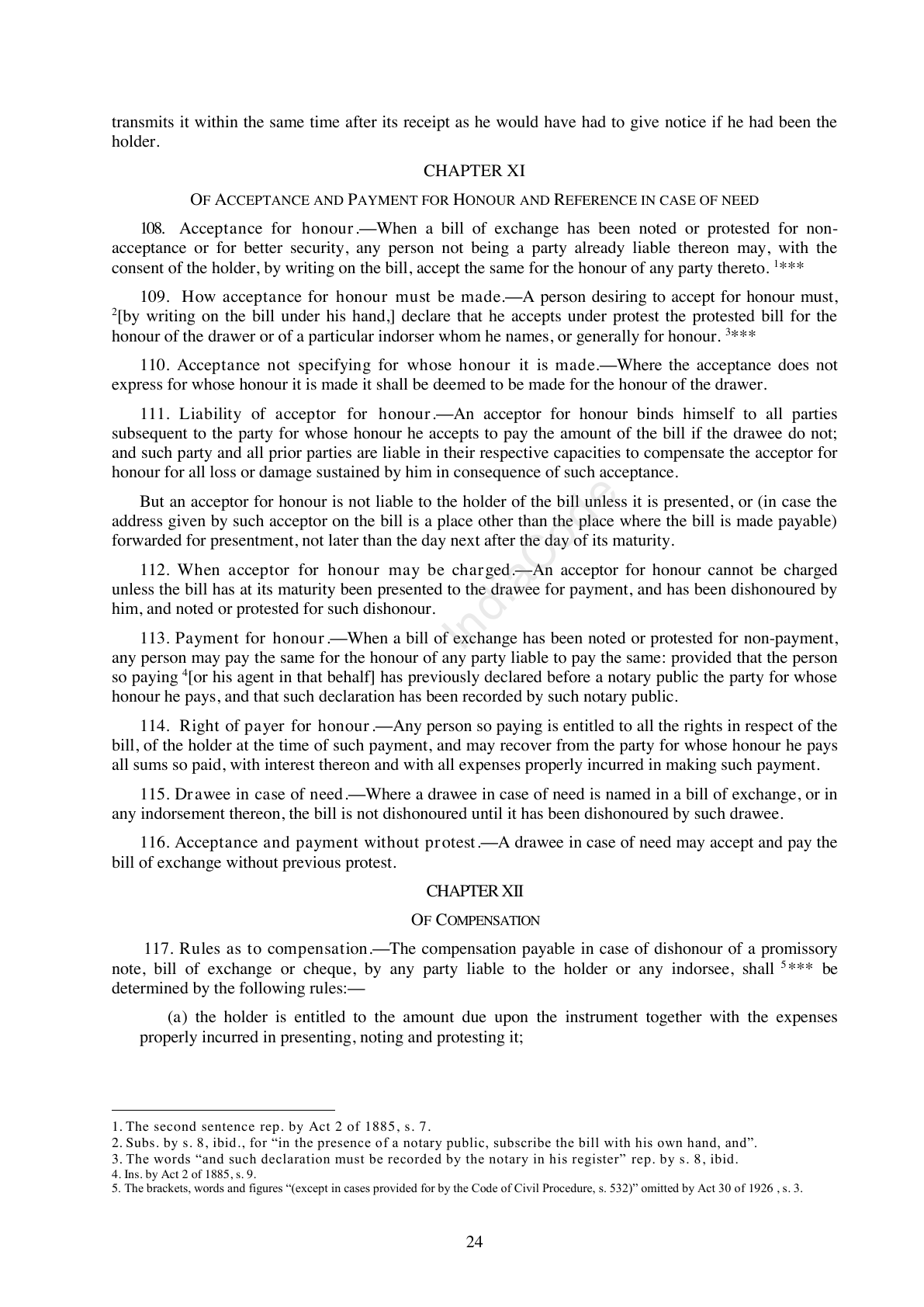
Full physical source page · unreviewed extraction
The Negotiable Instruments Act, 1881: page 24
The Negotiable Instruments Act, 1881, India Code delivered snapshot ed3e9db7f37052a1, physical page 24. Unreviewed extraction.
Source: official India Code PDF · catalog record. Fetched 2026-10-19T23:07:34Z. SHA-256 ed3e9db7f37052a1bc1cd665500910c5e123de888bce0375585e9a766bf38501.
Legal currency, territorial applicability and extraction fidelity are unverified. Catalog checksum/size differs from the delivered PDF; both identities are retained. Sections, state notes and footnotes share these physical pages. Compare the full original image.
Retained layout text
transmits it within the same time after its receipt as he would have had to give notice if he had been the
holder.
                                                               CHAPTER XI
               OF ACCEPTANCE AND PAYMENT FOR HONOUR AND REFERENCE IN CASE OF NEED
    108. Acceptance for honour.—When a bill of exchange has been noted or protested for non-
acceptance or for better security, any person not being a party already liable thereon may, with the
consent of the holder, by writing on the bill, accept the same for the honour of any party thereto. 1***
    109. How acceptance for honour must be made.—A person desiring to accept for honour must,
2
 [by writing on the bill under his hand,] declare that he accepts under protest the protested bill for the
honour of the drawer or of a particular indorser whom he names, or generally for honour. 3***
    110. Acceptance not specifying for whose honour it is made.—Where the acceptance does not
express for whose honour it is made it shall be deemed to be made for the honour of the drawer.
    111. Liability of acceptor for honour.—An acceptor for honour binds himself to all parties
subsequent to the party for whose honour he accepts to pay the amount of the bill if the drawee do not;
and such party and all prior parties are liable in their respective capacities to compensate the acceptor for
honour for all loss or damage sustained by him in consequence of such acceptance.
                                                                                            e
    But an acceptor for honour is not liable to the holder of the bill unless it is presented, or (in case the
                                                                                    od
address given by such acceptor on the bill is a place other than the place where the bill is made payable)
forwarded for presentment, not later than the day next after the day of its maturity.
                                                                            aC
    112. When acceptor for honour may be charged.—An acceptor for honour cannot be charged
unless the bill has at its maturity been presented to the drawee for payment, and has been dishonoured by
him, and noted or protested for such dishonour.                       di
                                                                In
    113. Payment for honour.—When a bill of exchange has been noted or protested for non-payment,
any person may pay the same for the honour of any party liable to pay the same: provided that the person
so paying 4[or his agent in that behalf] has previously declared before a notary public the party for whose
honour he pays, and that such declaration has been recorded by such notary public.
     114. Right of payer for honour.—Any person so paying is entitled to all the rights in respect of the
bill, of the holder at the time of such payment, and may recover from the party for whose honour he pays
all sums so paid, with interest thereon and with all expenses properly incurred in making such payment.
    115. Drawee in case of need.—Where a drawee in case of need is named in a bill of exchange, or in
any indorsement thereon, the bill is not dishonoured until it has been dishonoured by such drawee.
     116. Acceptance and payment without protest.—A drawee in case of need may accept and pay the
bill of exchange without previous protest.
                                                               CHAPTER XII
                                                            OF COMPENSATION
     117. Rules as to compensation.—The compensation payable in case of dishonour of a promissory
note, bill of exchange or cheque, by any party liable to the holder or any indorsee, shall 5 *** be
determined by the following rules:—
         (a) the holder is entitled to the amount due upon the instrument together with the expenses
     properly incurred in presenting, noting and protesting it;


1. The second sentence rep. by Act 2 of 1885, s. 7.
2. Subs. by s. 8, ibid., for “in the presence of a notary public, subscribe the bill with his own hand, and”.
3. The words “and such declaration must be recorded by the notary in his register” rep. by s. 8, ibid.
4. Ins. by Act 2 of 1885, s. 9.
5. The brackets, words and figures “(except in cases provided for by the Code of Civil Procedure, s. 532)” omitted by Act 30 of 1926 , s. 3.


                                                                       24
Compare original page image