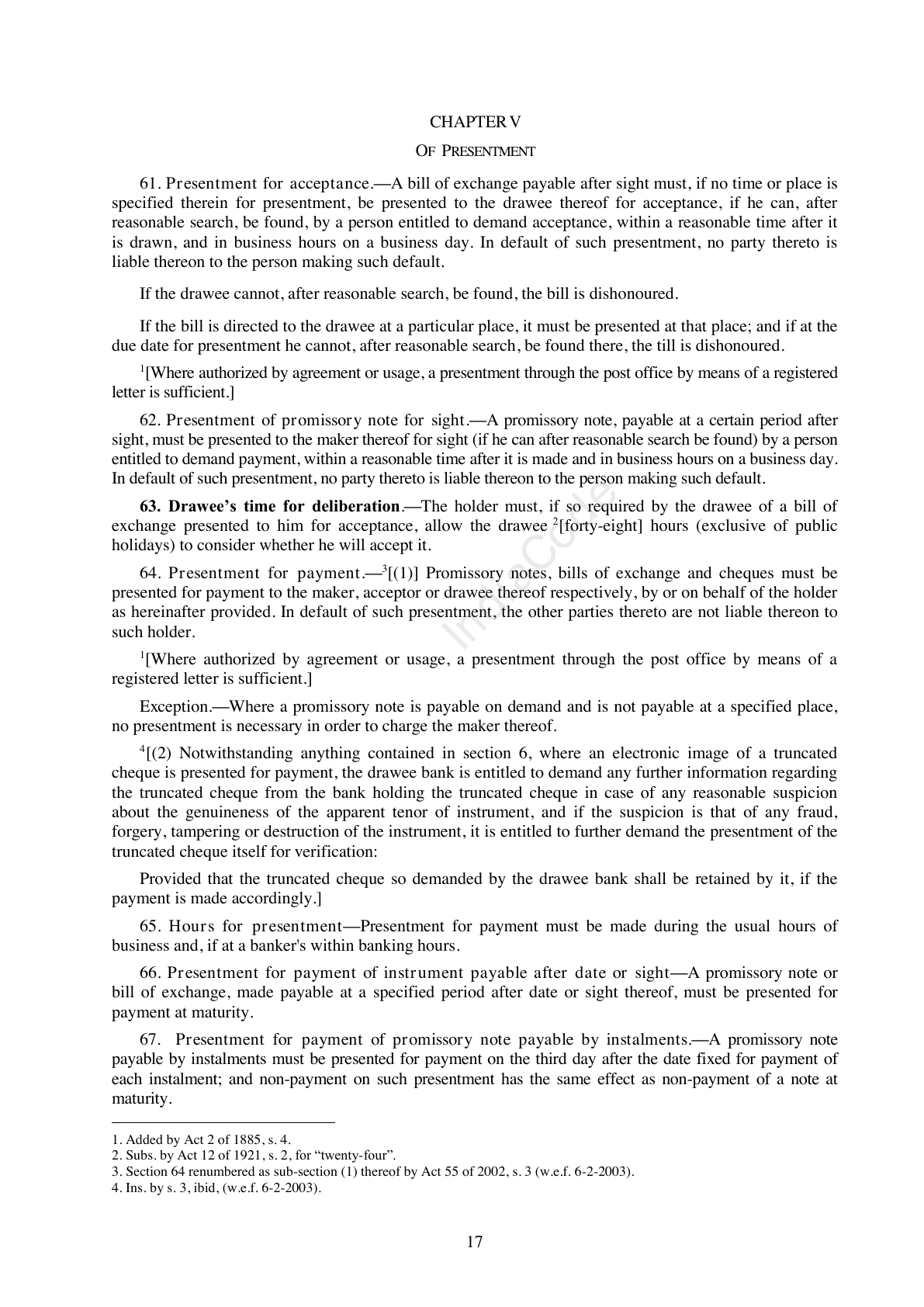
Full physical source page · unreviewed extraction
The Negotiable Instruments Act, 1881: page 17
The Negotiable Instruments Act, 1881, India Code delivered snapshot ed3e9db7f37052a1, physical page 17. Unreviewed extraction.
Source: official India Code PDF · catalog record. Fetched 2026-10-19T23:07:34Z. SHA-256 ed3e9db7f37052a1bc1cd665500910c5e123de888bce0375585e9a766bf38501.
Legal currency, territorial applicability and extraction fidelity are unverified. Catalog checksum/size differs from the delivered PDF; both identities are retained. Sections, state notes and footnotes share these physical pages. Compare the full original image.
Retained layout text
                                                         CHAPTER V
                                                      OF PRESENTMENT
    61. Presentment for acceptance.—A bill of exchange payable after sight must, if no time or place is
specified therein for presentment, be presented to the drawee thereof for acceptance, if he can, after
reasonable search, be found, by a person entitled to demand acceptance, within a reasonable time after it
is drawn, and in business hours on a business day. In default of such presentment, no party thereto is
liable thereon to the person making such default.
     If the drawee cannot, after reasonable search, be found, the bill is dishonoured.
    If the bill is directed to the drawee at a particular place, it must be presented at that place; and if at the
due date for presentment he cannot, after reasonable search, be found there, the till is dishonoured.
     1
      [Where authorized by agreement or usage, a presentment through the post office by means of a registered
letter is sufficient.]
     62. Presentment of promissory note for sight.—A promissory note, payable at a certain period after
sight, must be presented to the maker thereof for sight (if he can after reasonable search be found) by a person
entitled to demand payment, within a reasonable time after it is made and in business hours on a business day.
In default of such presentment, no party thereto is liable thereon to the person making such default.
                                                                                  e
    63. Drawee’s time for deliberation.—The holder must, if so required by the drawee of a bill of
                                                                           od
exchange presented to him for acceptance, allow the drawee 2 [forty-eight] hours (exclusive of public
holidays) to consider whether he will accept it.
                                                                    aC
    64. Presentment for payment.—3[(1)] Promissory notes, bills of exchange and cheques must be
presented for payment to the maker, acceptor or drawee thereof respectively, by or on behalf of the holder
                                                              di
as hereinafter provided. In default of such presentment, the other parties thereto are not liable thereon to
such holder.
     1
                                                        In
     [Where authorized by agreement or usage, a presentment through the post office by means of a
registered letter is sufficient.]
    Exception.—Where a promissory note is payable on demand and is not payable at a specified place,
no presentment is necessary in order to charge the maker thereof.
     4
     [(2) Notwithstanding anything contained in section 6, where an electronic image of a truncated
cheque is presented for payment, the drawee bank is entitled to demand any further information regarding
the truncated cheque from the bank holding the truncated cheque in case of any reasonable suspicion
about the genuineness of the apparent tenor of instrument, and if the suspicion is that of any fraud,
forgery, tampering or destruction of the instrument, it is entitled to further demand the presentment of the
truncated cheque itself for verification:
   Provided that the truncated cheque so demanded by the drawee bank shall be retained by it, if the
payment is made accordingly.]
    65. Hours for presentment—Presentment for payment must be made during the usual hours of
business and, if at a banker's within banking hours.
     66. Presentment for payment of instrument payable after date or sight—A promissory note or
bill of exchange, made payable at a specified period after date or sight thereof, must be presented for
payment at maturity.
    67. Presentment for payment of promissory note payable by instalments.—A promissory note
payable by instalments must be presented for payment on the third day after the date fixed for payment of
each instalment; and non-payment on such presentment has the same effect as non-payment of a note at
maturity.

1. Added by Act 2 of 1885, s. 4.
2. Subs. by Act 12 of 1921, s. 2, for “twenty-four”.
3. Section 64 renumbered as sub-section (1) thereof by Act 55 of 2002, s. 3 (w.e.f. 6-2-2003).
4. Ins. by s. 3, ibid, (w.e.f. 6-2-2003).


                                                               17
Compare original page image