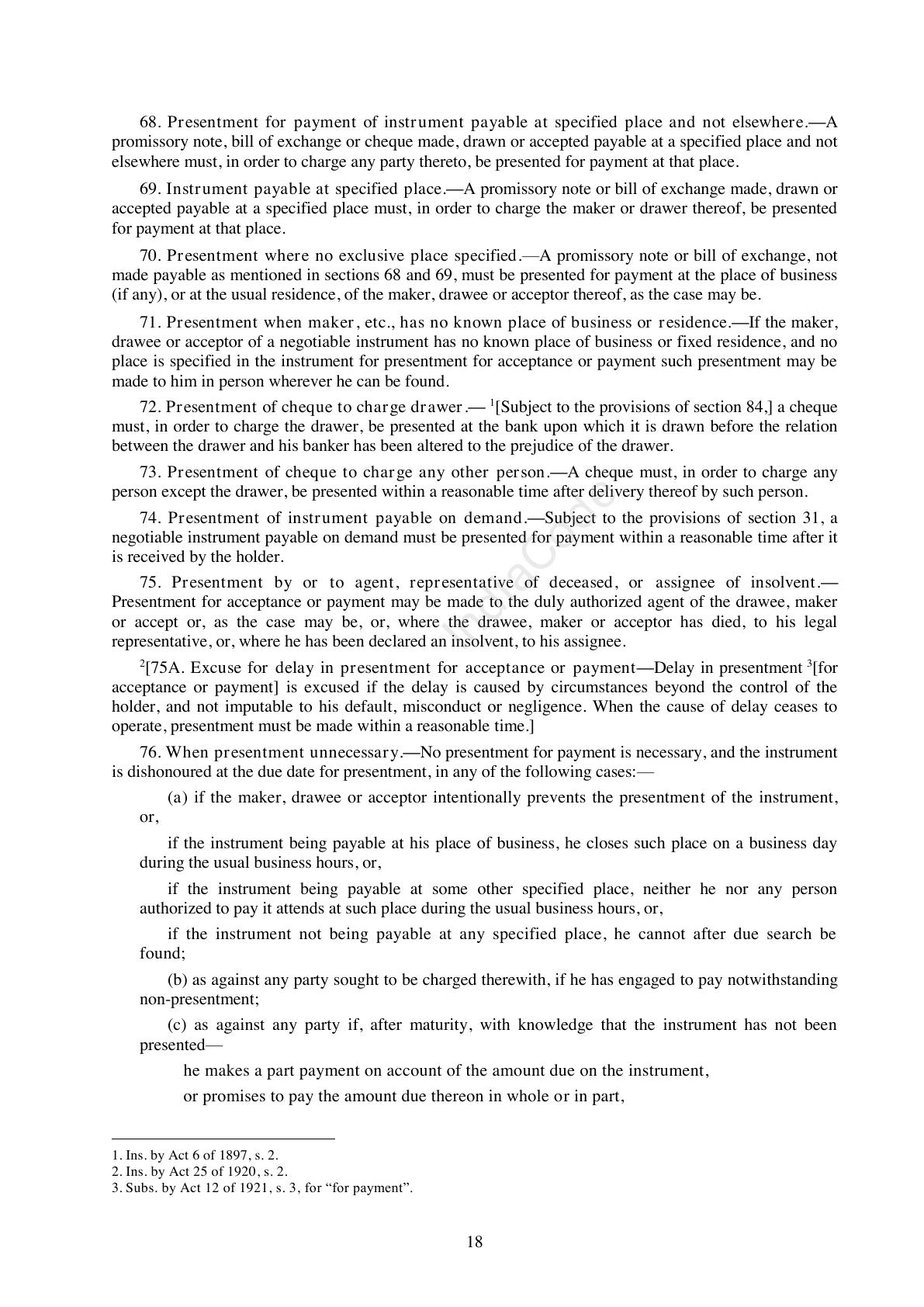
Full physical source page · unreviewed extraction
The Negotiable Instruments Act, 1881: page 18
The Negotiable Instruments Act, 1881, India Code delivered snapshot ed3e9db7f37052a1, physical page 18. Unreviewed extraction.
Source: official India Code PDF · catalog record. Fetched 2026-10-19T23:07:34Z. SHA-256 ed3e9db7f37052a1bc1cd665500910c5e123de888bce0375585e9a766bf38501.
Legal currency, territorial applicability and extraction fidelity are unverified. Catalog checksum/size differs from the delivered PDF; both identities are retained. Sections, state notes and footnotes share these physical pages. Compare the full original image.
Retained layout text
    68. Presentment for payment of instrument payable at specified place and not elsewhere.—A
promissory note, bill of exchange or cheque made, drawn or accepted payable at a specified place and not
elsewhere must, in order to charge any party thereto, be presented for payment at that place.
    69. Instrument payable at specified place.—A promissory note or bill of exchange made, drawn or
accepted payable at a specified place must, in order to charge the maker or drawer thereof, be presented
for payment at that place.
     70. Presentment where no exclusive place specified.—A promissory note or bill of exchange, not
made payable as mentioned in sections 68 and 69, must be presented for payment at the place of business
(if any), or at the usual residence, of the maker, drawee or acceptor thereof, as the case may be.
    71. Presentment when maker, etc., has no known place of business or residence.—If the maker,
drawee or acceptor of a negotiable instrument has no known place of business or fixed residence, and no
place is specified in the instrument for presentment for acceptance or payment such presentment may be
made to him in person wherever he can be found.
    72. Presentment of cheque to charge drawer.— 1[Subject to the provisions of section 84,] a cheque
must, in order to charge the drawer, be presented at the bank upon which it is drawn before the relation
between the drawer and his banker has been altered to the prejudice of the drawer.
    73. Presentment of cheque to charge any other person.—A cheque must, in order to charge any
person except the drawer, be presented within a reasonable time after delivery thereof by such person.
                                                                  e
     74. Presentment of instrument payable on demand.—Subject to the provisions of section 31, a
                                                              od
negotiable instrument payable on demand must be presented for payment within a reasonable time after it
is received by the holder.
                                                             aC
    75. Presentment by or to agent, representative of deceased, or assignee of insolvent.—
                                                        di
Presentment for acceptance or payment may be made to the duly authorized agent of the drawee, maker
or accept or, as the case may be, or, where the drawee, maker or acceptor has died, to his legal
                                                       In
representative, or, where he has been declared an insolvent, to his assignee.
    2
    [75A. Excuse for delay in presentment for acceptance or payment—Delay in presentment 3[for
acceptance or payment] is excused if the delay is caused by circumstances beyond the control of the
holder, and not imputable to his default, misconduct or negligence. When the cause of delay ceases to
operate, presentment must be made within a reasonable time.]
     76. When presentment unnecessary.—No presentment for payment is necessary, and the instrument
is dishonoured at the due date for presentment, in any of the following cases:—
          (a) if the maker, drawee or acceptor intentionally prevents the presentment of the instrument,
    or,
        if the instrument being payable at his place of business, he closes such place on a business day
    during the usual business hours, or,
        if the instrument being payable at some other specified place, neither he nor any person
    authorized to pay it attends at such place during the usual business hours, or,
       if the instrument not being payable at any specified place, he cannot after due search be
    found;
       (b) as against any party sought to be charged therewith, if he has engaged to pay notwithstanding
    non-presentment;
        (c) as against any party if, after maturity, with knowledge that the instrument has not been
    presented—
            he makes a part payment on account of the amount due on the instrument,
            or promises to pay the amount due thereon in whole or in part,


1. Ins. by Act 6 of 1897, s. 2.
2. Ins. by Act 25 of 1920, s. 2.
3. Subs. by Act 12 of 1921, s. 3, for “for payment”.


                                                        18
Compare original page image