Full physical source page · unreviewed extraction
The Negotiable Instruments Act, 1881: page 16
The Negotiable Instruments Act, 1881, India Code delivered snapshot ed3e9db7f37052a1, physical page 16. Unreviewed extraction.
Source: official India Code PDF · catalog record. Fetched 2026-10-19T23:07:34Z. SHA-256 ed3e9db7f37052a1bc1cd665500910c5e123de888bce0375585e9a766bf38501.
Legal currency, territorial applicability and extraction fidelity are unverified. Catalog checksum/size differs from the delivered PDF; both identities are retained. Sections, state notes and footnotes share these physical pages. Compare the full original image.
Retained layout text
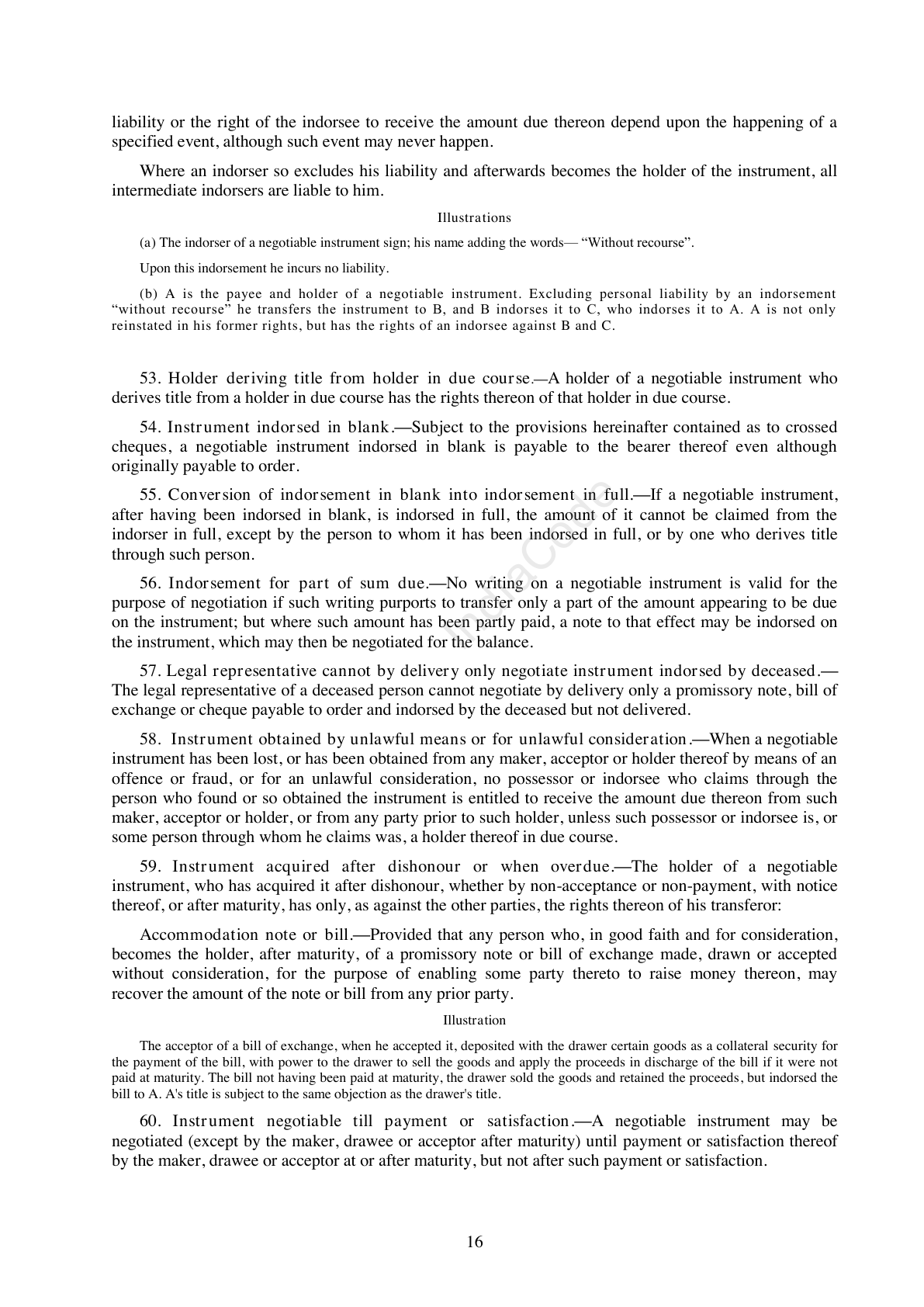
liability or the right of the indorsee to receive the amount due thereon depend upon the happening of a
specified event, although such event may never happen.
    Where an indorser so excludes his liability and afterwards becomes the holder of the instrument, all
intermediate indorsers are liable to him.
                                                          Illustrations
     (a) The indorser of a negotiable instrument sign; his name adding the words— “Without recourse”.
     Upon this indorsement he incurs no liability.
     (b) A is the payee and holder of a negotiable instrument. Excluding personal liability by an indorsement
“without recourse” he transfers the instrument to B, and B indorses it to C, who indorses it to A. A is not only
reinstated in his former rights, but has the rights of an indorsee against B and C.


    53. Holder deriving title from holder in due course.—A holder of a negotiable instrument who
derives title from a holder in due course has the rights thereon of that holder in due course.
    54. Instrument indorsed in blank.—Subject to the provisions hereinafter contained as to crossed
cheques, a negotiable instrument indorsed in blank is payable to the bearer thereof even although
originally payable to order.
    55. Conversion of indorsement in blank into indorsement in full.—If a negotiable instrument,
                                                                                  e
after having been indorsed in blank, is indorsed in full, the amount of it cannot be claimed from the
                                                                           od
indorser in full, except by the person to whom it has been indorsed in full, or by one who derives title
through such person.
                                                                    aC
     56. Indorsement for part of sum due.—No writing on a negotiable instrument is valid for the
                                                              di
purpose of negotiation if such writing purports to transfer only a part of the amount appearing to be due
on the instrument; but where such amount has been partly paid, a note to that effect may be indorsed on
                                                         In
the instrument, which may then be negotiated for the balance.
   57. Legal representative cannot by delivery only negotiate instrument indorsed by deceased.—
The legal representative of a deceased person cannot negotiate by delivery only a promissory note, bill of
exchange or cheque payable to order and indorsed by the deceased but not delivered.
     58. Instrument obtained by unlawful means or for unlawful consideration.—When a negotiable
instrument has been lost, or has been obtained from any maker, acceptor or holder thereof by means of an
offence or fraud, or for an unlawful consideration, no possessor or indorsee who claims through the
person who found or so obtained the instrument is entitled to receive the amount due thereon from such
maker, acceptor or holder, or from any party prior to such holder, unless such possessor or indorsee is, or
some person through whom he claims was, a holder thereof in due course.
     59. Instrument acquired after dishonour or when overdue.—The holder of a negotiable
instrument, who has acquired it after dishonour, whether by non-acceptance or non-payment, with notice
thereof, or after maturity, has only, as against the other parties, the rights thereon of his transferor:
    Accommodation note or bill.—Provided that any person who, in good faith and for consideration,
becomes the holder, after maturity, of a promissory note or bill of exchange made, drawn or accepted
without consideration, for the purpose of enabling some party thereto to raise money thereon, may
recover the amount of the note or bill from any prior party.
                                                           Illustration
      The acceptor of a bill of exchange, when he accepted it, deposited with the drawer certain goods as a collateral security for
the payment of the bill, with power to the drawer to sell the goods and apply the proceeds in discharge of the bill if it were not
paid at maturity. The bill not having been paid at maturity, the drawer sold the goods and retained the proceeds, but indorsed the
bill to A. A's title is subject to the same objection as the drawer's title.

    60. Instrument negotiable till payment or satisfaction.—A negotiable instrument may be
negotiated (except by the maker, drawee or acceptor after maturity) until payment or satisfaction thereof
by the maker, drawee or acceptor at or after maturity, but not after such payment or satisfaction.


                                                               16
Compare original page image