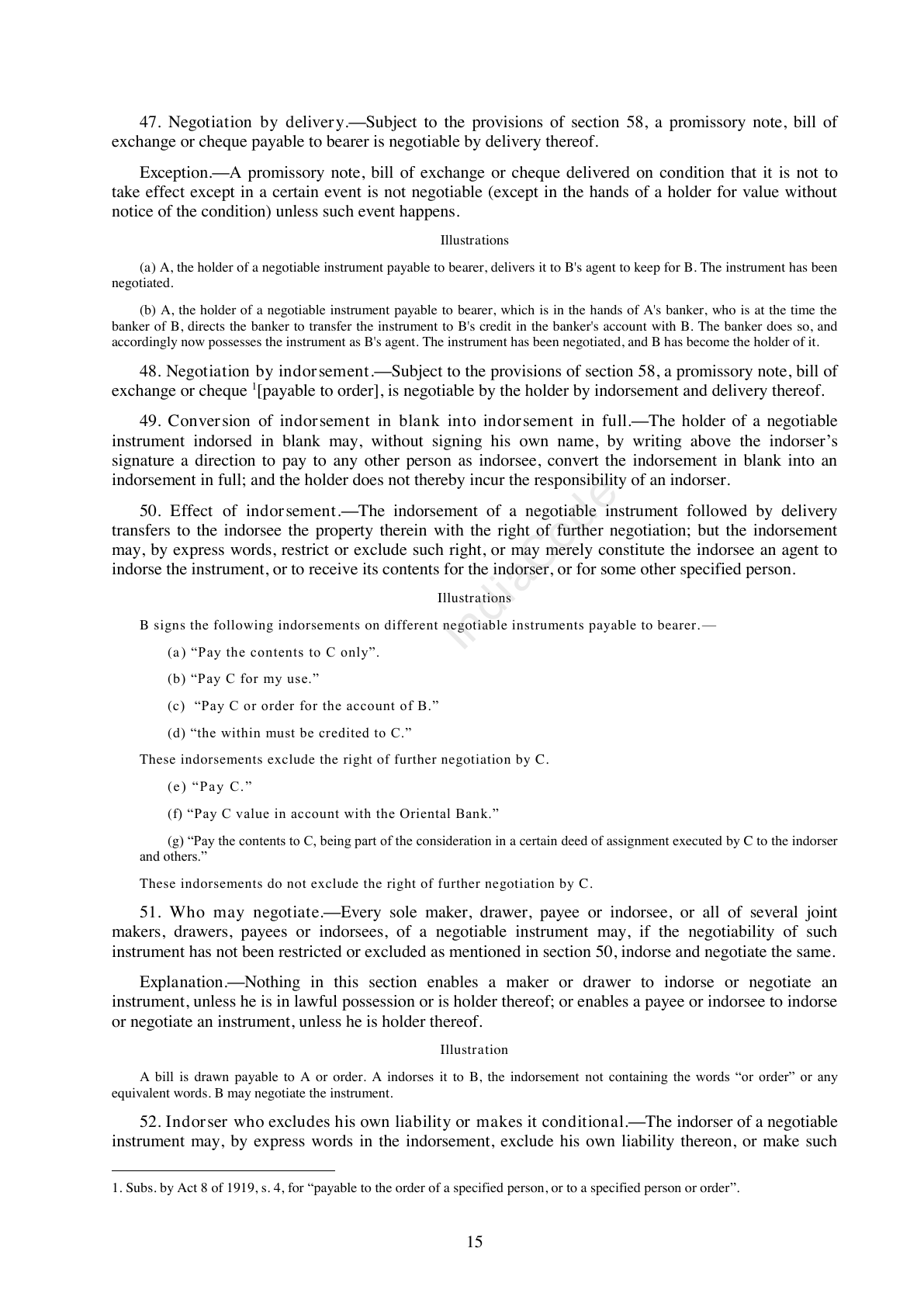
Full physical source page · unreviewed extraction
The Negotiable Instruments Act, 1881: page 15
The Negotiable Instruments Act, 1881, India Code delivered snapshot ed3e9db7f37052a1, physical page 15. Unreviewed extraction.
Source: official India Code PDF · catalog record. Fetched 2026-10-19T23:07:34Z. SHA-256 ed3e9db7f37052a1bc1cd665500910c5e123de888bce0375585e9a766bf38501.
Legal currency, territorial applicability and extraction fidelity are unverified. Catalog checksum/size differs from the delivered PDF; both identities are retained. Sections, state notes and footnotes share these physical pages. Compare the full original image.
Retained layout text
   47. Negotiation by delivery.—Subject to the provisions of section 58, a promissory note, bill of
exchange or cheque payable to bearer is negotiable by delivery thereof.
    Exception.—A promissory note, bill of exchange or cheque delivered on condition that it is not to
take effect except in a certain event is not negotiable (except in the hands of a holder for value without
notice of the condition) unless such event happens.
                                                             Illustrations
    (a) A, the holder of a negotiable instrument payable to bearer, delivers it to B's agent to keep for B. The instrument has been
negotiated.
     (b) A, the holder of a negotiable instrument payable to bearer, which is in the hands of A's banker, who is at the time the
banker of B, directs the banker to transfer the instrument to B's credit in the banker's account with B. The banker does so, and
accordingly now possesses the instrument as B's agent. The instrument has been negotiated, and B has become the holder of it.

   48. Negotiation by indorsement.—Subject to the provisions of section 58, a promissory note, bill of
exchange or cheque 1[payable to order], is negotiable by the holder by indorsement and delivery thereof.
     49. Conversion of indorsement in blank into indorsement in full.—The holder of a negotiable
instrument indorsed in blank may, without signing his own name, by writing above the indorser’s
signature a direction to pay to any other person as indorsee, convert the indorsement in blank into an
indorsement in full; and the holder does not thereby incur the responsibility of an indorser.
                                                                                     e
    50. Effect of indorsement.—The indorsement of a negotiable instrument followed by delivery
                                                                             od
transfers to the indorsee the property therein with the right of further negotiation; but the indorsement
may, by express words, restrict or exclude such right, or may merely constitute the indorsee an agent to
                                                                       aC
indorse the instrument, or to receive its contents for the indorser, or for some other specified person.
                                                            Illustrations
                                                                di
     B signs the following indorsements on different negotiable instruments payable to bearer. —
          (a) “Pay the contents to C only”.
                                                           In
          (b) “Pay C for my use.”
          (c) “Pay C or order for the account of B.”
          (d) “the within must be credited to C.”
     These indorsements exclude the right of further negotiation by C.
          ( e ) “P a y C. ”
          (f) “Pay C value in account with the Oriental Bank.”
          (g) “Pay the contents to C, being part of the consideration in a certain deed of assignment executed by C to the indorser
     and others.”
     These indorsements do not exclude the right of further negotiation by C.

     51. Who may negotiate.—Every sole maker, drawer, payee or indorsee, or all of several joint
makers, drawers, payees or indorsees, of a negotiable instrument may, if the negotiability of such
instrument has not been restricted or excluded as mentioned in section 50, indorse and negotiate the same.
     Explanation.—Nothing in this section enables a maker or drawer to indorse or negotiate an
instrument, unless he is in lawful possession or is holder thereof; or enables a payee or indorsee to indorse
or negotiate an instrument, unless he is holder thereof.
                                                             Illustration
     A bill is drawn payable to A or order. A indorses it to B, the indorsement not containing the words “or order” or any
equivalent words. B may negotiate the instrument.

     52. Indorser who excludes his own liability or makes it conditional.—The indorser of a negotiable
instrument may, by express words in the indorsement, exclude his own liability thereon, or make such

1. Subs. by Act 8 of 1919, s. 4, for “payable to the order of a specified person, or to a specified person or order”.


                                                                  15
Compare original page image