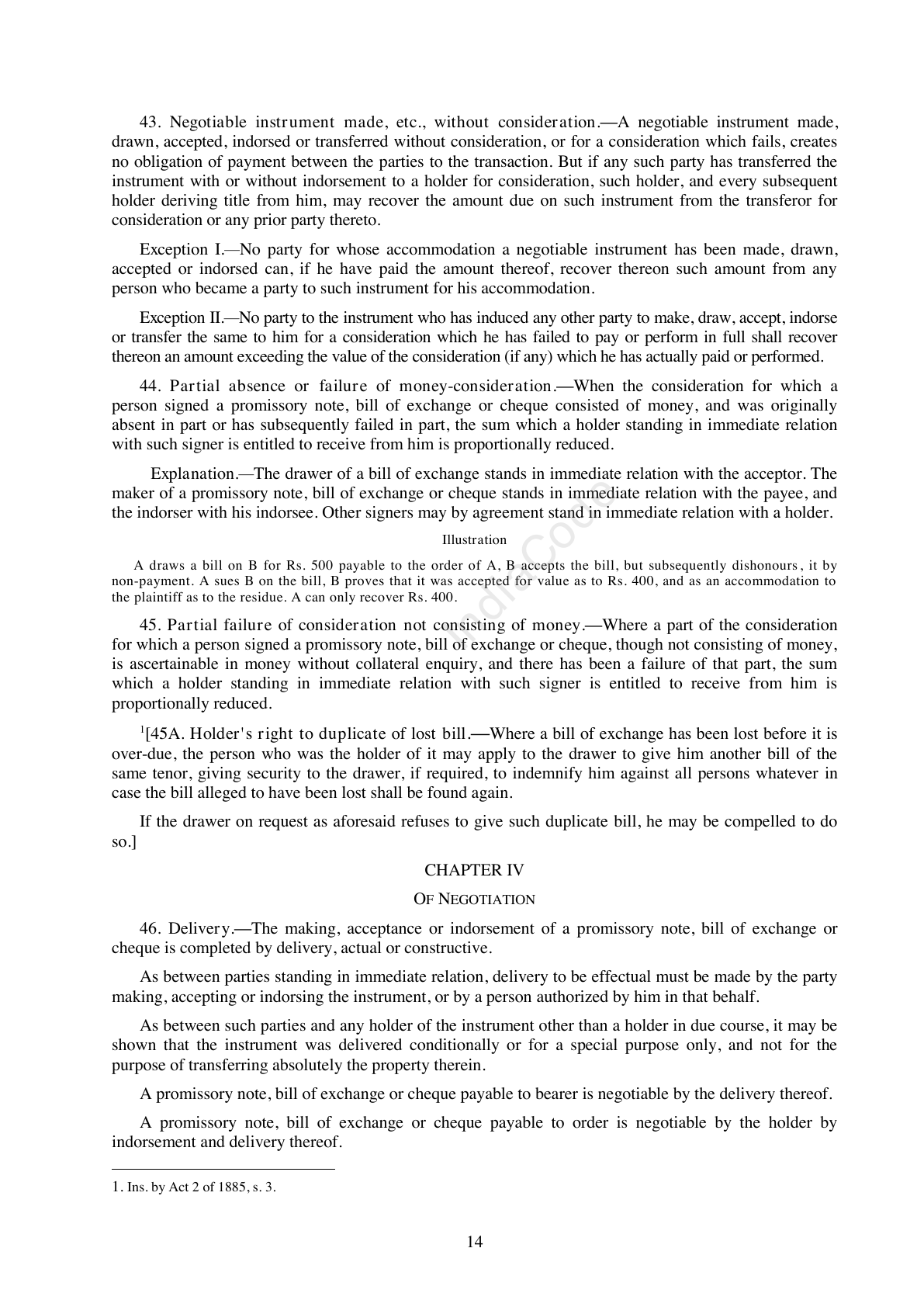
Full physical source page · unreviewed extraction
The Negotiable Instruments Act, 1881: page 14
The Negotiable Instruments Act, 1881, India Code delivered snapshot ed3e9db7f37052a1, physical page 14. Unreviewed extraction.
Source: official India Code PDF · catalog record. Fetched 2026-10-19T23:07:34Z. SHA-256 ed3e9db7f37052a1bc1cd665500910c5e123de888bce0375585e9a766bf38501.
Legal currency, territorial applicability and extraction fidelity are unverified. Catalog checksum/size differs from the delivered PDF; both identities are retained. Sections, state notes and footnotes share these physical pages. Compare the full original image.
Retained layout text
     43. Negotiable instrument made, etc., without consideration.—A negotiable instrument made,
drawn, accepted, indorsed or transferred without consideration, or for a consideration which fails, creates
no obligation of payment between the parties to the transaction. But if any such party has transferred the
instrument with or without indorsement to a holder for consideration, such holder, and every subsequent
holder deriving title from him, may recover the amount due on such instrument from the transferor for
consideration or any prior party thereto.
    Exception I.—No party for whose accommodation a negotiable instrument has been made, drawn,
accepted or indorsed can, if he have paid the amount thereof, recover thereon such amount from any
person who became a party to such instrument for his accommodation.
     Exception II.—No party to the instrument who has induced any other party to make, draw, accept, indorse
or transfer the same to him for a consideration which he has failed to pay or perform in full shall recover
thereon an amount exceeding the value of the consideration (if any) which he has actually paid or performed.
    44. Partial absence or failure of money-consideration.—When the consideration for which a
person signed a promissory note, bill of exchange or cheque consisted of money, and was originally
absent in part or has subsequently failed in part, the sum which a holder standing in immediate relation
with such signer is entitled to receive from him is proportionally reduced.
      Explanation.—The drawer of a bill of exchange stands in immediate relation with the acceptor. The
maker of a promissory note, bill of exchange or cheque stands in immediate relation with the payee, and
                                                                          e
the indorser with his indorsee. Other signers may by agreement stand in immediate relation with a holder.
                                                     Illustration
                                                                    od
                                                              aC
    A draws a bill on B for Rs. 500 payable to the order of A, B accepts the bill, but subsequently dishonours , it by
non-payment. A sues B on the bill, B proves that it was accepted for value as to Rs. 400, and as an accommodation to
the plaintiff as to the residue. A can only recover Rs. 400.
                                                        di
    45. Partial failure of consideration not consisting of money.—Where a part of the consideration
                                                   In
for which a person signed a promissory note, bill of exchange or cheque, though not consisting of money,
is ascertainable in money without collateral enquiry, and there has been a failure of that part, the sum
which a holder standing in immediate relation with such signer is entitled to receive from him is
proportionally reduced.
       1
     [45A. Holder's right to duplicate of lost bill.—Where a bill of exchange has been lost before it is
over-due, the person who was the holder of it may apply to the drawer to give him another bill of the
same tenor, giving security to the drawer, if required, to indemnify him against all persons whatever in
case the bill alleged to have been lost shall be found again.
       If the drawer on request as aforesaid refuses to give such duplicate bill, he may be compelled to do
so.]
                                                  CHAPTER IV
                                                 OF NEGOTIATION
   46. Delivery.—The making, acceptance or indorsement of a promissory note, bill of exchange or
cheque is completed by delivery, actual or constructive.
   As between parties standing in immediate relation, delivery to be effectual must be made by the party
making, accepting or indorsing the instrument, or by a person authorized by him in that behalf.
    As between such parties and any holder of the instrument other than a holder in due course, it may be
shown that the instrument was delivered conditionally or for a special purpose only, and not for the
purpose of transferring absolutely the property therein.
       A promissory note, bill of exchange or cheque payable to bearer is negotiable by the delivery thereof.
    A promissory note, bill of exchange or cheque payable to order is negotiable by the holder by
indorsement and delivery thereof.

1. Ins. by Act 2 of 1885, s. 3.


                                                         14
Compare original page image