Full physical source page · unreviewed extraction
The Code of Civil Procedure, 1908: page 345
The Code of Civil Procedure, 1908, India Code delivered snapshot 393b8848fdfc476a, physical page 345, typed edition 77428589d4e341672ed6a3e5f663be7dec530c42d0600064ac1314302939267d. Unreviewed extraction.
Source: official India Code PDF · catalog record. Fetched 2026-10-19T23:06:46Z. SHA-256 393b8848fdfc476a21cc3abf4f0d3f510557e2dff6fc6914b1f379bea1730614.
Legal currency, territorial applicability and extraction fidelity are unverified. Catalog checksum/size differs from the delivered PDF; both identities are retained. Sections, state notes and footnotes share these physical pages. Compare the full original image.
Retained layout text
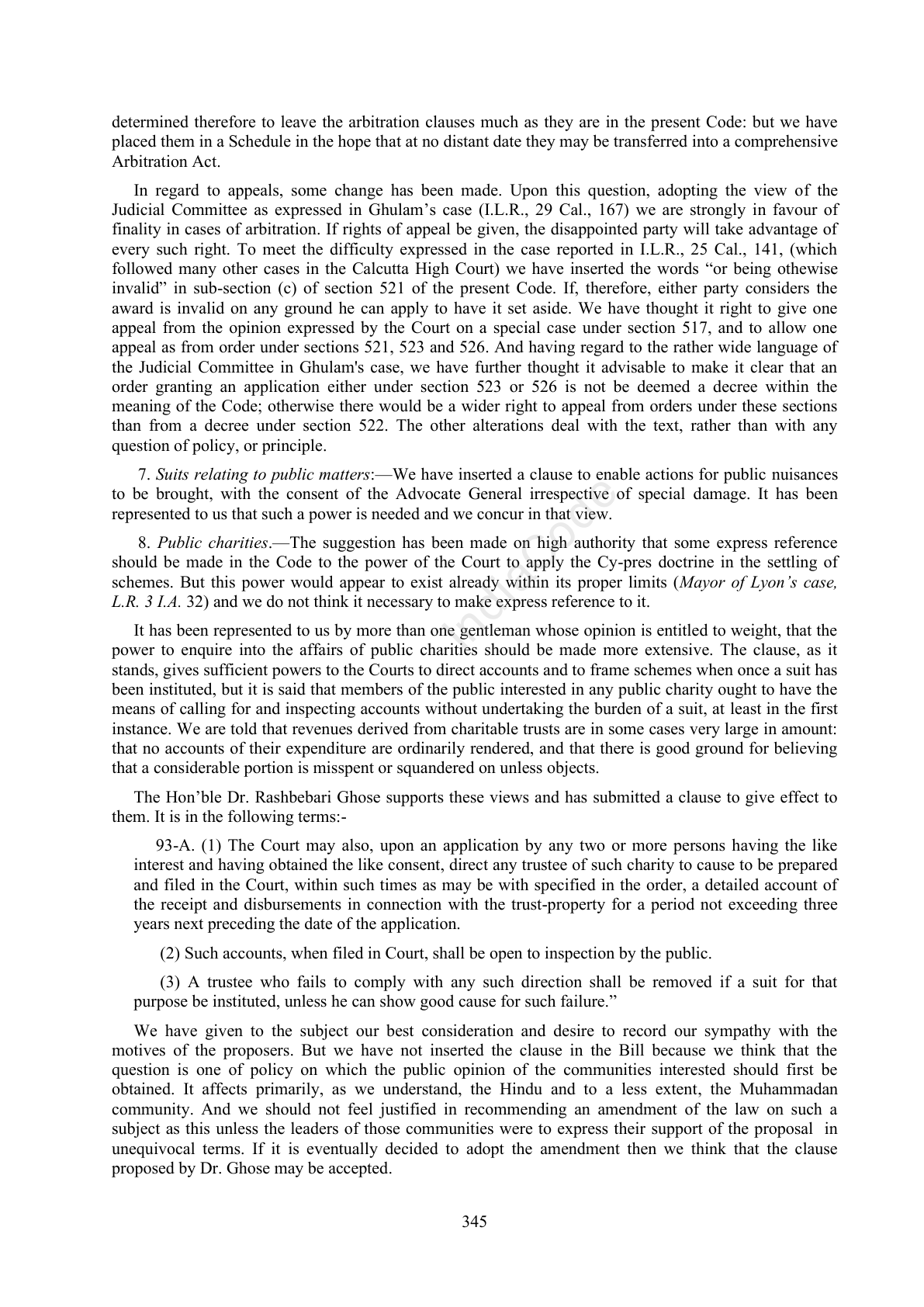
determined therefore to leave the arbitration clauses much as they are in the present Code: but we have
placed them in a Schedule in the hope that at no distant date they may be transferred into a comprehensive
Arbitration Act.
    In regard to appeals, some change has been made. Upon this question, adopting the view of the
Judicial Committee as expressed in Ghulam’s case (I.L.R., 29 Cal., 167) we are strongly in favour of
finality in cases of arbitration. If rights of appeal be given, the disappointed party will take advantage of
every such right. To meet the difficulty expressed in the case reported in I.L.R., 25 Cal., 141, (which
followed many other cases in the Calcutta High Court) we have inserted the words “or being othewise
invalid” in sub-section (c) of section 521 of the present Code. If, therefore, either party considers the
award is invalid on any ground he can apply to have it set aside. We have thought it right to give one
appeal from the opinion expressed by the Court on a special case under section 517, and to allow one
appeal as from order under sections 521, 523 and 526. And having regard to the rather wide language of
the Judicial Committee in Ghulam's case, we have further thought it advisable to make it clear that an
order granting an application either under section 523 or 526 is not be deemed a decree within the
meaning of the Code; otherwise there would be a wider right to appeal from orders under these sections
than from a decree under section 522. The other alterations deal with the text, rather than with any
question of policy, or principle.
    7. Suits relating to public matters:—We have inserted a clause to enable actions for public nuisances
to be brought, with the consent of the Advocate General irrespective of special damage. It has been
                                                                    e
represented to us that such a power is needed and we concur in that view.
                                                              od
   8. Public charities.—The suggestion has been made on high authority that some express reference
should be made in the Code to the power of the Court to apply the Cy-pres doctrine in the settling of
                                                        aC
schemes. But this power would appear to exist already within its proper limits (Mayor of Lyon’s case,
L.R. 3 I.A. 32) and we do not think it necessary to make express reference to it.
                                                   di
   It has been represented to us by more than one gentleman whose opinion is entitled to weight, that the
                                               In
power to enquire into the affairs of public charities should be made more extensive. The clause, as it
stands, gives sufficient powers to the Courts to direct accounts and to frame schemes when once a suit has
been instituted, but it is said that members of the public interested in any public charity ought to have the
means of calling for and inspecting accounts without undertaking the burden of a suit, at least in the first
instance. We are told that revenues derived from charitable trusts are in some cases very large in amount:
that no accounts of their expenditure are ordinarily rendered, and that there is good ground for believing
that a considerable portion is misspent or squandered on unless objects.
   The Hon’ble Dr. Rashbebari Ghose supports these views and has submitted a clause to give effect to
them. It is in the following terms:-
       93-A. (1) The Court may also, upon an application by any two or more persons having the like
   interest and having obtained the like consent, direct any trustee of such charity to cause to be prepared
   and filed in the Court, within such times as may be with specified in the order, a detailed account of
   the receipt and disbursements in connection with the trust-property for a period not exceeding three
   years next preceding the date of the application.
       (2) Such accounts, when filed in Court, shall be open to inspection by the public.
      (3) A trustee who fails to comply with any such direction shall be removed if a suit for that
   purpose be instituted, unless he can show good cause for such failure.”
   We have given to the subject our best consideration and desire to record our sympathy with the
motives of the proposers. But we have not inserted the clause in the Bill because we think that the
question is one of policy on which the public opinion of the communities interested should first be
obtained. It affects primarily, as we understand, the Hindu and to a less extent, the Muhammadan
community. And we should not feel justified in recommending an amendment of the law on such a
subject as this unless the leaders of those communities were to express their support of the proposal in
unequivocal terms. If it is eventually decided to adopt the amendment then we think that the clause
proposed by Dr. Ghose may be accepted.


                                                    345
Compare original page image