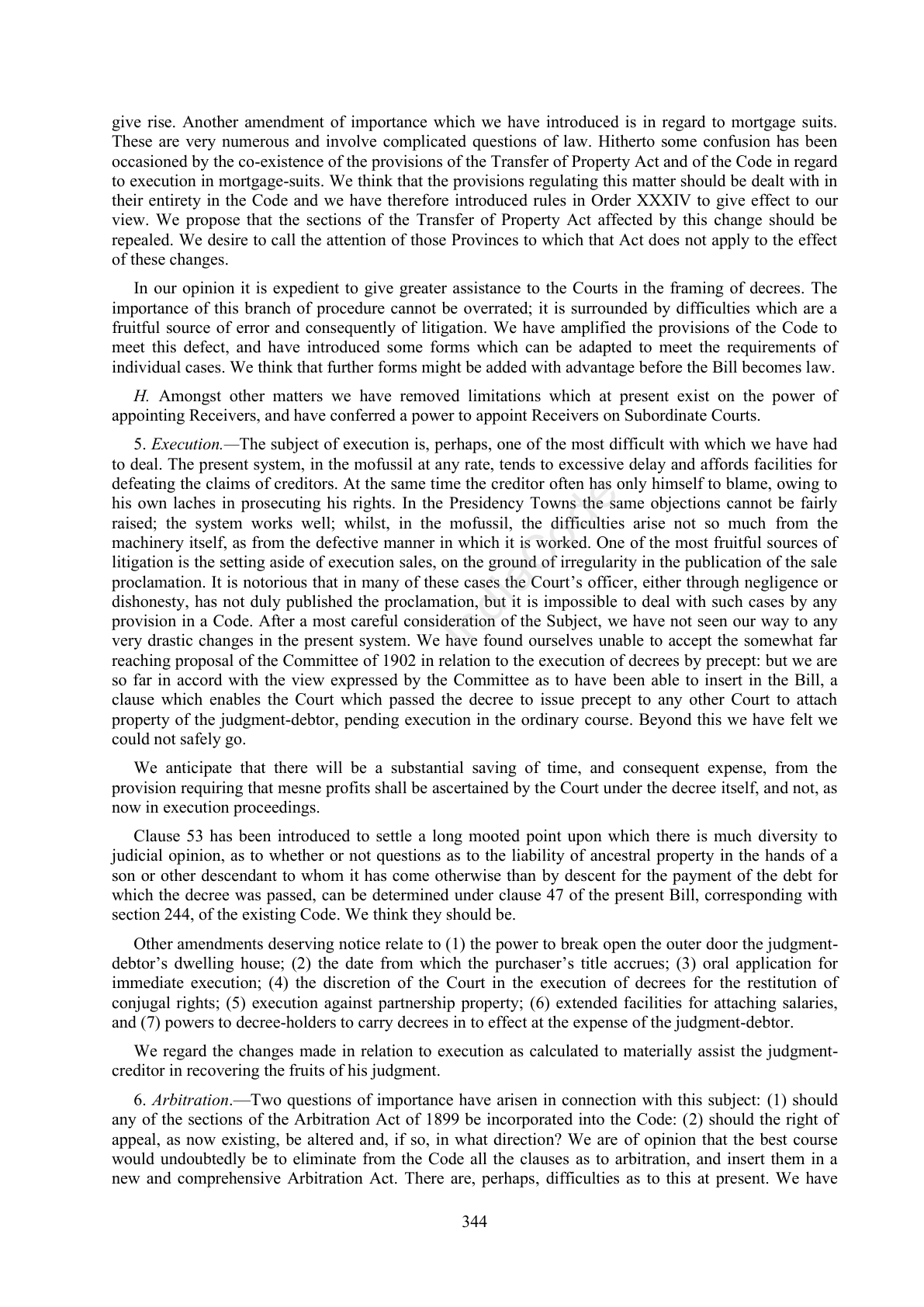
Full physical source page · unreviewed extraction
The Code of Civil Procedure, 1908: page 344
The Code of Civil Procedure, 1908, India Code delivered snapshot 393b8848fdfc476a, physical page 344, typed edition 77428589d4e341672ed6a3e5f663be7dec530c42d0600064ac1314302939267d. Unreviewed extraction.
Source: official India Code PDF · catalog record. Fetched 2026-10-19T23:06:46Z. SHA-256 393b8848fdfc476a21cc3abf4f0d3f510557e2dff6fc6914b1f379bea1730614.
Legal currency, territorial applicability and extraction fidelity are unverified. Catalog checksum/size differs from the delivered PDF; both identities are retained. Sections, state notes and footnotes share these physical pages. Compare the full original image.
Retained layout text
give rise. Another amendment of importance which we have introduced is in regard to mortgage suits.
These are very numerous and involve complicated questions of law. Hitherto some confusion has been
occasioned by the co-existence of the provisions of the Transfer of Property Act and of the Code in regard
to execution in mortgage-suits. We think that the provisions regulating this matter should be dealt with in
their entirety in the Code and we have therefore introduced rules in Order XXXIV to give effect to our
view. We propose that the sections of the Transfer of Property Act affected by this change should be
repealed. We desire to call the attention of those Provinces to which that Act does not apply to the effect
of these changes.
   In our opinion it is expedient to give greater assistance to the Courts in the framing of decrees. The
importance of this branch of procedure cannot be overrated; it is surrounded by difficulties which are a
fruitful source of error and consequently of litigation. We have amplified the provisions of the Code to
meet this defect, and have introduced some forms which can be adapted to meet the requirements of
individual cases. We think that further forms might be added with advantage before the Bill becomes law.
   H. Amongst other matters we have removed limitations which at present exist on the power of
appointing Receivers, and have conferred a power to appoint Receivers on Subordinate Courts.
    5. Execution.—The subject of execution is, perhaps, one of the most difficult with which we have had
to deal. The present system, in the mofussil at any rate, tends to excessive delay and affords facilities for
defeating the claims of creditors. At the same time the creditor often has only himself to blame, owing to
his own laches in prosecuting his rights. In the Presidency Towns the same objections cannot be fairly
                                                                      e
                                                                od
raised; the system works well; whilst, in the mofussil, the difficulties arise not so much from the
machinery itself, as from the defective manner in which it is worked. One of the most fruitful sources of
litigation is the setting aside of execution sales, on the ground of irregularity in the publication of the sale
                                                         aC
proclamation. It is notorious that in many of these cases the Court’s officer, either through negligence or
dishonesty, has not duly published the proclamation, but it is impossible to deal with such cases by any
                                                     di
provision in a Code. After a most careful consideration of the Subject, we have not seen our way to any
                                                In
very drastic changes in the present system. We have found ourselves unable to accept the somewhat far
reaching proposal of the Committee of 1902 in relation to the execution of decrees by precept: but we are
so far in accord with the view expressed by the Committee as to have been able to insert in the Bill, a
clause which enables the Court which passed the decree to issue precept to any other Court to attach
property of the judgment-debtor, pending execution in the ordinary course. Beyond this we have felt we
could not safely go.
   We anticipate that there will be a substantial saving of time, and consequent expense, from the
provision requiring that mesne profits shall be ascertained by the Court under the decree itself, and not, as
now in execution proceedings.
   Clause 53 has been introduced to settle a long mooted point upon which there is much diversity to
judicial opinion, as to whether or not questions as to the liability of ancestral property in the hands of a
son or other descendant to whom it has come otherwise than by descent for the payment of the debt for
which the decree was passed, can be determined under clause 47 of the present Bill, corresponding with
section 244, of the existing Code. We think they should be.
   Other amendments deserving notice relate to (1) the power to break open the outer door the judgment-
debtor’s dwelling house; (2) the date from which the purchaser’s title accrues; (3) oral application for
immediate execution; (4) the discretion of the Court in the execution of decrees for the restitution of
conjugal rights; (5) execution against partnership property; (6) extended facilities for attaching salaries,
and (7) powers to decree-holders to carry decrees in to effect at the expense of the judgment-debtor.
   We regard the changes made in relation to execution as calculated to materially assist the judgment-
creditor in recovering the fruits of his judgment.
   6. Arbitration.—Two questions of importance have arisen in connection with this subject: (1) should
any of the sections of the Arbitration Act of 1899 be incorporated into the Code: (2) should the right of
appeal, as now existing, be altered and, if so, in what direction? We are of opinion that the best course
would undoubtedly be to eliminate from the Code all the clauses as to arbitration, and insert them in a
new and comprehensive Arbitration Act. There are, perhaps, difficulties as to this at present. We have

                                                     344
Compare original page image