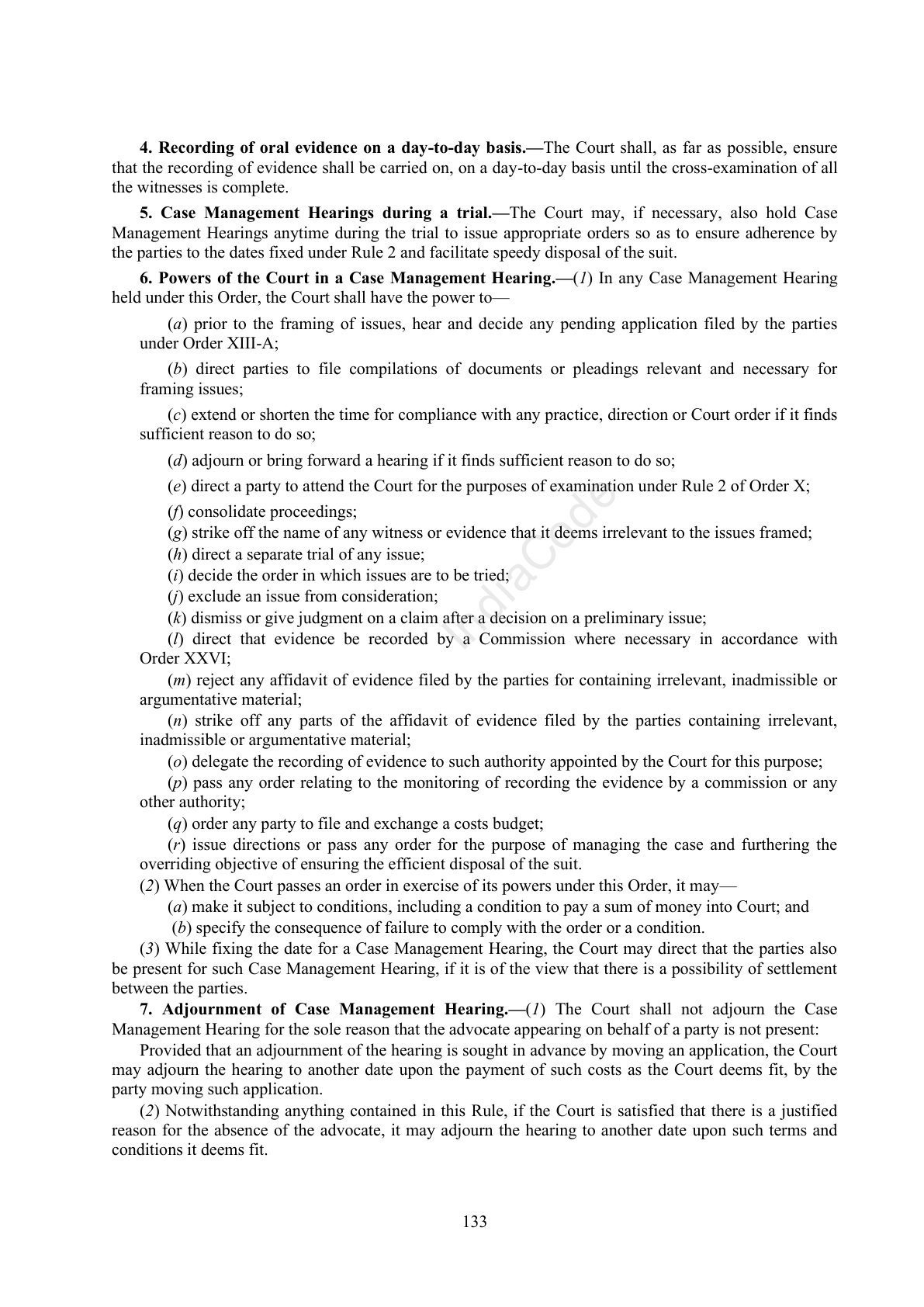
Full physical source page · unreviewed extraction
The Code of Civil Procedure, 1908: page 133
The Code of Civil Procedure, 1908, India Code delivered snapshot 393b8848fdfc476a, physical page 133, typed edition 77428589d4e341672ed6a3e5f663be7dec530c42d0600064ac1314302939267d. Unreviewed extraction.
Source: official India Code PDF · catalog record. Fetched 2026-10-19T23:06:46Z. SHA-256 393b8848fdfc476a21cc3abf4f0d3f510557e2dff6fc6914b1f379bea1730614.
Legal currency, territorial applicability and extraction fidelity are unverified. Catalog checksum/size differs from the delivered PDF; both identities are retained. Sections, state notes and footnotes share these physical pages. Compare the full original image.
Retained layout text
    4. Recording of oral evidence on a day-to-day basis.—The Court shall, as far as possible, ensure
that the recording of evidence shall be carried on, on a day-to-day basis until the cross-examination of all
the witnesses is complete.
    5. Case Management Hearings during a trial.—The Court may, if necessary, also hold Case
Management Hearings anytime during the trial to issue appropriate orders so as to ensure adherence by
the parties to the dates fixed under Rule 2 and facilitate speedy disposal of the suit.
    6. Powers of the Court in a Case Management Hearing.—(1) In any Case Management Hearing
held under this Order, the Court shall have the power to—
       (a) prior to the framing of issues, hear and decide any pending application filed by the parties
    under Order XIII-A;
        (b) direct parties to file compilations of documents or pleadings relevant and necessary for
    framing issues;
        (c) extend or shorten the time for compliance with any practice, direction or Court order if it finds
    sufficient reason to do so;
        (d) adjourn or bring forward a hearing if it finds sufficient reason to do so;
        (e) direct a party to attend the Court for the purposes of examination under Rule 2 of Order X;
        (f) consolidate proceedings;
                                                                     e
                                                               od
        (g) strike off the name of any witness or evidence that it deems irrelevant to the issues framed;
        (h) direct a separate trial of any issue;
                                                         aC
        (i) decide the order in which issues are to be tried;
        (j) exclude an issue from consideration;    di
        (k) dismiss or give judgment on a claim after a decision on a preliminary issue;
                                                In
        (l) direct that evidence be recorded by a Commission where necessary in accordance with
    Order XXVI;
        (m) reject any affidavit of evidence filed by the parties for containing irrelevant, inadmissible or
    argumentative material;
        (n) strike off any parts of the affidavit of evidence filed by the parties containing irrelevant,
    inadmissible or argumentative material;
        (o) delegate the recording of evidence to such authority appointed by the Court for this purpose;
        (p) pass any order relating to the monitoring of recording the evidence by a commission or any
    other authority;
        (q) order any party to file and exchange a costs budget;
        (r) issue directions or pass any order for the purpose of managing the case and furthering the
    overriding objective of ensuring the efficient disposal of the suit.
    (2) When the Court passes an order in exercise of its powers under this Order, it may—
        (a) make it subject to conditions, including a condition to pay a sum of money into Court; and
         (b) specify the consequence of failure to comply with the order or a condition.
    (3) While fixing the date for a Case Management Hearing, the Court may direct that the parties also
be present for such Case Management Hearing, if it is of the view that there is a possibility of settlement
between the parties.
    7. Adjournment of Case Management Hearing.—(1) The Court shall not adjourn the Case
Management Hearing for the sole reason that the advocate appearing on behalf of a party is not present:
    Provided that an adjournment of the hearing is sought in advance by moving an application, the Court
may adjourn the hearing to another date upon the payment of such costs as the Court deems fit, by the
party moving such application.
    (2) Notwithstanding anything contained in this Rule, if the Court is satisfied that there is a justified
reason for the absence of the advocate, it may adjourn the hearing to another date upon such terms and
conditions it deems fit.


                                                     133
Compare original page image