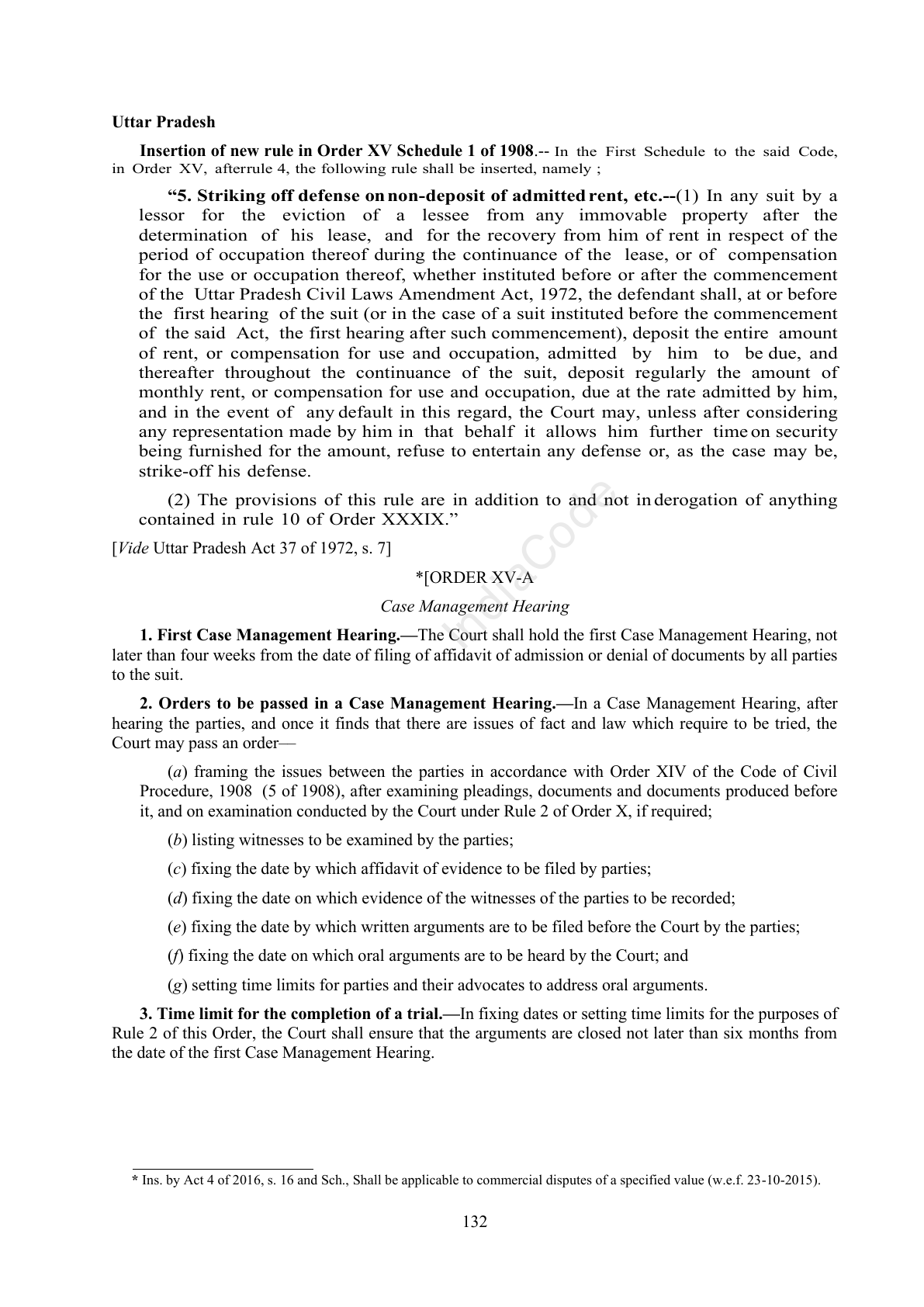
Full physical source page · unreviewed extraction
The Code of Civil Procedure, 1908: page 132
The Code of Civil Procedure, 1908, India Code delivered snapshot 393b8848fdfc476a, physical page 132, typed edition 77428589d4e341672ed6a3e5f663be7dec530c42d0600064ac1314302939267d. Unreviewed extraction.
Source: official India Code PDF · catalog record. Fetched 2026-10-19T23:06:46Z. SHA-256 393b8848fdfc476a21cc3abf4f0d3f510557e2dff6fc6914b1f379bea1730614.
Legal currency, territorial applicability and extraction fidelity are unverified. Catalog checksum/size differs from the delivered PDF; both identities are retained. Sections, state notes and footnotes share these physical pages. Compare the full original image.
Retained layout text
Uttar Pradesh
    Insertion of new rule in Order XV Schedule 1 of 1908.-- In the First Schedule to the said Code,
in Order XV, after rule 4, the following rule shall be inserted, namely ;

        “5. Striking off defense on non-deposit of admitted rent, etc.--(1) In any suit by a
    lessor for the eviction of a lessee from any immovable property after the
    determination of his lease, and for the recovery from him of rent in respect of the
    period of occupation thereof during the continuance of the lease, or of compensation
    for the use or occupation thereof, whether instituted before or after the commencement
    of the Uttar Pradesh Civil Laws Amendment Act, 1972, the defendant shall, at or before
    the first hearing of the suit (or in the case of a suit instituted before the commencement
    of the said Act, the first hearing after such commencement), deposit the entire amount
    of rent, or compensation for use and occupation, admitted by him to be due, and
    thereafter throughout the continuance of the suit, deposit regularly the amount of
    monthly rent, or compensation for use and occupation, due at the rate admitted by him,
    and in the event of any default in this regard, the Court may, unless after considering
    any representation made by him in that behalf it allows him further time on security
    being furnished for the amount, refuse to entertain any defense or, as the case may be,
    strike-off his defense.
       (2) The provisions of this rule are in addition to and not in derogation of anything
                                                                                 e
    contained in rule 10 of Order XXXIX.”
[Vide Uttar Pradesh Act 37 of 1972, s. 7]
                                                                          od
                                                     *[ORDER XV-A aC
                                                             di
                                               Case Management Hearing
                                                       In
     1. First Case Management Hearing.—The Court shall hold the first Case Management Hearing, not
later than four weeks from the date of filing of affidavit of admission or denial of documents by all parties
to the suit.
    2. Orders to be passed in a Case Management Hearing.—In a Case Management Hearing, after
hearing the parties, and once it finds that there are issues of fact and law which require to be tried, the
Court may pass an order––
         (a) framing the issues between the parties in accordance with Order XIV of the Code of Civil
    Procedure, 1908 (5 of 1908), after examining pleadings, documents and documents produced before
    it, and on examination conducted by the Court under Rule 2 of Order X, if required;
        (b) listing witnesses to be examined by the parties;
        (c) fixing the date by which affidavit of evidence to be filed by parties;
        (d) fixing the date on which evidence of the witnesses of the parties to be recorded;
        (e) fixing the date by which written arguments are to be filed before the Court by the parties;
        (f) fixing the date on which oral arguments are to be heard by the Court; and
        (g) setting time limits for parties and their advocates to address oral arguments.
    3. Time limit for the completion of a trial.—In fixing dates or setting time limits for the purposes of
Rule 2 of this Order, the Court shall ensure that the arguments are closed not later than six months from
the date of the first Case Management Hearing.


  * Ins. by Act 4 of 2016, s. 16 and Sch., Shall be applicable to commercial disputes of a specified value (w.e.f. 23-10-2015).


                                                             132
Compare original page image