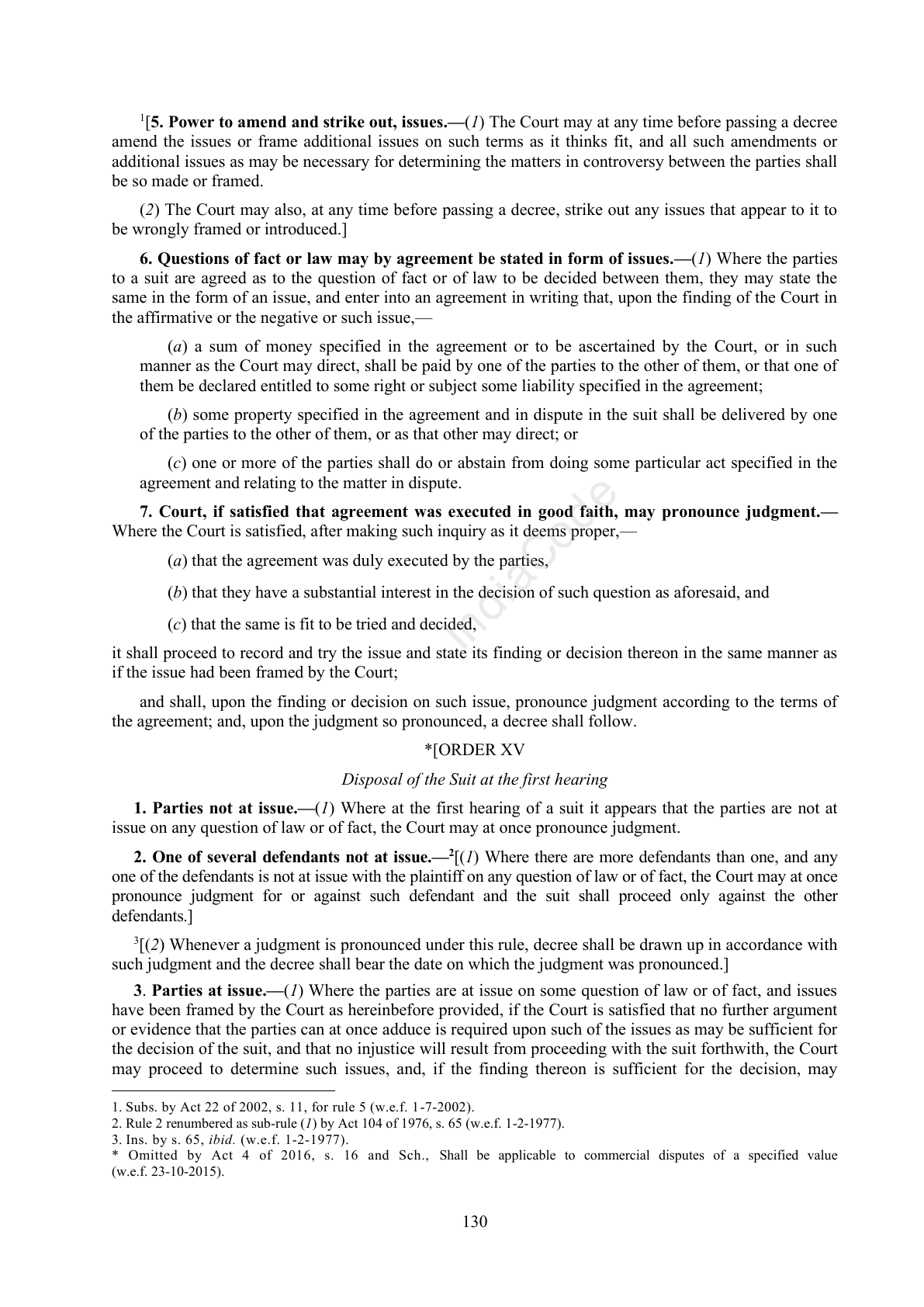
Full physical source page · unreviewed extraction
The Code of Civil Procedure, 1908: page 130
The Code of Civil Procedure, 1908, India Code delivered snapshot 393b8848fdfc476a, physical page 130, typed edition 77428589d4e341672ed6a3e5f663be7dec530c42d0600064ac1314302939267d. Unreviewed extraction.
Source: official India Code PDF · catalog record. Fetched 2026-10-19T23:06:46Z. SHA-256 393b8848fdfc476a21cc3abf4f0d3f510557e2dff6fc6914b1f379bea1730614.
Legal currency, territorial applicability and extraction fidelity are unverified. Catalog checksum/size differs from the delivered PDF; both identities are retained. Sections, state notes and footnotes share these physical pages. Compare the full original image.
Retained layout text
       1
     [5. Power to amend and strike out, issues.—(1) The Court may at any time before passing a decree
amend the issues or frame additional issues on such terms as it thinks fit, and all such amendments or
additional issues as may be necessary for determining the matters in controversy between the parties shall
be so made or framed.
    (2) The Court may also, at any time before passing a decree, strike out any issues that appear to it to
be wrongly framed or introduced.]
    6. Questions of fact or law may by agreement be stated in form of issues.—(1) Where the parties
to a suit are agreed as to the question of fact or of law to be decided between them, they may state the
same in the form of an issue, and enter into an agreement in writing that, upon the finding of the Court in
the affirmative or the negative or such issue,—
           (a) a sum of money specified in the agreement or to be ascertained by the Court, or in such
       manner as the Court may direct, shall be paid by one of the parties to the other of them, or that one of
       them be declared entitled to some right or subject some liability specified in the agreement;
            (b) some property specified in the agreement and in dispute in the suit shall be delivered by one
       of the parties to the other of them, or as that other may direct; or
           (c) one or more of the parties shall do or abstain from doing some particular act specified in the
       agreement and relating to the matter in dispute.
                                                                         e
  7. Court, if satisfied that agreement was executed in good faith, may pronounce judgment.—
                                                                  od
Where the Court is satisfied, after making such inquiry as it deems proper,—
           (a) that the agreement was duly executed by the parties,
                                                               aC
           (b) that they have a substantial interest in the decision of such question as aforesaid, and
                                                        di
           (c) that the same is fit to be tried and decided,
                                                    In
it shall proceed to record and try the issue and state its finding or decision thereon in the same manner as
if the issue had been framed by the Court;
    and shall, upon the finding or decision on such issue, pronounce judgment according to the terms of
the agreement; and, upon the judgment so pronounced, a decree shall follow.
                                                   *[ORDER XV
                                      Disposal of the Suit at the first hearing
   1. Parties not at issue.—(1) Where at the first hearing of a suit it appears that the parties are not at
issue on any question of law or of fact, the Court may at once pronounce judgment.
   2. One of several defendants not at issue.—2[(1) Where there are more defendants than one, and any
one of the defendants is not at issue with the plaintiff on any question of law or of fact, the Court may at once
pronounce judgment for or against such defendant and the suit shall proceed only against the other
defendants.]
   3
    [(2) Whenever a judgment is pronounced under this rule, decree shall be drawn up in accordance with
such judgment and the decree shall bear the date on which the judgment was pronounced.]
   3. Parties at issue.—(1) Where the parties are at issue on some question of law or of fact, and issues
have been framed by the Court as hereinbefore provided, if the Court is satisfied that no further argument
or evidence that the parties can at once adduce is required upon such of the issues as may be sufficient for
the decision of the suit, and that no injustice will result from proceeding with the suit forthwith, the Court
may proceed to determine such issues, and, if the finding thereon is sufficient for the decision, may

1. Subs. by Act 22 of 2002, s. 11, for rule 5 (w.e.f. 1-7-2002).
2. Rule 2 renumbered as sub-rule (1) by Act 104 of 1976, s. 65 (w.e.f. 1-2-1977).
3. Ins. by s. 65, ibid. (w.e.f. 1-2-1977).
* Omitted by Act 4 of 2016, s. 16 and Sch., Shall be applicable to commercial disputes of a specified value
(w.e.f. 23-10-2015).


                                                         130
Compare original page image