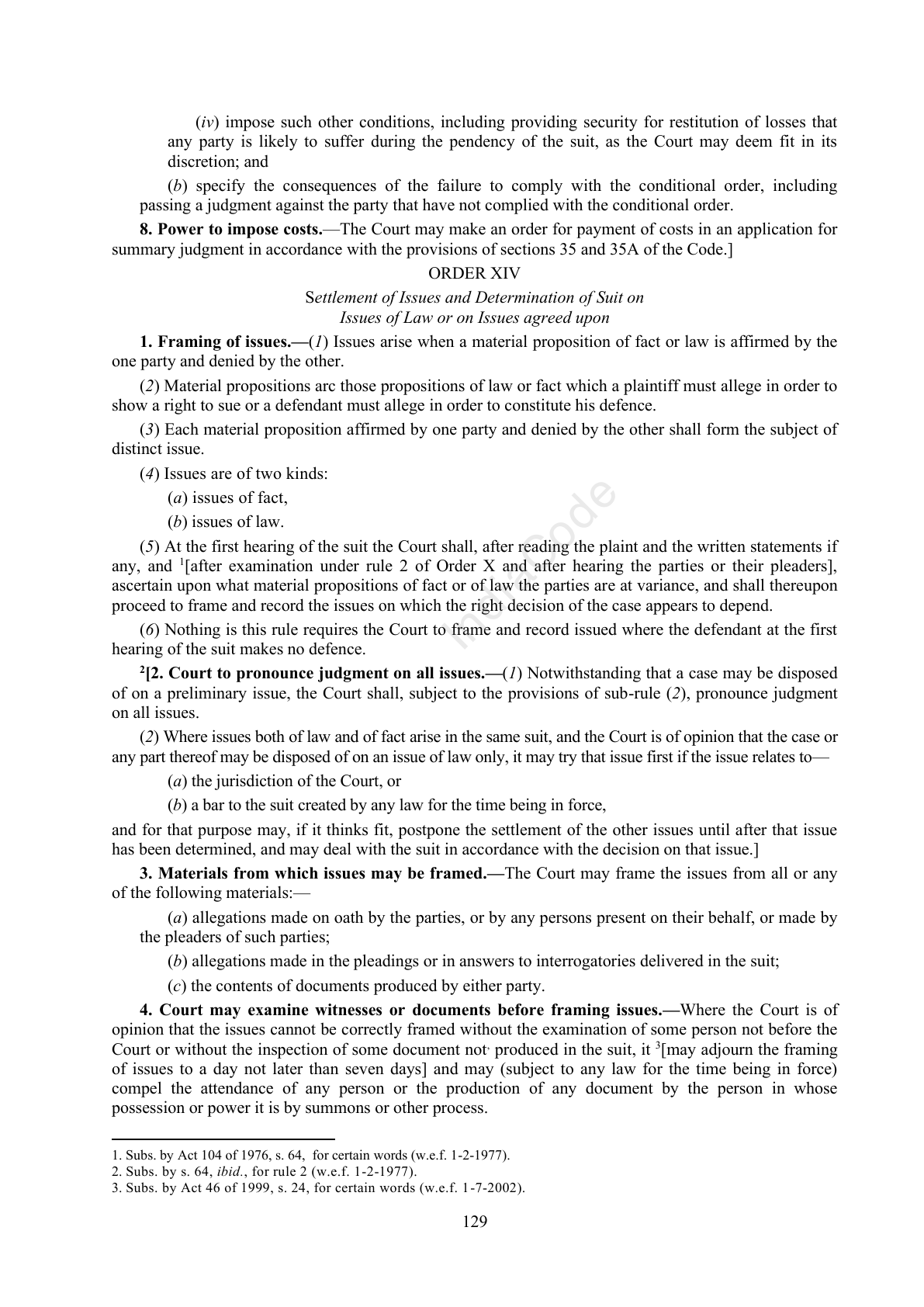
Full physical source page · unreviewed extraction
The Code of Civil Procedure, 1908: page 129
The Code of Civil Procedure, 1908, India Code delivered snapshot 393b8848fdfc476a, physical page 129, typed edition 77428589d4e341672ed6a3e5f663be7dec530c42d0600064ac1314302939267d. Unreviewed extraction.
Source: official India Code PDF · catalog record. Fetched 2026-10-19T23:06:46Z. SHA-256 393b8848fdfc476a21cc3abf4f0d3f510557e2dff6fc6914b1f379bea1730614.
Legal currency, territorial applicability and extraction fidelity are unverified. Catalog checksum/size differs from the delivered PDF; both identities are retained. Sections, state notes and footnotes share these physical pages. Compare the full original image.
Retained layout text
                (iv) impose such other conditions, including providing security for restitution of losses that
           any party is likely to suffer during the pendency of the suit, as the Court may deem fit in its
           discretion; and
           (b) specify the consequences of the failure to comply with the conditional order, including
     passing a judgment against the party that have not complied with the conditional order.
     8. Power to impose costs.—The Court may make an order for payment of costs in an application for
summary judgment in accordance with the provisions of sections 35 and 35A of the Code.]
                                                    ORDER XIV
                                  Settlement of Issues and Determination of Suit on
                                       Issues of Law or on Issues agreed upon
     1. Framing of issues.—(1) Issues arise when a material proposition of fact or law is affirmed by the
one party and denied by the other.
     (2) Material propositions arc those propositions of law or fact which a plaintiff must allege in order to
show a right to sue or a defendant must allege in order to constitute his defence.
     (3) Each material proposition affirmed by one party and denied by the other shall form the subject of
distinct issue.
     (4) Issues are of two kinds:
           (a) issues of fact,                                              e
           (b) issues of law.                                              od
     (5) At the first hearing of the suit the Court shall, after reading the plaint and the written statements if
                                                                 aC
any, and 1[after examination under rule 2 of Order X and after hearing the parties or their pleaders],
ascertain upon what material propositions of fact or of law the parties are at variance, and shall thereupon
                                                            di
proceed to frame and record the issues on which the right decision of the case appears to depend.
     (6) Nothing is this rule requires the Court to frame and record issued where the defendant at the first
                                                       In
hearing of the suit makes no defence.
     2
       [2. Court to pronounce judgment on all issues.—(1) Notwithstanding that a case may be disposed
of on a preliminary issue, the Court shall, subject to the provisions of sub-rule (2), pronounce judgment
on all issues.
     (2) Where issues both of law and of fact arise in the same suit, and the Court is of opinion that the case or
any part thereof may be disposed of on an issue of law only, it may try that issue first if the issue relates to—
           (a) the jurisdiction of the Court, or
           (b) a bar to the suit created by any law for the time being in force,
and for that purpose may, if it thinks fit, postpone the settlement of the other issues until after that issue
has been determined, and may deal with the suit in accordance with the decision on that issue.]
     3. Materials from which issues may be framed.—The Court may frame the issues from all or any
of the following materials:—
           (a) allegations made on oath by the parties, or by any persons present on their behalf, or made by
     the pleaders of such parties;
           (b) allegations made in the pleadings or in answers to interrogatories delivered in the suit;
           (c) the contents of documents produced by either party.
     4. Court may examine witnesses or documents before framing issues.—Where the Court is of
opinion that the issues cannot be correctly framed without the examination of some person not before the
Court or without the inspection of some document not, produced in the suit, it 3[may adjourn the framing
of issues to a day not later than seven days] and may (subject to any law for the time being in force)
compel the attendance of any person or the production of any document by the person in whose
possession or power it is by summons or other process.

1. Subs. by Act 104 of 1976, s. 64, for certain words (w.e.f. 1-2-1977).
2. Subs. by s. 64, ibid., for rule 2 (w.e.f. 1-2-1977).
3. Subs. by Act 46 of 1999, s. 24, for certain words (w.e.f. 1-7-2002).

                                                            129
Compare original page image