Full physical source page · unreviewed extraction
The Code of Civil Procedure, 1908: page 112
The Code of Civil Procedure, 1908, India Code delivered snapshot 393b8848fdfc476a, physical page 112, typed edition 77428589d4e341672ed6a3e5f663be7dec530c42d0600064ac1314302939267d. Unreviewed extraction.
Source: official India Code PDF · catalog record. Fetched 2026-10-19T23:06:46Z. SHA-256 393b8848fdfc476a21cc3abf4f0d3f510557e2dff6fc6914b1f379bea1730614.
Legal currency, territorial applicability and extraction fidelity are unverified. Catalog checksum/size differs from the delivered PDF; both identities are retained. Sections, state notes and footnotes share these physical pages. Compare the full original image.
Retained layout text
     1
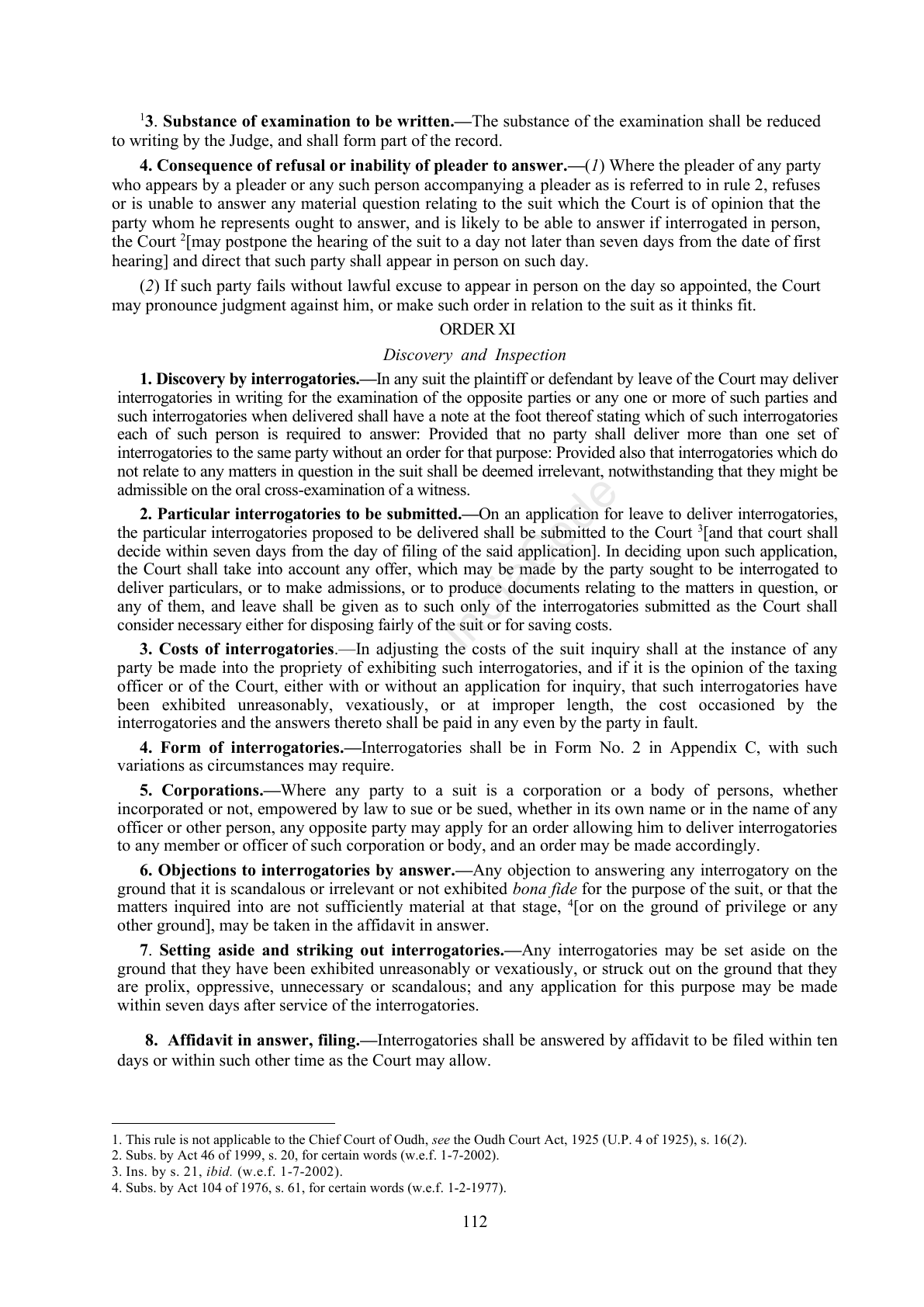
      3. Substance of examination to be written.—The substance of the examination shall be reduced
to writing by the Judge, and shall form part of the record.
     4. Consequence of refusal or inability of pleader to answer.—(1) Where the pleader of any party
who appears by a pleader or any such person accompanying a pleader as is referred to in rule 2, refuses
or is unable to answer any material question relating to the suit which the Court is of opinion that the
party whom he represents ought to answer, and is likely to be able to answer if interrogated in person,
the Court 2[may postpone the hearing of the suit to a day not later than seven days from the date of first
hearing] and direct that such party shall appear in person on such day.
     (2) If such party fails without lawful excuse to appear in person on the day so appointed, the Court
may pronounce judgment against him, or make such order in relation to the suit as it thinks fit.
                                                  ORDER XI
                                           Discovery and Inspection
     1. Discovery by interrogatories.—In any suit the plaintiff or defendant by leave of the Court may deliver
 interrogatories in writing for the examination of the opposite parties or any one or more of such parties and
 such interrogatories when delivered shall have a note at the foot thereof stating which of such interrogatories
 each of such person is required to answer: Provided that no party shall deliver more than one set of
 interrogatories to the same party without an order for that purpose: Provided also that interrogatories which do
 not relate to any matters in question in the suit shall be deemed irrelevant, notwithstanding that they might be
 admissible on the oral cross-examination of a witness.
                                                                                  e
     2. Particular interrogatories to be submitted.—On an application for leave to deliver interrogatories,
                                                                           od
 the particular interrogatories proposed to be delivered shall be submitted to the Court 3[and that court shall
 decide within seven days from the day of filing of the said application]. In deciding upon such application,
                                                                   aC
 the Court shall take into account any offer, which may be made by the party sought to be interrogated to
 deliver particulars, or to make admissions, or to produce documents relating to the matters in question, or
                                                              di
 any of them, and leave shall be given as to such only of the interrogatories submitted as the Court shall
 consider necessary either for disposing fairly of the suit or for saving costs.
                                                         In
     3. Costs of interrogatories.—In adjusting the costs of the suit inquiry shall at the instance of any
 party be made into the propriety of exhibiting such interrogatories, and if it is the opinion of the taxing
 officer or of the Court, either with or without an application for inquiry, that such interrogatories have
 been exhibited unreasonably, vexatiously, or at improper length, the cost occasioned by the
 interrogatories and the answers thereto shall be paid in any even by the party in fault.
     4. Form of interrogatories.—Interrogatories shall be in Form No. 2 in Appendix C, with such
 variations as circumstances may require.
     5. Corporations.—Where any party to a suit is a corporation or a body of persons, whether
 incorporated or not, empowered by law to sue or be sued, whether in its own name or in the name of any
 officer or other person, any opposite party may apply for an order allowing him to deliver interrogatories
 to any member or officer of such corporation or body, and an order may be made accordingly.
     6. Objections to interrogatories by answer.—Any objection to answering any interrogatory on the
 ground that it is scandalous or irrelevant or not exhibited bona fide for the purpose of the suit, or that the
 matters inquired into are not sufficiently material at that stage, 4[or on the ground of privilege or any
 other ground], may be taken in the affidavit in answer.
     7. Setting aside and striking out interrogatories.—Any interrogatories may be set aside on the
 ground that they have been exhibited unreasonably or vexatiously, or struck out on the ground that they
 are prolix, oppressive, unnecessary or scandalous; and any application for this purpose may be made
 within seven days after service of the interrogatories.

    8. Affidavit in answer, filing.—Interrogatories shall be answered by affidavit to be filed within ten
 days or within such other time as the Court may allow.


1. This rule is not applicable to the Chief Court of Oudh, see the Oudh Court Act, 1925 (U.P. 4 of 1925), s. 16(2).
2. Subs. by Act 46 of 1999, s. 20, for certain words (w.e.f. 1-7-2002).
3. Ins. by s. 21, ibid. (w.e.f. 1-7-2002).
4. Subs. by Act 104 of 1976, s. 61, for certain words (w.e.f. 1-2-1977).

                                                               112
Compare original page image