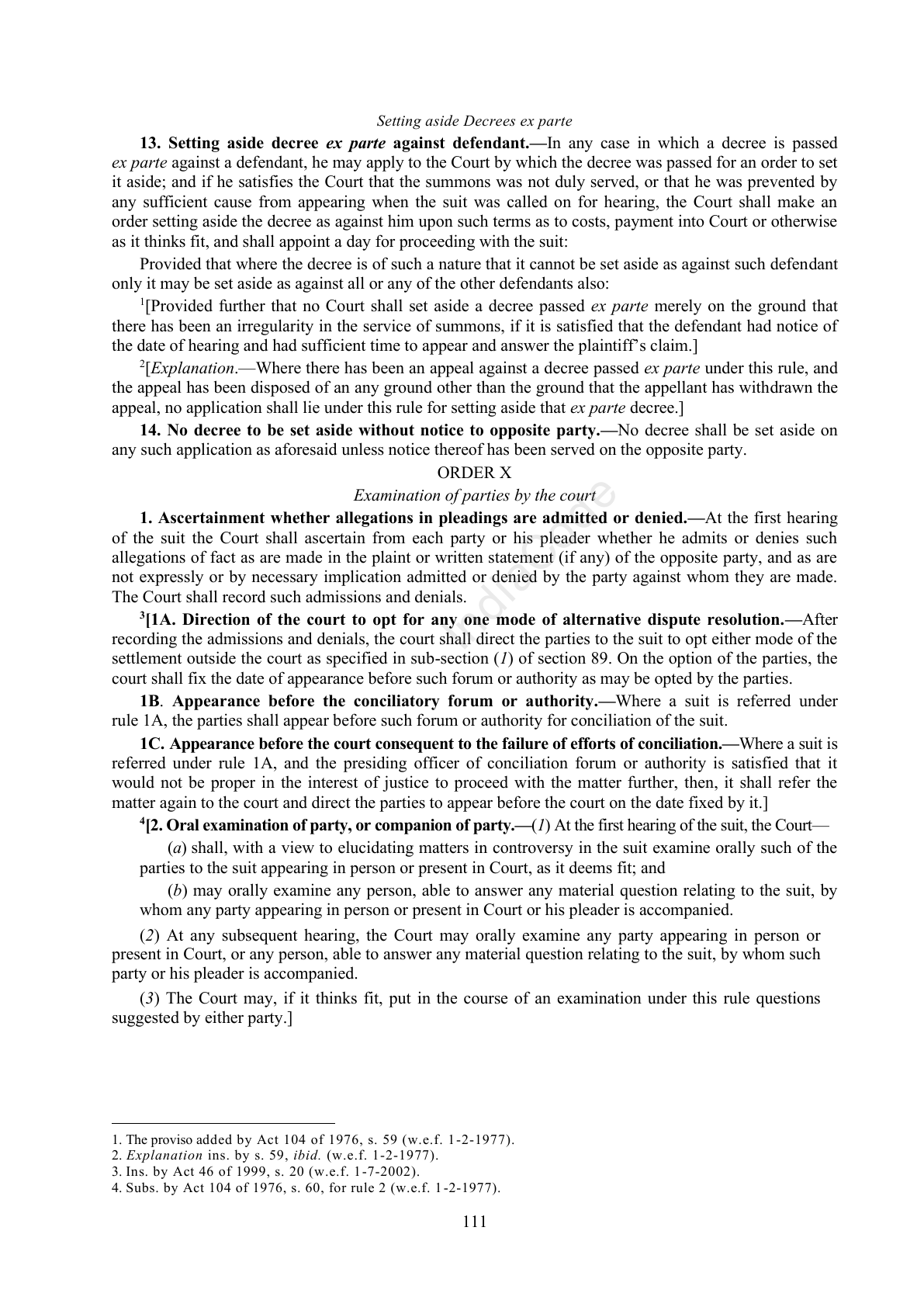
Full physical source page · unreviewed extraction
The Code of Civil Procedure, 1908: page 111
The Code of Civil Procedure, 1908, India Code delivered snapshot 393b8848fdfc476a, physical page 111, typed edition 77428589d4e341672ed6a3e5f663be7dec530c42d0600064ac1314302939267d. Unreviewed extraction.
Source: official India Code PDF · catalog record. Fetched 2026-10-19T23:06:46Z. SHA-256 393b8848fdfc476a21cc3abf4f0d3f510557e2dff6fc6914b1f379bea1730614.
Legal currency, territorial applicability and extraction fidelity are unverified. Catalog checksum/size differs from the delivered PDF; both identities are retained. Sections, state notes and footnotes share these physical pages. Compare the full original image.
Retained layout text
                                           Setting aside Decrees ex parte
     13. Setting aside decree ex parte against defendant.—In any case in which a decree is passed
ex parte against a defendant, he may apply to the Court by which the decree was passed for an order to set
it aside; and if he satisfies the Court that the summons was not duly served, or that he was prevented by
any sufficient cause from appearing when the suit was called on for hearing, the Court shall make an
order setting aside the decree as against him upon such terms as to costs, payment into Court or otherwise
as it thinks fit, and shall appoint a day for proceeding with the suit:
     Provided that where the decree is of such a nature that it cannot be set aside as against such defendant
only it may be set aside as against all or any of the other defendants also:
     1
       [Provided further that no Court shall set aside a decree passed ex parte merely on the ground that
there has been an irregularity in the service of summons, if it is satisfied that the defendant had notice of
the date of hearing and had sufficient time to appear and answer the plaintiff’s claim.]
     2
       [Explanation.—Where there has been an appeal against a decree passed ex parte under this rule, and
the appeal has been disposed of an any ground other than the ground that the appellant has withdrawn the
appeal, no application shall lie under this rule for setting aside that ex parte decree.]
     14. No decree to be set aside without notice to opposite party.—No decree shall be set aside on
any such application as aforesaid unless notice thereof has been served on the opposite party.
                                                   ORDER X
                                       Examination of parties by the court
                                                                        e
     1. Ascertainment whether allegations in pleadings are admitted or denied.—At the first hearing
                                                                     od
of the suit the Court shall ascertain from each party or his pleader whether he admits or denies such
allegations of fact as are made in the plaint or written statement (if any) of the opposite party, and as are
                                                             aC
not expressly or by necessary implication admitted or denied by the party against whom they are made.
The Court shall record such admissions and denials.     di
     3
       [1A. Direction of the court to opt for any one mode of alternative dispute resolution.—After
                                                   In
recording the admissions and denials, the court shall direct the parties to the suit to opt either mode of the
settlement outside the court as specified in sub-section (1) of section 89. On the option of the parties, the
court shall fix the date of appearance before such forum or authority as may be opted by the parties.
     1B. Appearance before the conciliatory forum or authority.—Where a suit is referred under
rule 1A, the parties shall appear before such forum or authority for conciliation of the suit.
     1C. Appearance before the court consequent to the failure of efforts of conciliation.—Where a suit is
referred under rule 1A, and the presiding officer of conciliation forum or authority is satisfied that it
would not be proper in the interest of justice to proceed with the matter further, then, it shall refer the
matter again to the court and direct the parties to appear before the court on the date fixed by it.]
     4
       [2. Oral examination of party, or companion of party.—(1) At the first hearing of the suit, the Court—
           (a) shall, with a view to elucidating matters in controversy in the suit examine orally such of the
     parties to the suit appearing in person or present in Court, as it deems fit; and
           (b) may orally examine any person, able to answer any material question relating to the suit, by
     whom any party appearing in person or present in Court or his pleader is accompanied.
     (2) At any subsequent hearing, the Court may orally examine any party appearing in person or
present in Court, or any person, able to answer any material question relating to the suit, by whom such
party or his pleader is accompanied.
     (3) The Court may, if it thinks fit, put in the course of an examination under this rule questions
suggested by either party.]


1. The proviso added by Act 104 of 1976, s. 59 (w.e.f. 1-2-1977).
2. Explanation ins. by s. 59, ibid. (w.e.f. 1-2-1977).
3. Ins. by Act 46 of 1999, s. 20 (w.e.f. 1-7-2002).
4. Subs. by Act 104 of 1976, s. 60, for rule 2 (w.e.f. 1 -2-1977).

                                                         111
Compare original page image