Full physical source page · unreviewed extraction
The Indian Contract Act, 1872: page 50
The Indian Contract Act, 1872, India Code delivered snapshot 85a7a066098255c9, physical page 50. Unreviewed extraction.
Source: official India Code PDF · catalog record. Fetched 2026-10-19T23:06:49Z. SHA-256 85a7a066098255c93001d678aeaf483f91d3080918363c03b78d40c3eeb8b386.
Legal currency, territorial applicability and extraction fidelity are unverified. Catalog checksum/size differs from the delivered PDF; both identities are retained. Sections, state notes and footnotes share these physical pages. Compare the full original image.
Retained layout text
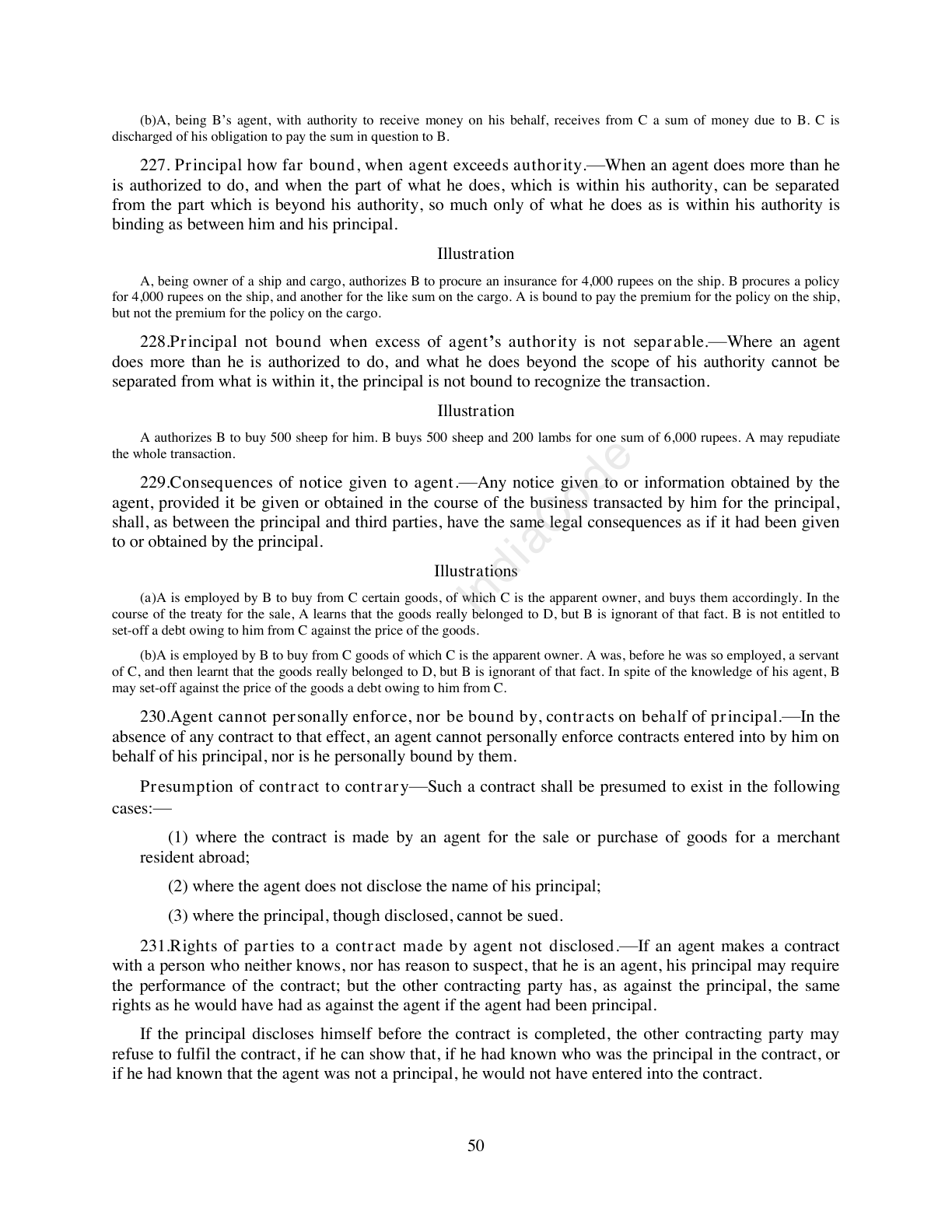
     (b)A, being B’s agent, with authority to receive money on his behalf, receives from C a sum of money due to B. C is
discharged of his obligation to pay the sum in question to B.

    227. Principal how far bound, when agent exceeds authority.—When an agent does more than he
is authorized to do, and when the part of what he does, which is within his authority, can be separated
from the part which is beyond his authority, so much only of what he does as is within his authority is
binding as between him and his principal.
                                                           Illustration
     A, being owner of a ship and cargo, authorizes B to procure an insurance for 4,000 rupees on the ship. B procures a policy
for 4,000 rupees on the ship, and another for the like sum on the cargo. A is bound to pay the premium for the policy on the ship,
but not the premium for the policy on the cargo.

    228.Principal not bound when excess of agent’s authority is not separable.—Where an agent
does more than he is authorized to do, and what he does beyond the scope of his authority cannot be
separated from what is within it, the principal is not bound to recognize the transaction.
                                                           Illustration
     A authorizes B to buy 500 sheep for him. B buys 500 sheep and 200 lambs for one sum of 6,000 rupees. A may repudiate
the whole transaction.
                                                                                      e
    229.Consequences of notice given to agent.—Any notice given to or information obtained by the
                                                                              od
agent, provided it be given or obtained in the course of the business transacted by him for the principal,
                                                                       aC
shall, as between the principal and third parties, have the same legal consequences as if it had been given
to or obtained by the principal.
                                                                 di
                                                          Illustrations
                                                            In
     (a)A is employed by B to buy from C certain goods, of which C is the apparent owner, and buys them accordingly. In the
course of the treaty for the sale, A learns that the goods really belonged to D, but B is ignorant of that fact. B is not entitled to
set-off a debt owing to him from C against the price of the goods.
     (b)A is employed by B to buy from C goods of which C is the apparent owner. A was, before he was so employed, a servant
of C, and then learnt that the goods really belonged to D, but B is ignorant of that fact. In spite of the knowledge of his agent, B
may set-off against the price of the goods a debt owing to him from C.

    230.Agent cannot personally enforce, nor be bound by, contracts on behalf of principal.—In the
absence of any contract to that effect, an agent cannot personally enforce contracts entered into by him on
behalf of his principal, nor is he personally bound by them.
    Presumption of contract to contrary—Such a contract shall be presumed to exist in the following
cases:—
         (1) where the contract is made by an agent for the sale or purchase of goods for a merchant
     resident abroad;
          (2) where the agent does not disclose the name of his principal;
          (3) where the principal, though disclosed, cannot be sued.
    231.Rights of parties to a contract made by agent not disclosed.—If an agent makes a contract
with a person who neither knows, nor has reason to suspect, that he is an agent, his principal may require
the performance of the contract; but the other contracting party has, as against the principal, the same
rights as he would have had as against the agent if the agent had been principal.
     If the principal discloses himself before the contract is completed, the other contracting party may
refuse to fulfil the contract, if he can show that, if he had known who was the principal in the contract, or
if he had known that the agent was not a principal, he would not have entered into the contract.


                                                                50
Compare original page image