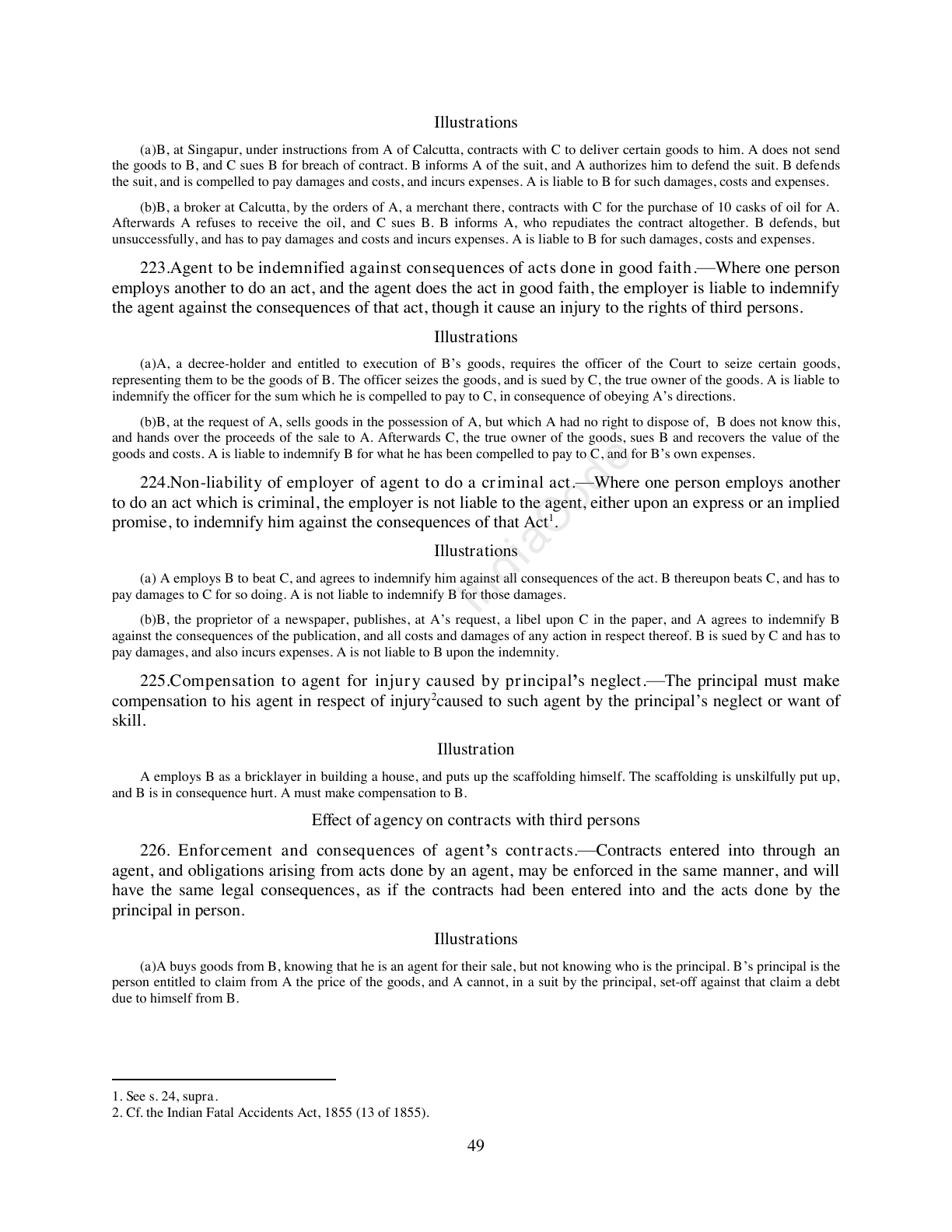
Full physical source page · unreviewed extraction
The Indian Contract Act, 1872: page 49
The Indian Contract Act, 1872, India Code delivered snapshot 85a7a066098255c9, physical page 49. Unreviewed extraction.
Source: official India Code PDF · catalog record. Fetched 2026-10-19T23:06:49Z. SHA-256 85a7a066098255c93001d678aeaf483f91d3080918363c03b78d40c3eeb8b386.
Legal currency, territorial applicability and extraction fidelity are unverified. Catalog checksum/size differs from the delivered PDF; both identities are retained. Sections, state notes and footnotes share these physical pages. Compare the full original image.
Retained layout text
                                                            Illustrations
     (a)B, at Singapur, under instructions from A of Calcutta, contracts with C to deliver certain goods to him. A does not send
the goods to B, and C sues B for breach of contract. B informs A of the suit, and A authorizes him to defend the suit. B defends
the suit, and is compelled to pay damages and costs, and incurs expenses. A is liable to B for such damages, costs and expenses.
     (b)B, a broker at Calcutta, by the orders of A, a merchant there, contracts with C for the purchase of 10 casks of oil for A.
Afterwards A refuses to receive the oil, and C sues B. B informs A, who repudiates the contract altogether. B defends, but
unsuccessfully, and has to pay damages and costs and incurs expenses. A is liable to B for such damages, costs and expenses.

    223.Agent to be indemnified against consequences of acts done in good faith.—Where one person
employs another to do an act, and the agent does the act in good faith, the employer is liable to indemnify
the agent against the consequences of that act, though it cause an injury to the rights of third persons.
                                                            Illustrations
     (a)A, a decree-holder and entitled to execution of B’s goods, requires the officer of the Court to seize certain goods,
representing them to be the goods of B. The officer seizes the goods, and is sued by C, the true owner of the goods. A is liable to
indemnify the officer for the sum which he is compelled to pay to C, in consequence of obeying A’s directions.
    (b)B, at the request of A, sells goods in the possession of A, but which A had no right to dispose of, B does not know this,
and hands over the proceeds of the sale to A. Afterwards C, the true owner of the goods, sues B and recovers the value of the
goods and costs. A is liable to indemnify B for what he has been compelled to pay to C, and for B’s own expenses.
                                                                                    e
    224.Non-liability of employer of agent to do a criminal act.—Where one person employs another
                                                                             od
to do an act which is criminal, the employer is not liable to the agent, either upon an express or an implied
promise, to indemnify him against the consequences of that Act1.
                                                                      aC
                                                            Illustrations
                                                                 di
     (a) A employs B to beat C, and agrees to indemnify him against all consequences of the act. B thereupon beats C, and has to
                                                             In
pay damages to C for so doing. A is not liable to indemnify B for those damages.
     (b)B, the proprietor of a newspaper, publishes, at A’s request, a libel upon C in the paper, and A agrees to indemnify B
against the consequences of the publication, and all costs and damages of any action in respect thereof. B is sued by C and has to
pay damages, and also incurs expenses. A is not liable to B upon the indemnity.

     225.Compensation to agent for injury caused by principal’s neglect.—The principal must make
compensation to his agent in respect of injury2caused to such agent by the principal’s neglect or want of
skill.
                                                            Illustration
    A employs B as a bricklayer in building a house, and puts up the scaffolding himself. The scaffolding is unskilfully put up,
and B is in consequence hurt. A must make compensation to B.

                                   Effect of agency on contracts with third persons
    226. Enforcement and consequences of agent’s contracts.—Contracts entered into through an
agent, and obligations arising from acts done by an agent, may be enforced in the same manner, and will
have the same legal consequences, as if the contracts had been entered into and the acts done by the
principal in person.
                                                            Illustrations
     (a)A buys goods from B, knowing that he is an agent for their sale, but not knowing who is the principal. B’s principal is the
person entitled to claim from A the price of the goods, and A cannot, in a suit by the principal, set-off against that claim a debt
due to himself from B.


1. See s. 24, supra.
2. Cf. the Indian Fatal Accidents Act, 1855 (13 of 1855).

                                                                 49
Compare original page image