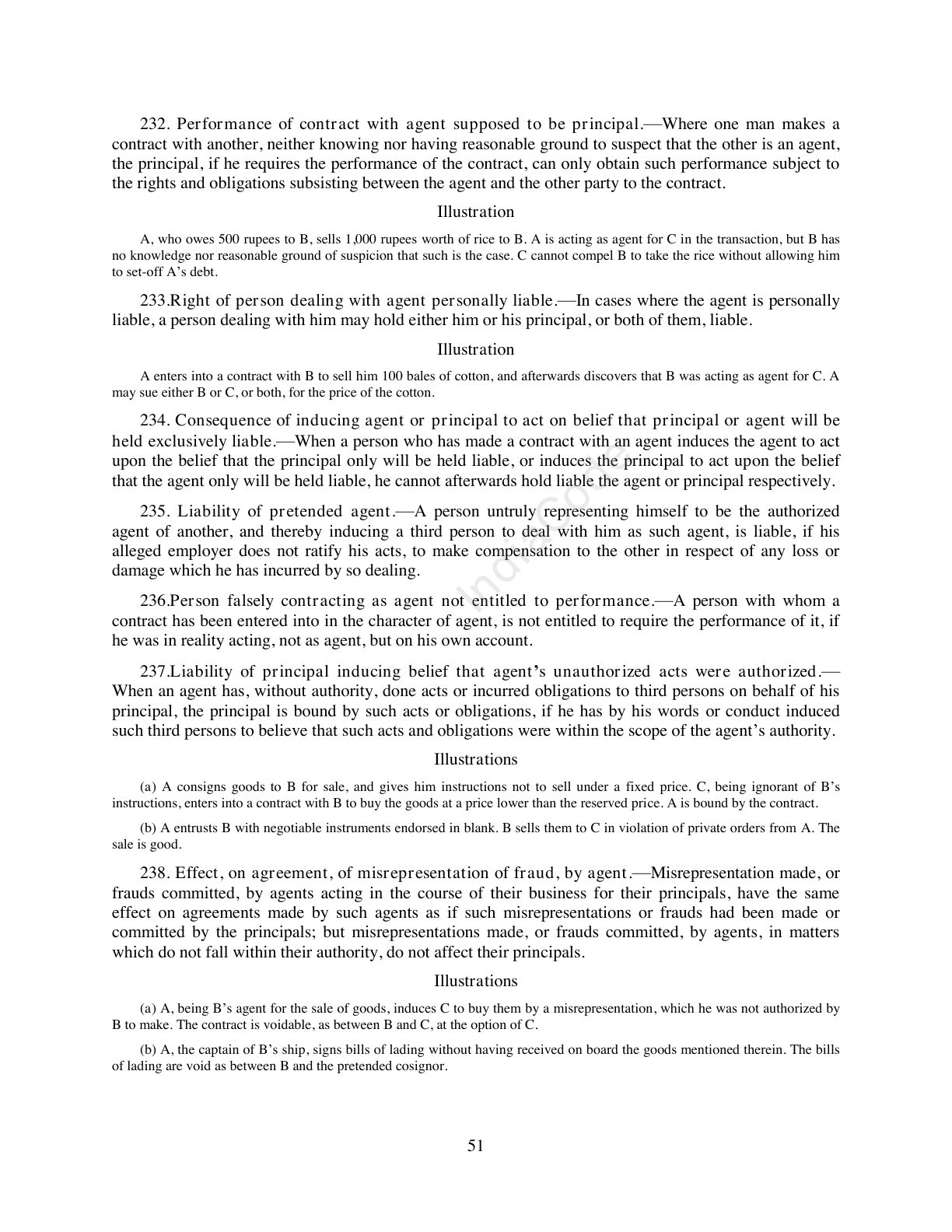
Full physical source page · unreviewed extraction
The Indian Contract Act, 1872: page 51
The Indian Contract Act, 1872, India Code delivered snapshot 85a7a066098255c9, physical page 51. Unreviewed extraction.
Source: official India Code PDF · catalog record. Fetched 2026-10-19T23:06:49Z. SHA-256 85a7a066098255c93001d678aeaf483f91d3080918363c03b78d40c3eeb8b386.
Legal currency, territorial applicability and extraction fidelity are unverified. Catalog checksum/size differs from the delivered PDF; both identities are retained. Sections, state notes and footnotes share these physical pages. Compare the full original image.
Retained layout text
    232. Performance of contract with agent supposed to be principal.—Where one man makes a
contract with another, neither knowing nor having reasonable ground to suspect that the other is an agent,
the principal, if he requires the performance of the contract, can only obtain such performance subject to
the rights and obligations subsisting between the agent and the other party to the contract.
                                                          Illustration
     A, who owes 500 rupees to B, sells 1,000 rupees worth of rice to B. A is acting as agent for C in the transaction, but B has
no knowledge nor reasonable ground of suspicion that such is the case. C cannot compel B to take the rice without allowing him
to set-off A’s debt.

    233.Right of person dealing with agent personally liable.—In cases where the agent is personally
liable, a person dealing with him may hold either him or his principal, or both of them, liable.
                                                          Illustration
    A enters into a contract with B to sell him 100 bales of cotton, and afterwards discovers that B was acting as agent for C. A
may sue either B or C, or both, for the price of the cotton.

     234. Consequence of inducing agent or principal to act on belief that principal or agent will be
held exclusively liable.—When a person who has made a contract with an agent induces the agent to act
upon the belief that the principal only will be held liable, or induces the principal to act upon the belief
                                                                                    e
that the agent only will be held liable, he cannot afterwards hold liable the agent or principal respectively.
                                                                             od
    235. Liability of pretended agent.—A person untruly representing himself to be the authorized
                                                                     aC
agent of another, and thereby inducing a third person to deal with him as such agent, is liable, if his
alleged employer does not ratify his acts, to make compensation to the other in respect of any loss or
damage which he has incurred by so dealing.                     di
                                                           In
    236.Person falsely contracting as agent not entitled to performance.—A person with whom a
contract has been entered into in the character of agent, is not entitled to require the performance of it, if
he was in reality acting, not as agent, but on his own account.
    237.Liability of principal inducing belief that agent’s unauthorized acts were authorized.—
When an agent has, without authority, done acts or incurred obligations to third persons on behalf of his
principal, the principal is bound by such acts or obligations, if he has by his words or conduct induced
such third persons to believe that such acts and obligations were within the scope of the agent’s authority.
                                                         Illustrations
     (a) A consigns goods to B for sale, and gives him instructions not to sell under a fixed price. C, being ignorant of B’s
instructions, enters into a contract with B to buy the goods at a price lower than the reserved price. A is bound by the contract.
      (b) A entrusts B with negotiable instruments endorsed in blank. B sells them to C in violation of private orders from A. The
sale is good.

    238. Effect, on agreement, of misrepresentation of fraud, by agent.—Misrepresentation made, or
frauds committed, by agents acting in the course of their business for their principals, have the same
effect on agreements made by such agents as if such misrepresentations or frauds had been made or
committed by the principals; but misrepresentations made, or frauds committed, by agents, in matters
which do not fall within their authority, do not affect their principals.
                                                         Illustrations
     (a) A, being B’s agent for the sale of goods, induces C to buy them by a misrepresentation, which he was not authorized by
B to make. The contract is voidable, as between B and C, at the option of C.
     (b) A, the captain of B’s ship, signs bills of lading without having received on board the goods mentioned therein. The bills
of lading are void as between B and the pretended cosignor.


                                                               51
Compare original page image