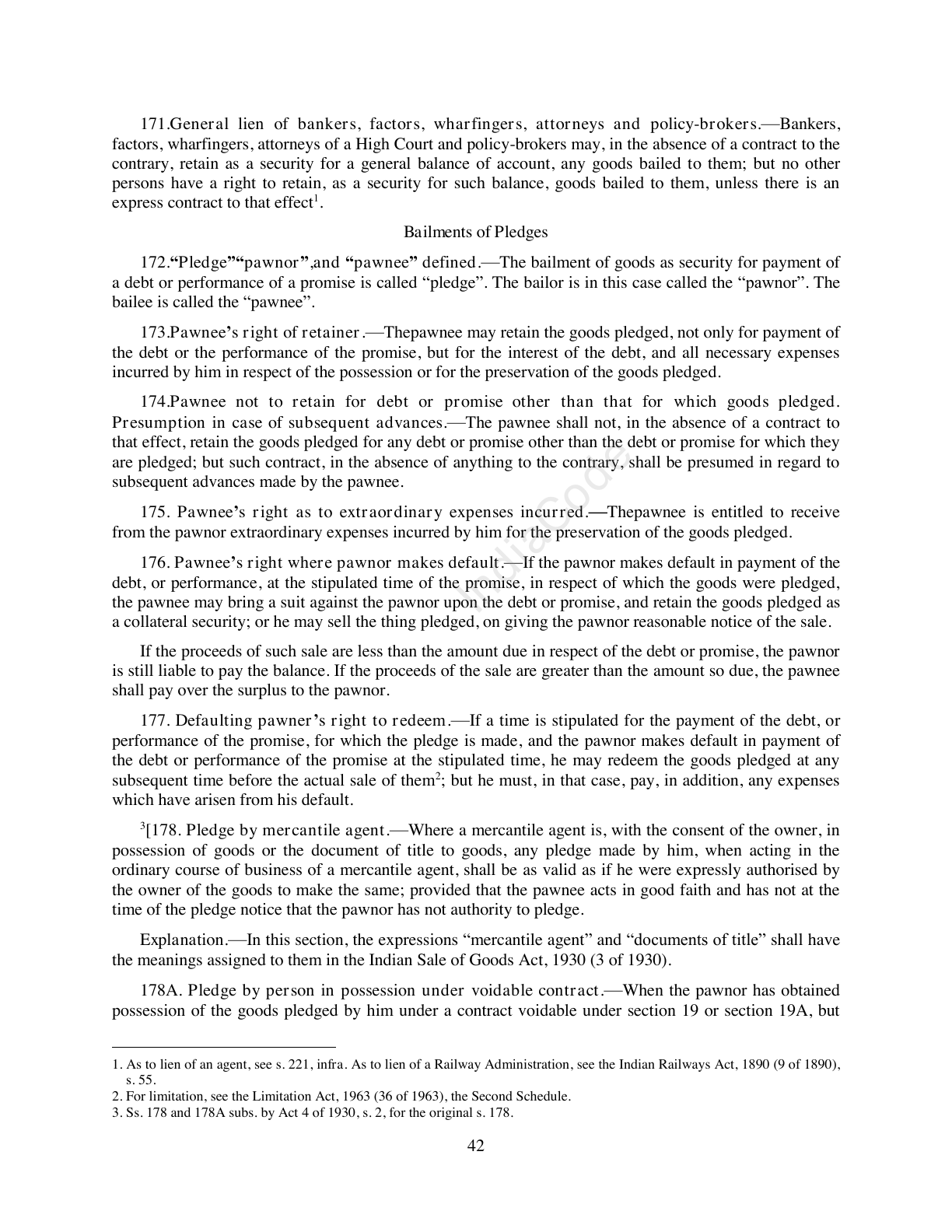
Full physical source page · unreviewed extraction
The Indian Contract Act, 1872: page 42
The Indian Contract Act, 1872, India Code delivered snapshot 85a7a066098255c9, physical page 42. Unreviewed extraction.
Source: official India Code PDF · catalog record. Fetched 2026-10-19T23:06:49Z. SHA-256 85a7a066098255c93001d678aeaf483f91d3080918363c03b78d40c3eeb8b386.
Legal currency, territorial applicability and extraction fidelity are unverified. Catalog checksum/size differs from the delivered PDF; both identities are retained. Sections, state notes and footnotes share these physical pages. Compare the full original image.
Retained layout text
    171.General lien of bankers, factors, wharfingers, attorneys and policy-brokers.—Bankers,
factors, wharfingers, attorneys of a High Court and policy-brokers may, in the absence of a contract to the
contrary, retain as a security for a general balance of account, any goods bailed to them; but no other
persons have a right to retain, as a security for such balance, goods bailed to them, unless there is an
express contract to that effect1.
                                                    Bailments of Pledges
    172.“Pledge”“pawnor”,and “pawnee” defined.—The bailment of goods as security for payment of
a debt or performance of a promise is called “pledge”. The bailor is in this case called the “pawnor”. The
bailee is called the “pawnee”.
    173.Pawnee’s right of retainer.—Thepawnee may retain the goods pledged, not only for payment of
the debt or the performance of the promise, but for the interest of the debt, and all necessary expenses
incurred by him in respect of the possession or for the preservation of the goods pledged.
     174.Pawnee not to retain for debt or promise other than that for which goods pledged.
Presumption in case of subsequent advances.—The pawnee shall not, in the absence of a contract to
that effect, retain the goods pledged for any debt or promise other than the debt or promise for which they
are pledged; but such contract, in the absence of anything to the contrary, shall be presumed in regard to
                                                                                     e
subsequent advances made by the pawnee.
                                                                              od
    175. Pawnee’s right as to extraordinary expenses incurred.—Thepawnee is entitled to receive
                                                                      aC
from the pawnor extraordinary expenses incurred by him for the preservation of the goods pledged.
    176. Pawnee’s right where pawnor makes default.—If the pawnor makes default in payment of the
                                                                 di
debt, or performance, at the stipulated time of the promise, in respect of which the goods were pledged,
                                                           In
the pawnee may bring a suit against the pawnor upon the debt or promise, and retain the goods pledged as
a collateral security; or he may sell the thing pledged, on giving the pawnor reasonable notice of the sale.
     If the proceeds of such sale are less than the amount due in respect of the debt or promise, the pawnor
is still liable to pay the balance. If the proceeds of the sale are greater than the amount so due, the pawnee
shall pay over the surplus to the pawnor.
    177. Defaulting pawner’s right to redeem.—If a time is stipulated for the payment of the debt, or
performance of the promise, for which the pledge is made, and the pawnor makes default in payment of
the debt or performance of the promise at the stipulated time, he may redeem the goods pledged at any
subsequent time before the actual sale of them2; but he must, in that case, pay, in addition, any expenses
which have arisen from his default.
     [178. Pledge by mercantile agent.—Where a mercantile agent is, with the consent of the owner, in
     3

possession of goods or the document of title to goods, any pledge made by him, when acting in the
ordinary course of business of a mercantile agent, shall be as valid as if he were expressly authorised by
the owner of the goods to make the same; provided that the pawnee acts in good faith and has not at the
time of the pledge notice that the pawnor has not authority to pledge.
    Explanation.—In this section, the expressions “mercantile agent” and “documents of title” shall have
the meanings assigned to them in the Indian Sale of Goods Act, 1930 (3 of 1930).
    178A. Pledge by person in possession under voidable contract.—When the pawnor has obtained
possession of the goods pledged by him under a contract voidable under section 19 or section 19A, but


1. As to lien of an agent, see s. 221, infra. As to lien of a Railway Administration, see the Indian Railways Act, 1890 (9 of 1890),
   s. 55.
2. For limitation, see the Limitation Act, 1963 (36 of 1963), the Second Schedule.
3. Ss. 178 and 178A subs. by Act 4 of 1930, s. 2, for the original s. 178.

                                                                42
Compare original page image