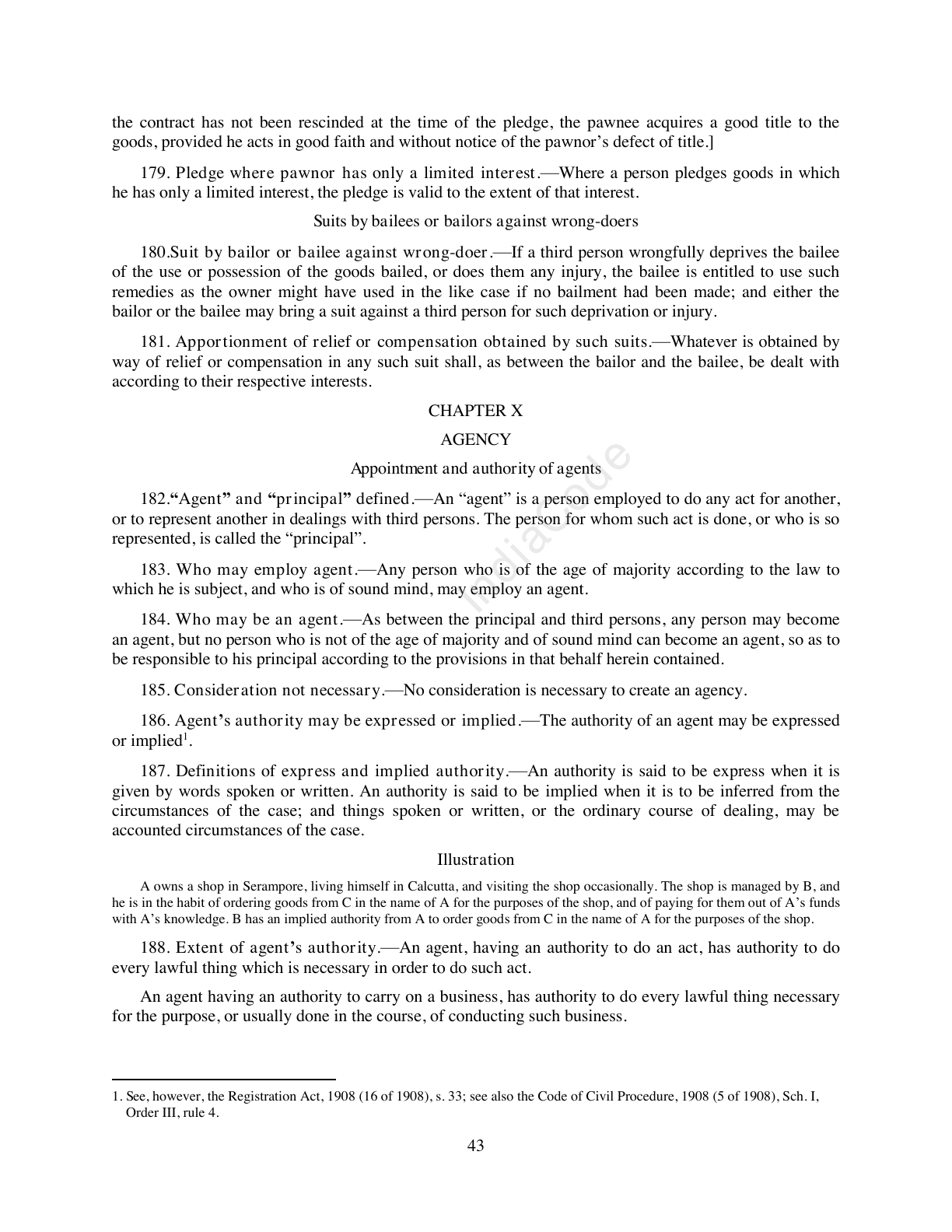
Full physical source page · unreviewed extraction
The Indian Contract Act, 1872: page 43
The Indian Contract Act, 1872, India Code delivered snapshot 85a7a066098255c9, physical page 43. Unreviewed extraction.
Source: official India Code PDF · catalog record. Fetched 2026-10-19T23:06:49Z. SHA-256 85a7a066098255c93001d678aeaf483f91d3080918363c03b78d40c3eeb8b386.
Legal currency, territorial applicability and extraction fidelity are unverified. Catalog checksum/size differs from the delivered PDF; both identities are retained. Sections, state notes and footnotes share these physical pages. Compare the full original image.
Retained layout text
the contract has not been rescinded at the time of the pledge, the pawnee acquires a good title to the
goods, provided he acts in good faith and without notice of the pawnor’s defect of title.]
    179. Pledge where pawnor has only a limited interest.—Where a person pledges goods in which
he has only a limited interest, the pledge is valid to the extent of that interest.
                                    Suits by bailees or bailors against wrong-doers
    180.Suit by bailor or bailee against wrong-doer.—If a third person wrongfully deprives the bailee
of the use or possession of the goods bailed, or does them any injury, the bailee is entitled to use such
remedies as the owner might have used in the like case if no bailment had been made; and either the
bailor or the bailee may bring a suit against a third person for such deprivation or injury.
    181. Apportionment of relief or compensation obtained by such suits.—Whatever is obtained by
way of relief or compensation in any such suit shall, as between the bailor and the bailee, be dealt with
according to their respective interests.
                                                         CHAPTER X
                                                           AGENCY
                                           Appointment and authority of agents       e
                                                                              od
     182.“Agent” and “principal” defined.—An “agent” is a person employed to do any act for another,
or to represent another in dealings with third persons. The person for whom such act is done, or who is so
represented, is called the “principal”.                               aC
                                                                 di
   183. Who may employ agent.—Any person who is of the age of majority according to the law to
which he is subject, and who is of sound mind, may employ an agent.
                                                           In
    184. Who may be an agent.—As between the principal and third persons, any person may become
an agent, but no person who is not of the age of majority and of sound mind can become an agent, so as to
be responsible to his principal according to the provisions in that behalf herein contained.
     185. Consideration not necessary.—No consideration is necessary to create an agency.
    186. Agent’s authority may be expressed or implied.—The authority of an agent may be expressed
or implied1.
    187. Definitions of express and implied authority.—An authority is said to be express when it is
given by words spoken or written. An authority is said to be implied when it is to be inferred from the
circumstances of the case; and things spoken or written, or the ordinary course of dealing, may be
accounted circumstances of the case.
                                                          Illustration
      A owns a shop in Serampore, living himself in Calcutta, and visiting the shop occasionally. The shop is managed by B, and
he is in the habit of ordering goods from C in the name of A for the purposes of the shop, and of paying for them out of A’s funds
with A’s knowledge. B has an implied authority from A to order goods from C in the name of A for the purposes of the shop.

    188. Extent of agent’s authority.—An agent, having an authority to do an act, has authority to do
every lawful thing which is necessary in order to do such act.
     An agent having an authority to carry on a business, has authority to do every lawful thing necessary
for the purpose, or usually done in the course, of conducting such business.


1. See, however, the Registration Act, 1908 (16 of 1908), s. 33; see also the Code of Civil Procedure, 1908 (5 of 1908), Sch. I,
   Order III, rule 4.

                                                                43
Compare original page image