Full physical source page · unreviewed extraction
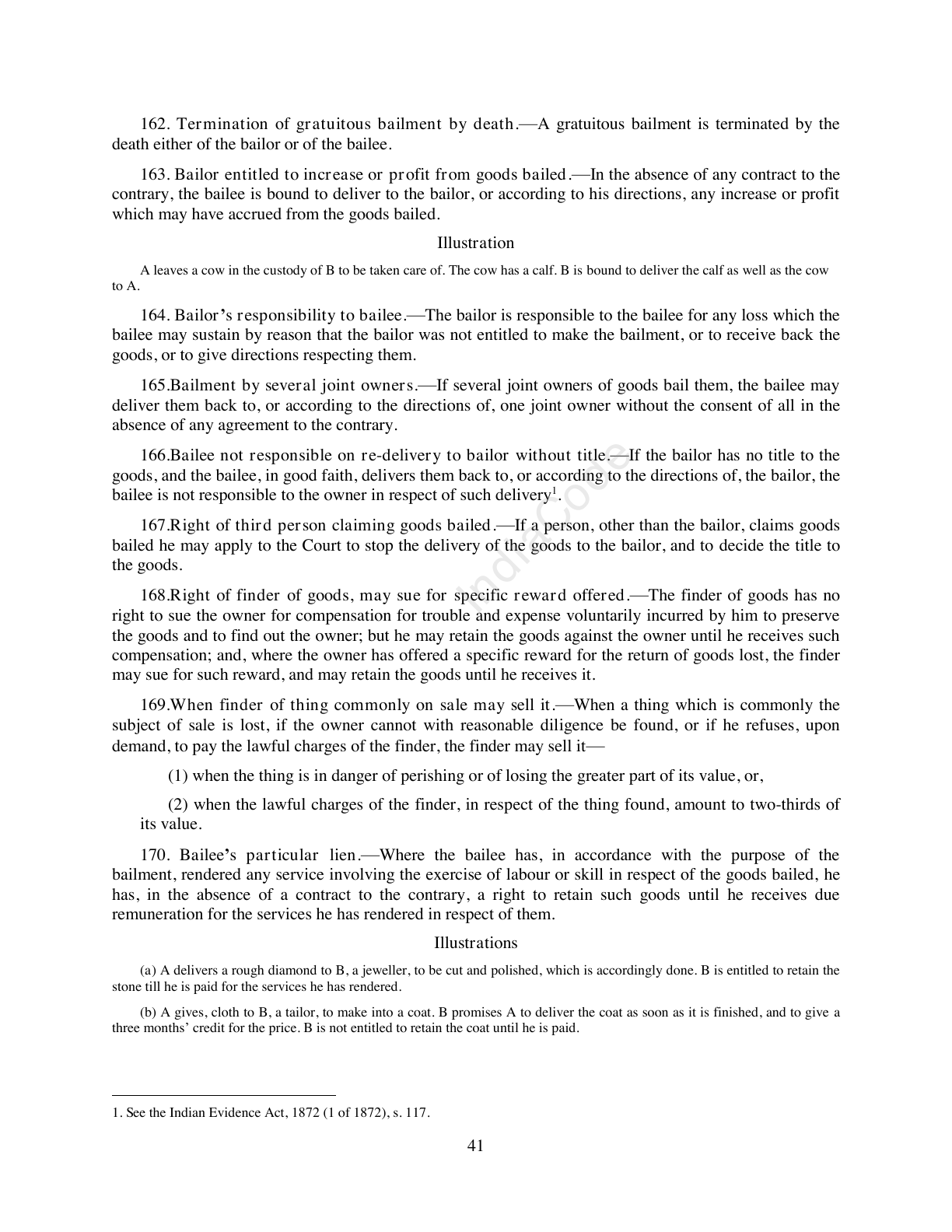
The Indian Contract Act, 1872: page 41
The Indian Contract Act, 1872, India Code delivered snapshot 85a7a066098255c9, physical page 41. Unreviewed extraction.
Source: official India Code PDF · catalog record. Fetched 2026-10-19T23:06:49Z. SHA-256 85a7a066098255c93001d678aeaf483f91d3080918363c03b78d40c3eeb8b386.
Legal currency, territorial applicability and extraction fidelity are unverified. Catalog checksum/size differs from the delivered PDF; both identities are retained. Sections, state notes and footnotes share these physical pages. Compare the full original image.
Retained layout text
    162. Termination of gratuitous bailment by death.—A gratuitous bailment is terminated by the
death either of the bailor or of the bailee.
    163. Bailor entitled to increase or profit from goods bailed.—In the absence of any contract to the
contrary, the bailee is bound to deliver to the bailor, or according to his directions, any increase or profit
which may have accrued from the goods bailed.
                                                             Illustration
        A leaves a cow in the custody of B to be taken care of. The cow has a calf. B is bound to deliver the calf as well as the cow
to A.

    164. Bailor’s responsibility to bailee.—The bailor is responsible to the bailee for any loss which the
bailee may sustain by reason that the bailor was not entitled to make the bailment, or to receive back the
goods, or to give directions respecting them.
    165.Bailment by several joint owners.—If several joint owners of goods bail them, the bailee may
deliver them back to, or according to the directions of, one joint owner without the consent of all in the
absence of any agreement to the contrary.
    166.Bailee not responsible on re-delivery to bailor without title.—If the bailor has no title to the
                                                                                        e
goods, and the bailee, in good faith, delivers them back to, or according to the directions of, the bailor, the
bailee is not responsible to the owner in respect of such delivery1.             od
    167.Right of third person claiming goods bailed.—If a person, other than the bailor, claims goods
                                                                         aC
bailed he may apply to the Court to stop the delivery of the goods to the bailor, and to decide the title to
the goods.                                                          di
    168.Right of finder of goods, may sue for specific reward offered.—The finder of goods has no
                                                              In
right to sue the owner for compensation for trouble and expense voluntarily incurred by him to preserve
the goods and to find out the owner; but he may retain the goods against the owner until he receives such
compensation; and, where the owner has offered a specific reward for the return of goods lost, the finder
may sue for such reward, and may retain the goods until he receives it.
    169.When finder of thing commonly on sale may sell it.—When a thing which is commonly the
subject of sale is lost, if the owner cannot with reasonable diligence be found, or if he refuses, upon
demand, to pay the lawful charges of the finder, the finder may sell it—
             (1) when the thing is in danger of perishing or of losing the greater part of its value, or,
             (2) when the lawful charges of the finder, in respect of the thing found, amount to two-thirds of
        its value.
    170. Bailee’s particular lien.—Where the bailee has, in accordance with the purpose of the
bailment, rendered any service involving the exercise of labour or skill in respect of the goods bailed, he
has, in the absence of a contract to the contrary, a right to retain such goods until he receives due
remuneration for the services he has rendered in respect of them.
                                                             Illustrations
     (a) A delivers a rough diamond to B, a jeweller, to be cut and polished, which is accordingly done. B is entitled to retain the
stone till he is paid for the services he has rendered.
     (b) A gives, cloth to B, a tailor, to make into a coat. B promises A to deliver the coat as soon as it is finished, and to give a
three months’ credit for the price. B is not entitled to retain the coat until he is paid.


1. See the Indian Evidence Act, 1872 (1 of 1872), s. 117.

                                                                   41
Compare original page image