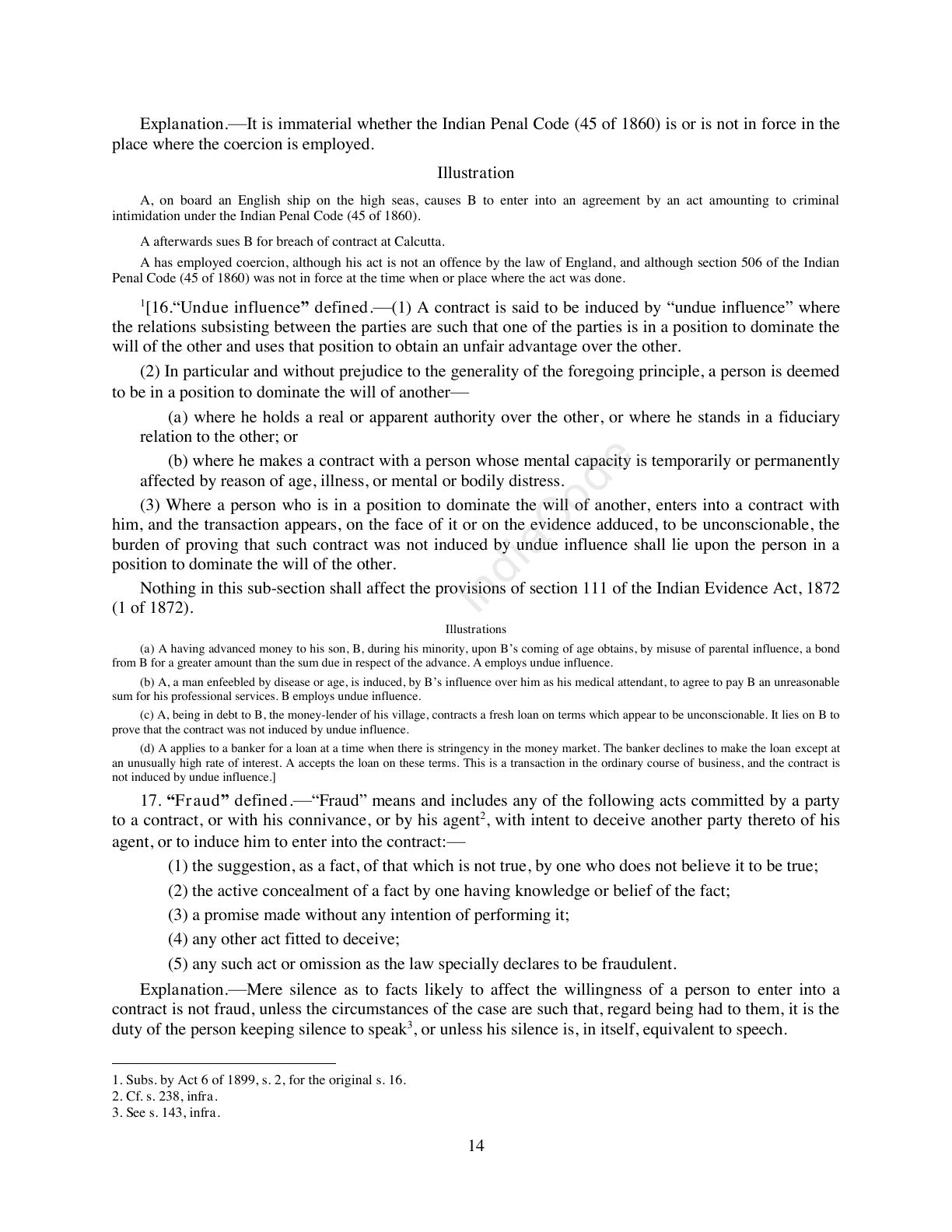
Full physical source page · unreviewed extraction
The Indian Contract Act, 1872: page 14
The Indian Contract Act, 1872, India Code delivered snapshot 85a7a066098255c9, physical page 14. Unreviewed extraction.
Source: official India Code PDF · catalog record. Fetched 2026-10-19T23:06:49Z. SHA-256 85a7a066098255c93001d678aeaf483f91d3080918363c03b78d40c3eeb8b386.
Legal currency, territorial applicability and extraction fidelity are unverified. Catalog checksum/size differs from the delivered PDF; both identities are retained. Sections, state notes and footnotes share these physical pages. Compare the full original image.
Retained layout text
    Explanation.—It is immaterial whether the Indian Penal Code (45 of 1860) is or is not in force in the
place where the coercion is employed.
                                                                  Illustration
     A, on board an English ship on the high seas, causes B to enter into an agreement by an act amounting to criminal
intimidation under the Indian Penal Code (45 of 1860).
    A afterwards sues B for breach of contract at Calcutta.
    A has employed coercion, although his act is not an offence by the law of England, and although section 506 of the Indian
Penal Code (45 of 1860) was not in force at the time when or place where the act was done.

     [16.“Undue influence” defined.—(1) A contract is said to be induced by “undue influence” where
     1

the relations subsisting between the parties are such that one of the parties is in a position to dominate the
will of the other and uses that position to obtain an unfair advantage over the other.
    (2) In particular and without prejudice to the generality of the foregoing principle, a person is deemed
to be in a position to dominate the will of another—
         (a) where he holds a real or apparent authority over the other, or where he stands in a fiduciary
    relation to the other; or
         (b) where he makes a contract with a person whose mental capacity is temporarily or permanently
                                                                                               e
    affected by reason of age, illness, or mental or bodily distress.
                                                                                       od
    (3) Where a person who is in a position to dominate the will of another, enters into a contract with
                                                                               aC
him, and the transaction appears, on the face of it or on the evidence adduced, to be unconscionable, the
burden of proving that such contract was not induced by undue influence shall lie upon the person in a
position to dominate the will of the other.                              di
    Nothing in this sub-section shall affect the provisions of section 111 of the Indian Evidence Act, 1872
(1 of 1872).                                                       In
                                                                   Illustrations
     (a) A having advanced money to his son, B, during his minority, upon B’s coming of age obtains, by misuse of parental influence, a bond
from B for a greater amount than the sum due in respect of the advance. A employs undue influence.
     (b) A, a man enfeebled by disease or age, is induced, by B’s influence over him as his medical attendant, to agree to pay B an unreasonable
sum for his professional services. B employs undue influence.
     (c) A, being in debt to B, the money-lender of his village, contracts a fresh loan on terms which appear to be unconscionable. It lies on B to
prove that the contract was not induced by undue influence.
      (d) A applies to a banker for a loan at a time when there is stringency in the money market. The banker declines to make the loan except at
an unusually high rate of interest. A accepts the loan on these terms. This is a transaction in the ordinary course of business, and the contract is
not induced by undue influence.]
    17. “Fraud” defined.—“Fraud” means and includes any of the following acts committed by a party
to a contract, or with his connivance, or by his agent2, with intent to deceive another party thereto of his
agent, or to induce him to enter into the contract:—
         (1) the suggestion, as a fact, of that which is not true, by one who does not believe it to be true;
         (2) the active concealment of a fact by one having knowledge or belief of the fact;
         (3) a promise made without any intention of performing it;
         (4) any other act fitted to deceive;
         (5) any such act or omission as the law specially declares to be fraudulent.
    Explanation.—Mere silence as to facts likely to affect the willingness of a person to enter into a
contract is not fraud, unless the circumstances of the case are such that, regard being had to them, it is the
duty of the person keeping silence to speak3, or unless his silence is, in itself, equivalent to speech.

1. Subs. by Act 6 of 1899, s. 2, for the original s. 16.
2. Cf. s. 238, infra.
3. See s. 143, infra.

                                                                        14
Compare original page image