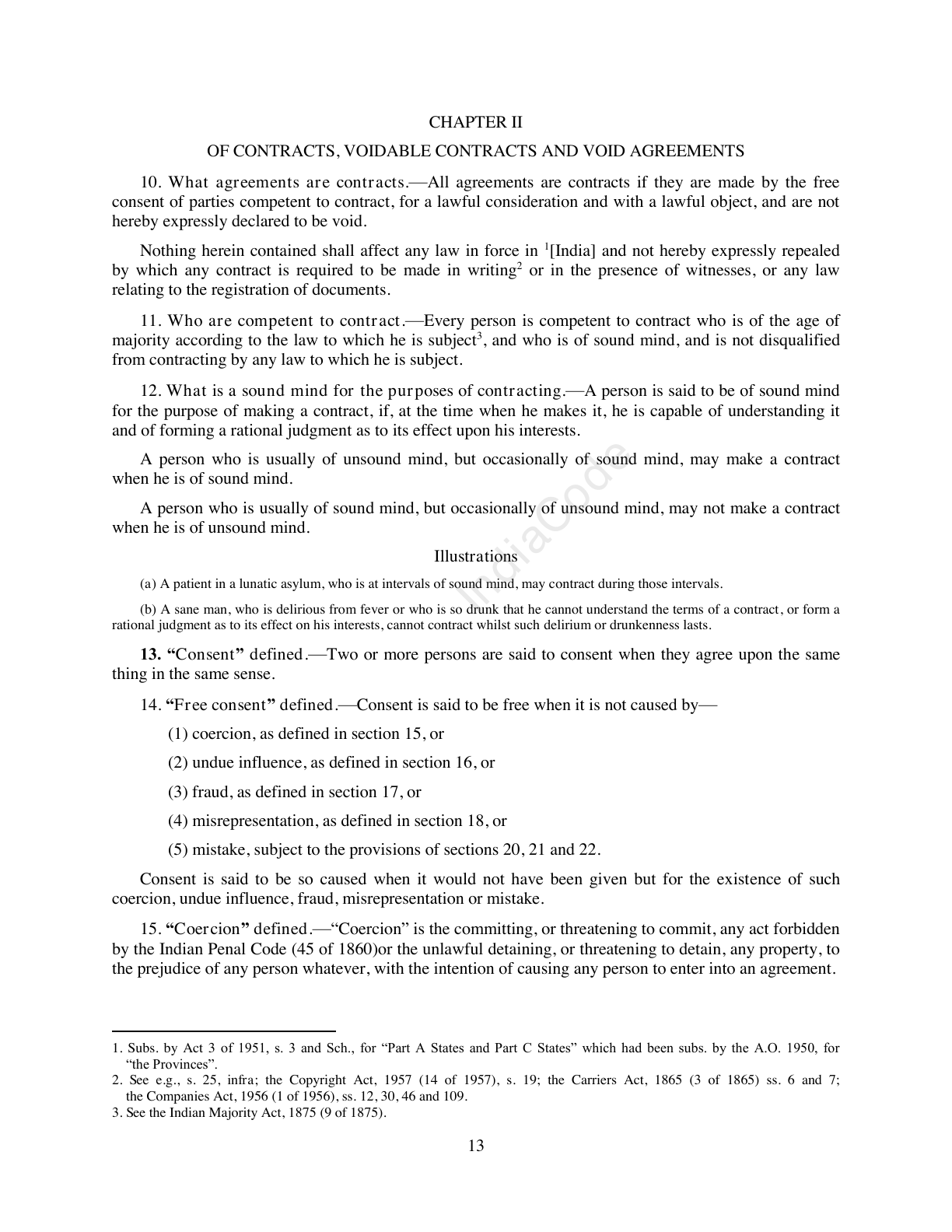
Full physical source page · unreviewed extraction
The Indian Contract Act, 1872: page 13
The Indian Contract Act, 1872, India Code delivered snapshot 85a7a066098255c9, physical page 13. Unreviewed extraction.
Source: official India Code PDF · catalog record. Fetched 2026-10-19T23:06:49Z. SHA-256 85a7a066098255c93001d678aeaf483f91d3080918363c03b78d40c3eeb8b386.
Legal currency, territorial applicability and extraction fidelity are unverified. Catalog checksum/size differs from the delivered PDF; both identities are retained. Sections, state notes and footnotes share these physical pages. Compare the full original image.
Retained layout text
                                                        CHAPTER II
                OF CONTRACTS, VOIDABLE CONTRACTS AND VOID AGREEMENTS
    10. What agreements are contracts.—All agreements are contracts if they are made by the free
consent of parties competent to contract, for a lawful consideration and with a lawful object, and are not
hereby expressly declared to be void.
    Nothing herein contained shall affect any law in force in 1[India] and not hereby expressly repealed
by which any contract is required to be made in writing2 or in the presence of witnesses, or any law
relating to the registration of documents.
    11. Who are competent to contract.—Every person is competent to contract who is of the age of
majority according to the law to which he is subject3, and who is of sound mind, and is not disqualified
from contracting by any law to which he is subject.
     12. What is a sound mind for the purposes of contracting.—A person is said to be of sound mind
for the purpose of making a contract, if, at the time when he makes it, he is capable of understanding it
and of forming a rational judgment as to its effect upon his interests.
   A person who is usually of unsound mind, but occasionally of sound mind, may make a contract
                                                                                    e
when he is of sound mind.
                                                                             od
   A person who is usually of sound mind, but occasionally of unsound mind, may not make a contract
when he is of unsound mind.                                          aC
                                                         Illustrations
                                                                di
    (a) A patient in a lunatic asylum, who is at intervals of sound mind, may contract during those intervals.
                                                           In
     (b) A sane man, who is delirious from fever or who is so drunk that he cannot understand the terms of a contract, or form a
rational judgment as to its effect on his interests, cannot contract whilst such delirium or drunkenness lasts.

    13. “Consent” defined.—Two or more persons are said to consent when they agree upon the same
thing in the same sense.
    14. “Free consent” defined.—Consent is said to be free when it is not caused by—
         (1) coercion, as defined in section 15, or
         (2) undue influence, as defined in section 16, or
         (3) fraud, as defined in section 17, or
         (4) misrepresentation, as defined in section 18, or
         (5) mistake, subject to the provisions of sections 20, 21 and 22.
    Consent is said to be so caused when it would not have been given but for the existence of such
coercion, undue influence, fraud, misrepresentation or mistake.
    15. “Coercion” defined.—“Coercion” is the committing, or threatening to commit, any act forbidden
by the Indian Penal Code (45 of 1860)or the unlawful detaining, or threatening to detain, any property, to
the prejudice of any person whatever, with the intention of causing any person to enter into an agreement.


1. Subs. by Act 3 of 1951, s. 3 and Sch., for “Part A States and Part C States” which had been subs. by the A.O. 1950, for
   “the Provinces”.
2. See e.g., s. 25, infra; the Copyright Act, 1957 (14 of 1957), s. 19; the Carriers Act, 1865 (3 of 1865) ss. 6 and 7;
   the Companies Act, 1956 (1 of 1956), ss. 12, 30, 46 and 109.
3. See the Indian Majority Act, 1875 (9 of 1875).

                                                               13
Compare original page image