Full physical source page · unreviewed extraction
The Indian Contract Act, 1872: page 12
The Indian Contract Act, 1872, India Code delivered snapshot 85a7a066098255c9, physical page 12. Unreviewed extraction.
Source: official India Code PDF · catalog record. Fetched 2026-10-19T23:06:49Z. SHA-256 85a7a066098255c93001d678aeaf483f91d3080918363c03b78d40c3eeb8b386.
Legal currency, territorial applicability and extraction fidelity are unverified. Catalog checksum/size differs from the delivered PDF; both identities are retained. Sections, state notes and footnotes share these physical pages. Compare the full original image.
Retained layout text
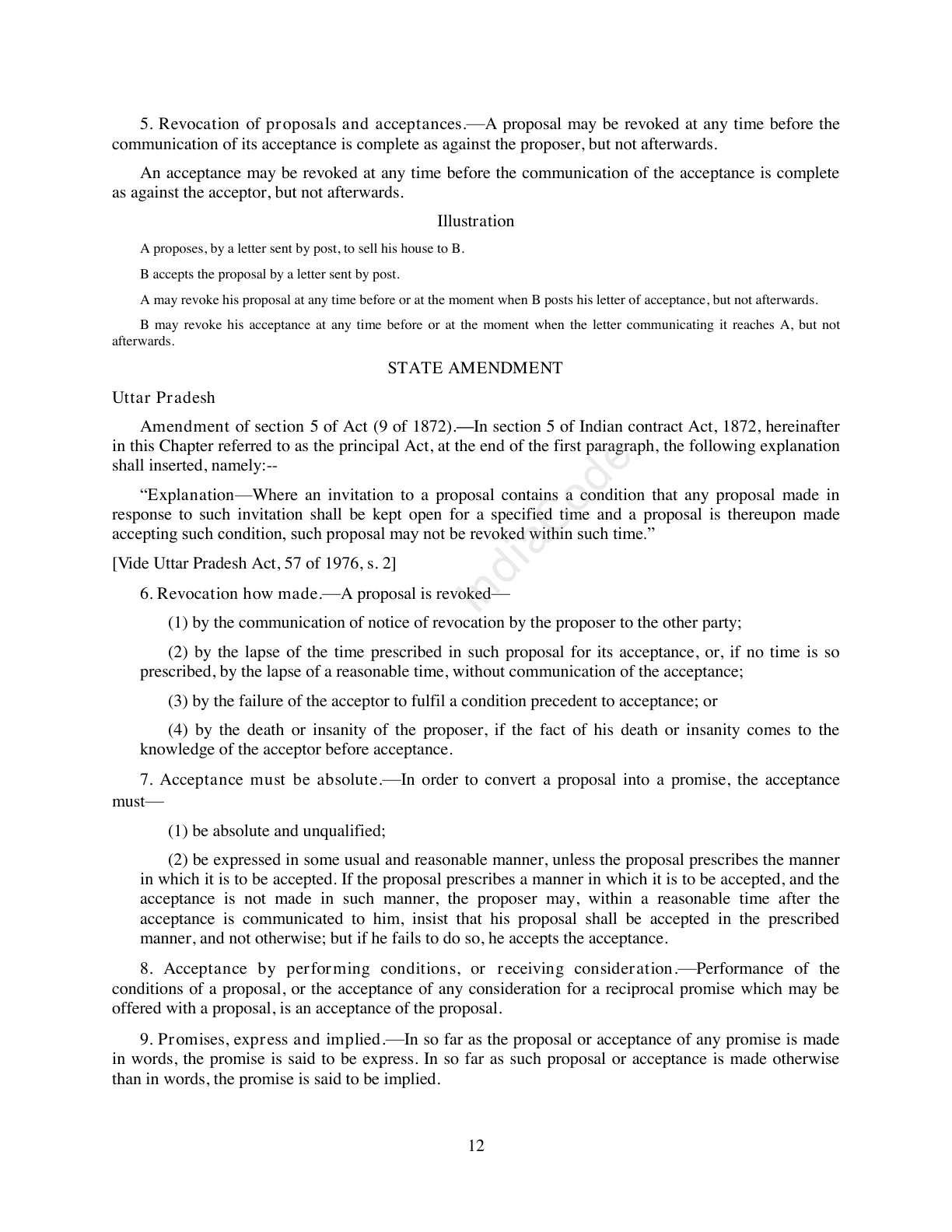
   5. Revocation of proposals and acceptances.—A proposal may be revoked at any time before the
communication of its acceptance is complete as against the proposer, but not afterwards.
    An acceptance may be revoked at any time before the communication of the acceptance is complete
as against the acceptor, but not afterwards.
                                                           Illustration
    A proposes, by a letter sent by post, to sell his house to B.
    B accepts the proposal by a letter sent by post.
    A may revoke his proposal at any time before or at the moment when B posts his letter of acceptance, but not afterwards.
     B may revoke his acceptance at any time before or at the moment when the letter communicating it reaches A, but not
afterwards.

                                                  STATE AMENDMENT
Uttar Pradesh
     Amendment of section 5 of Act (9 of 1872).—In section 5 of Indian contract Act, 1872, hereinafter
in this Chapter referred to as the principal Act, at the end of the first paragraph, the following explanation
shall inserted, namely:--                                                         e
                                                                           od
    “Explanation—Where an invitation to a proposal contains a condition that any proposal made in
response to such invitation shall be kept open for a specified time and a proposal is thereupon made
                                                                         aC
accepting such condition, such proposal may not be revoked within such time.”
[Vide Uttar Pradesh Act, 57 of 1976, s. 2]                          di
    6. Revocation how made.—A proposal is revoked—          In
         (1) by the communication of notice of revocation by the proposer to the other party;
        (2) by the lapse of the time prescribed in such proposal for its acceptance, or, if no time is so
    prescribed, by the lapse of a reasonable time, without communication of the acceptance;
         (3) by the failure of the acceptor to fulfil a condition precedent to acceptance; or
       (4) by the death or insanity of the proposer, if the fact of his death or insanity comes to the
    knowledge of the acceptor before acceptance.
   7. Acceptance must be absolute.—In order to convert a proposal into a promise, the acceptance
must—
         (1) be absolute and unqualified;
        (2) be expressed in some usual and reasonable manner, unless the proposal prescribes the manner
    in which it is to be accepted. If the proposal prescribes a manner in which it is to be accepted, and the
    acceptance is not made in such manner, the proposer may, within a reasonable time after the
    acceptance is communicated to him, insist that his proposal shall be accepted in the prescribed
    manner, and not otherwise; but if he fails to do so, he accepts the acceptance.
    8. Acceptance by performing conditions, or receiving consideration.—Performance of the
conditions of a proposal, or the acceptance of any consideration for a reciprocal promise which may be
offered with a proposal, is an acceptance of the proposal.
    9. Promises, express and implied.—In so far as the proposal or acceptance of any promise is made
in words, the promise is said to be express. In so far as such proposal or acceptance is made otherwise
than in words, the promise is said to be implied.


                                                                    12
Compare original page image