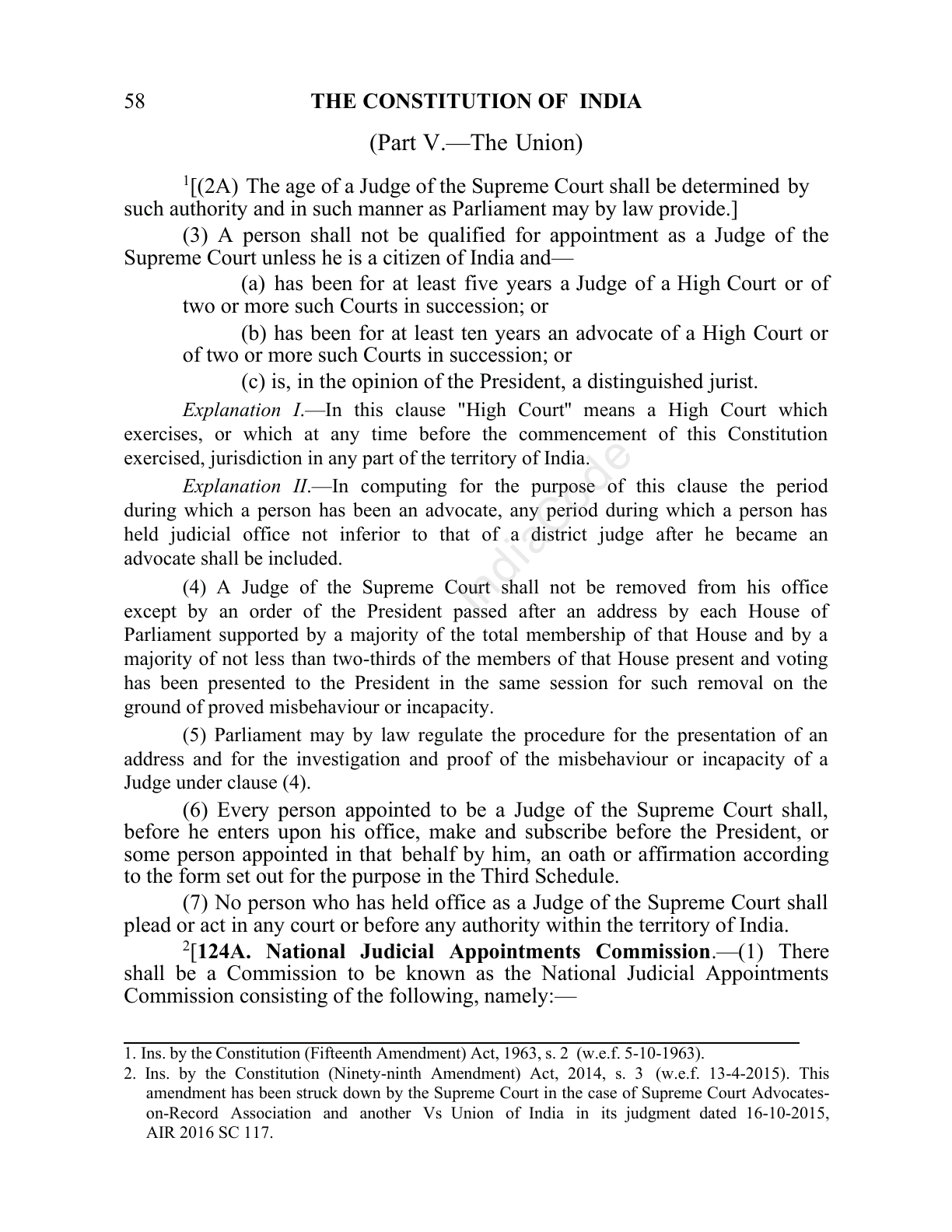
Full physical source page · unreviewed extraction
The Constitution of India in English 2026: page 89
The Constitution of India in English 2026, India Code delivered snapshot ed1820c0a1100c2c, physical page 89, typed edition 223d395df4de00897c78a4c0a752b32348d86f7c4f7013254fd4e03da46ceca0. Unreviewed extraction.
Source: official India Code PDF · catalog record. Fetched 2026-10-19T23:32:36Z. SHA-256 ed1820c0a1100c2c6aa8ece835a8c8a60f996ae7eba30cc1798233683c66cfba.
Legal currency, territorial applicability and extraction fidelity are unverified. Catalog checksum/size differs from the delivered PDF; both identities are retained. Articles, Schedule/appendix material and source footnotes share these physical pages. Compare the full original image.
Source cover/preface date: 10th September, 2026. Preface amendment statement: Constitution (One Hundred and Sixth Amendment) Act, 2023. Embedded PDF title: Constitution of India_ 20 MAY 2026 (final).pdf. These are distinct source labels, not currentness or commencement approval.
Retained layout text
58                       THE CONSTITUTION OF INDIA
                                 (Part V.—The Union)
       1
       [(2A) The age of a Judge of the Supreme Court shall be determined by
such authority and in such manner as Parliament may by law provide.]
      (3) A person shall not be qualified for appointment as a Judge of the
Supreme Court unless he is a citizen of India and—
             (a) has been for at least five years a Judge of a High Court or of
      two or more such Courts in succession; or
             (b) has been for at least ten years an advocate of a High Court or
      of two or more such Courts in succession; or
             (c) is, in the opinion of the President, a distinguished jurist.
       Explanation I.—In this clause "High Court'' means a High Court which
exercises, or which at any time before the commencement of this Constitution
exercised, jurisdiction in any part of the territory of India.
                                                             e
                                                        od
       Explanation II.—In computing for the purpose of this clause the period
during which a person has been an advocate, any period during which a person has
                                                  aC
held judicial office not inferior to that of a district judge after he became an
advocate shall be included.                   di
       (4) A Judge of the Supreme Court shall not be removed from his office
                                          In
except by an order of the President passed after an address by each House of
Parliament supported by a majority of the total membership of that House and by a
majority of not less than two-thirds of the members of that House present and voting
has been presented to the President in the same session for such removal on the
ground of proved misbehaviour or incapacity.
       (5) Parliament may by law regulate the procedure for the presentation of an
address and for the investigation and proof of the misbehaviour or incapacity of a
Judge under clause (4).
        (6) Every person appointed to be a Judge of the Supreme Court shall,
before he enters upon his office, make and subscribe before the President, or
some person appointed in that behalf by him, an oath or affirmation according
to the form set out for the purpose in the Third Schedule.
        (7) No person who has held office as a Judge of the Supreme Court shall
plead or act in any court or before any authority within the territory of India.
        2
          [124A. National Judicial Appointments Commission.—(1) There
shall be a Commission to be known as the National Judicial Appointments
Commission consisting of the following, namely:—

1. Ins. by the Constitution (Fifteenth Amendment) Act, 1963, s. 2 (w.e.f. 5-10-1963).
2. Ins. by the Constitution (Ninety-ninth Amendment) Act, 2014, s. 3 (w.e.f. 13-4-2015). This
    amendment has been struck down by the Supreme Court in the case of Supreme Court Advocates-
    on-Record Association and another Vs Union of India in its judgment dated 16-10-2015,
    AIR 2016 SC 117.
Compare original page image