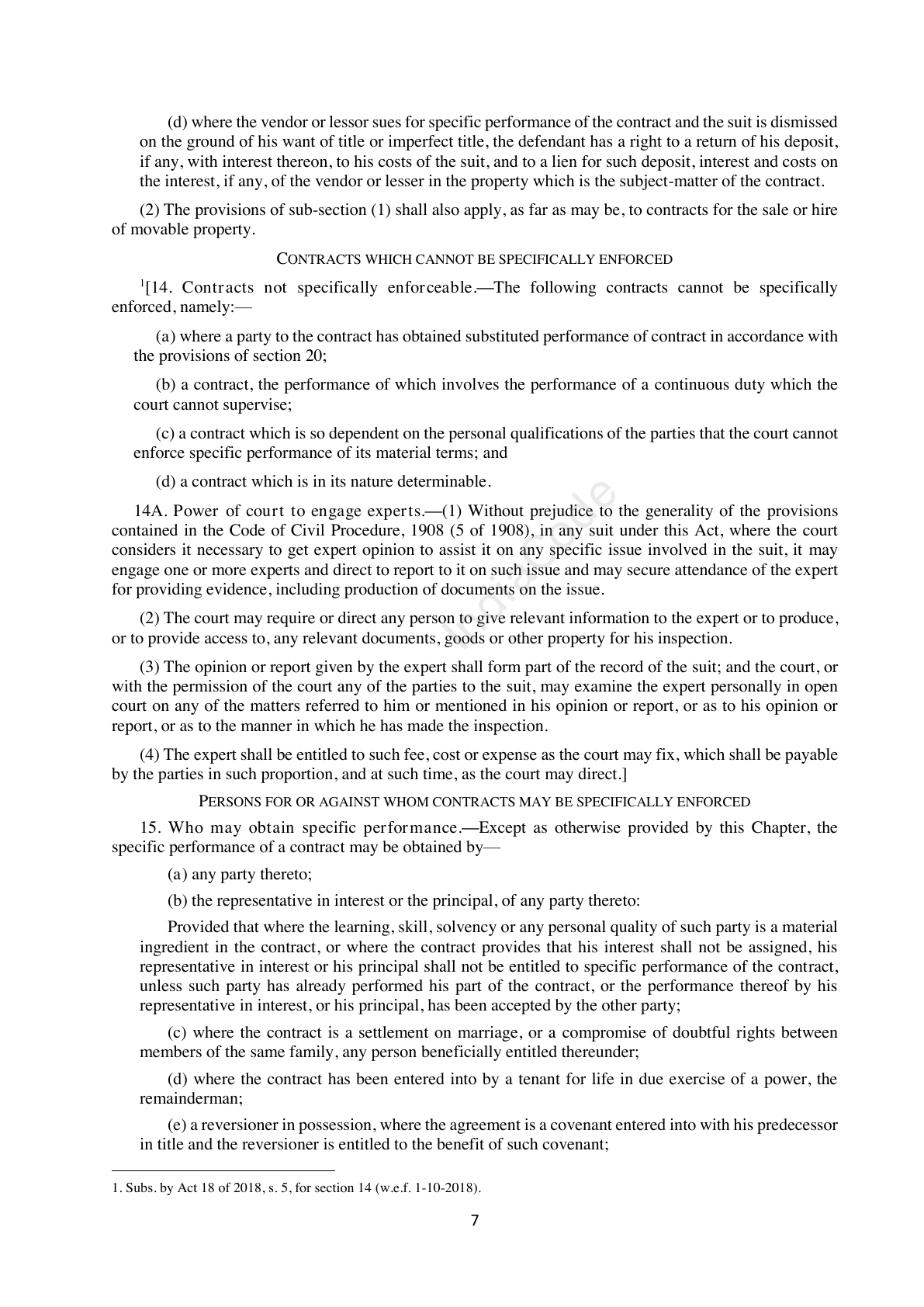
Full physical source page · unreviewed extraction
The Specific Relief Act, 1963: page 7
The Specific Relief Act, 1963, India Code delivered snapshot 6785305b261cbbde, physical page 7. Unreviewed extraction.
Source: official India Code PDF · catalog record. Fetched 2026-10-19T23:07:36Z. SHA-256 6785305b261cbbde103f8e68b6ace98dabc7a180b1eb621c94fa20186420939a.
Legal currency, territorial applicability and extraction fidelity are unverified. Catalog checksum/size differs from the delivered PDF; both identities are retained. Sections, state notes and footnotes share these physical pages. Compare the full original image.
Retained layout text
          (d) where the vendor or lessor sues for specific performance of the contract and the suit is dismissed
     on the ground of his want of title or imperfect title, the defendant has a right to a return of his deposit,
     if any, with interest thereon, to his costs of the suit, and to a lien for such deposit, interest and costs on
     the interest, if any, of the vendor or lesser in the property which is the subject-matter of the contract.
    (2) The provisions of sub-section (1) shall also apply, as far as may be, to contracts for the sale or hire
of movable property.
                              CONTRACTS WHICH CANNOT BE SPECIFICALLY ENFORCED
     1
     [14. Contracts not specifically enforceable.—The following contracts cannot be specifically
enforced, namely:—
       (a) where a party to the contract has obtained substituted performance of contract in accordance with
    the provisions of section 20;
       (b) a contract, the performance of which involves the performance of a continuous duty which the
    court cannot supervise;
       (c) a contract which is so dependent on the personal qualifications of the parties that the court cannot
    enforce specific performance of its material terms; and
         (d) a contract which is in its nature determinable.
                                                                            e
   14A. Power of court to engage experts.—(1) Without prejudice to the generality of the provisions
                                                                        od
contained in the Code of Civil Procedure, 1908 (5 of 1908), in any suit under this Act, where the court
considers it necessary to get expert opinion to assist it on any specific issue involved in the suit, it may
                                                                       aC
engage one or more experts and direct to report to it on such issue and may secure attendance of the expert
for providing evidence, including production of documents on the issue.
                                                               di
     (2) The court may require or direct any person to give relevant information to the expert or to produce,
                                                          In
or to provide access to, any relevant documents, goods or other property for his inspection.
    (3) The opinion or report given by the expert shall form part of the record of the suit; and the court, or
with the permission of the court any of the parties to the suit, may examine the expert personally in open
court on any of the matters referred to him or mentioned in his opinion or report, or as to his opinion or
report, or as to the manner in which he has made the inspection.
    (4) The expert shall be entitled to such fee, cost or expense as the court may fix, which shall be payable
by the parties in such proportion, and at such time, as the court may direct.]
                PERSONS FOR OR AGAINST WHOM CONTRACTS MAY BE SPECIFICALLY ENFORCED
    15. Who may obtain specific performance.—Except as otherwise provided by this Chapter, the
specific performance of a contract may be obtained by—
          (a) any party thereto;
          (b) the representative in interest or the principal, of any party thereto:
         Provided that where the learning, skill, solvency or any personal quality of such party is a material
     ingredient in the contract, or where the contract provides that his interest shall not be assigned, his
     representative in interest or his principal shall not be entitled to specific performance of the contract,
     unless such party has already performed his part of the contract, or the performance thereof by his
     representative in interest, or his principal, has been accepted by the other party;
        (c) where the contract is a settlement on marriage, or a compromise of doubtful rights between
     members of the same family, any person beneficially entitled thereunder;
        (d) where the contract has been entered into by a tenant for life in due exercise of a power, the
     remainderman;
          (e) a reversioner in possession, where the agreement is a covenant entered into with his predecessor
     in title and the reversioner is entitled to the benefit of such covenant;

1. Subs. by Act 18 of 2018, s. 5, for section 14 (w.e.f. 1-10-2018).

                                                                  7
Compare original page image