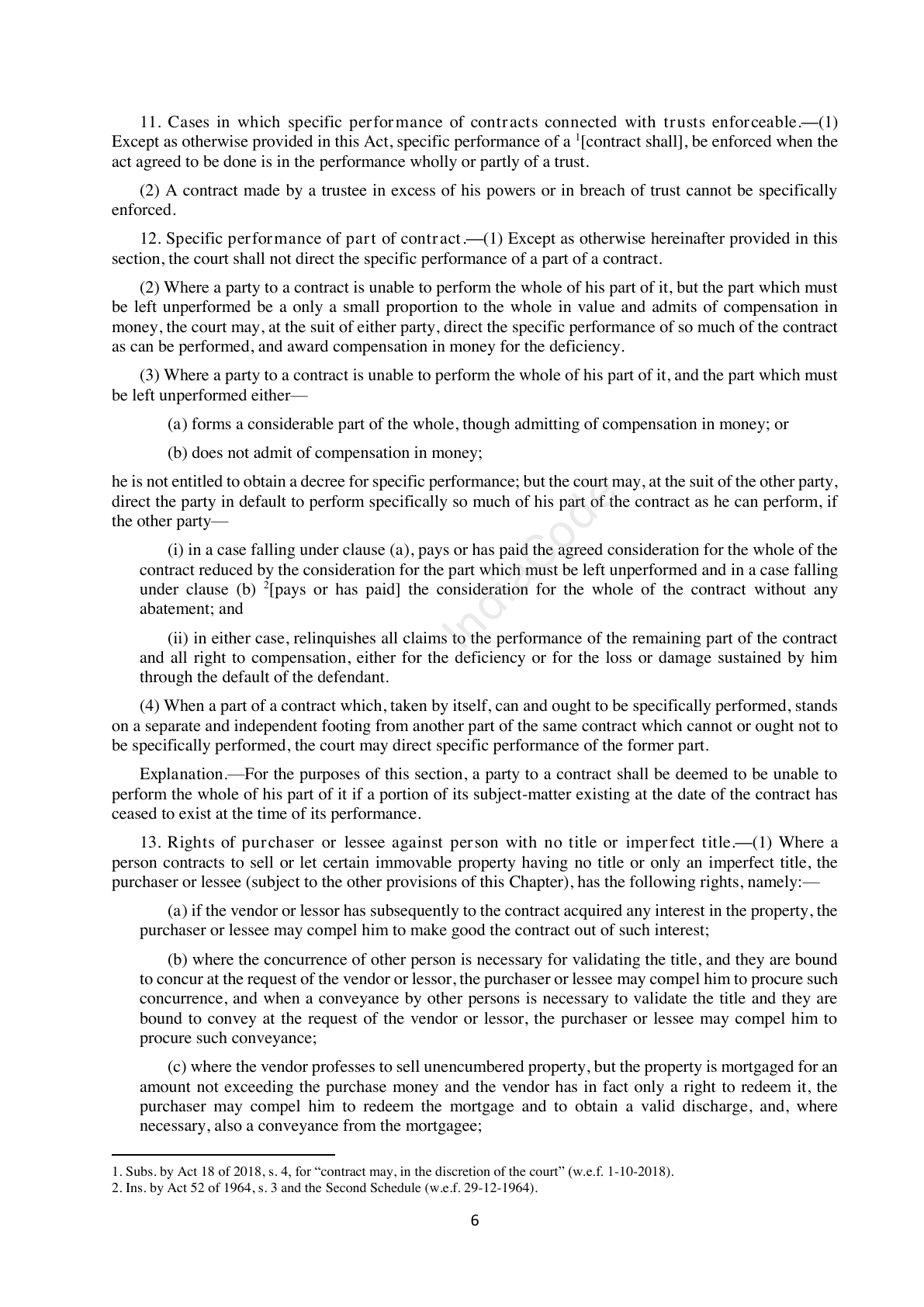
Full physical source page · unreviewed extraction
The Specific Relief Act, 1963: page 6
The Specific Relief Act, 1963, India Code delivered snapshot 6785305b261cbbde, physical page 6. Unreviewed extraction.
Source: official India Code PDF · catalog record. Fetched 2026-10-19T23:07:36Z. SHA-256 6785305b261cbbde103f8e68b6ace98dabc7a180b1eb621c94fa20186420939a.
Legal currency, territorial applicability and extraction fidelity are unverified. Catalog checksum/size differs from the delivered PDF; both identities are retained. Sections, state notes and footnotes share these physical pages. Compare the full original image.
Retained layout text
    11. Cases in which specific performance of contracts connected with trusts enforceable.—(1)
Except as otherwise provided in this Act, specific performance of a 1[contract shall], be enforced when the
act agreed to be done is in the performance wholly or partly of a trust.
    (2) A contract made by a trustee in excess of his powers or in breach of trust cannot be specifically
enforced.
    12. Specific performance of part of contract.—(1) Except as otherwise hereinafter provided in this
section, the court shall not direct the specific performance of a part of a contract.
    (2) Where a party to a contract is unable to perform the whole of his part of it, but the part which must
be left unperformed be a only a small proportion to the whole in value and admits of compensation in
money, the court may, at the suit of either party, direct the specific performance of so much of the contract
as can be performed, and award compensation in money for the deficiency.
    (3) Where a party to a contract is unable to perform the whole of his part of it, and the part which must
be left unperformed either—
          (a) forms a considerable part of the whole, though admitting of compensation in money; or
          (b) does not admit of compensation in money;
he is not entitled to obtain a decree for specific performance; but the court may, at the suit of the other party,
                                                                                    e
direct the party in default to perform specifically so much of his part of the contract as he can perform, if
the other party—                                                             od
         (i) in a case falling under clause (a), pays or has paid the agreed consideration for the whole of the
                                                                      aC
     contract reduced by the consideration for the part which must be left unperformed and in a case falling
     under clause (b) 2[pays or has paid] the consideration for the whole of the contract without any
     abatement; and                                            di
                                                          In
         (ii) in either case, relinquishes all claims to the performance of the remaining part of the contract
     and all right to compensation, either for the deficiency or for the loss or damage sustained by him
     through the default of the defendant.
    (4) When a part of a contract which, taken by itself, can and ought to be specifically performed, stands
on a separate and independent footing from another part of the same contract which cannot or ought not to
be specifically performed, the court may direct specific performance of the former part.
    Explanation.—For the purposes of this section, a party to a contract shall be deemed to be unable to
perform the whole of his part of it if a portion of its subject-matter existing at the date of the contract has
ceased to exist at the time of its performance.
    13. Rights of purchaser or lessee against person with no title or imperfect title.—(1) Where a
person contracts to sell or let certain immovable property having no title or only an imperfect title, the
purchaser or lessee (subject to the other provisions of this Chapter), has the following rights, namely:—
         (a) if the vendor or lessor has subsequently to the contract acquired any interest in the property, the
     purchaser or lessee may compel him to make good the contract out of such interest;
         (b) where the concurrence of other person is necessary for validating the title, and they are bound
     to concur at the request of the vendor or lessor, the purchaser or lessee may compel him to procure such
     concurrence, and when a conveyance by other persons is necessary to validate the title and they are
     bound to convey at the request of the vendor or lessor, the purchaser or lessee may compel him to
     procure such conveyance;
         (c) where the vendor professes to sell unencumbered property, but the property is mortgaged for an
     amount not exceeding the purchase money and the vendor has in fact only a right to redeem it, the
     purchaser may compel him to redeem the mortgage and to obtain a valid discharge, and, where
     necessary, also a conveyance from the mortgagee;

1. Subs. by Act 18 of 2018, s. 4, for “contract may, in the discretion of the court” (w.e.f. 1-10-2018).
2. Ins. by Act 52 of 1964, s. 3 and the Second Schedule (w.e.f. 29-12-1964).

                                                                  6
Compare original page image