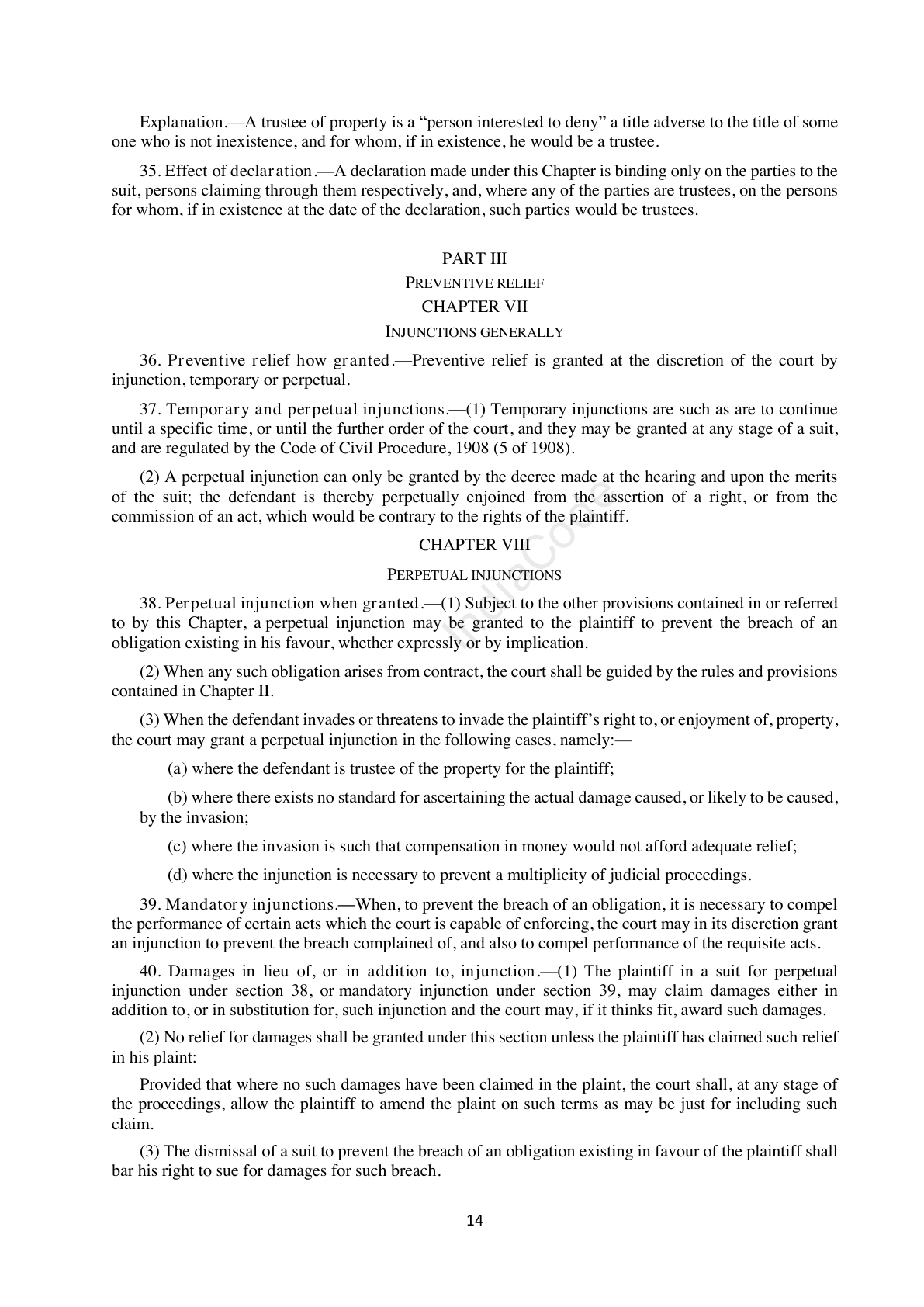
Full physical source page · unreviewed extraction
The Specific Relief Act, 1963: page 14
The Specific Relief Act, 1963, India Code delivered snapshot 6785305b261cbbde, physical page 14. Unreviewed extraction.
Source: official India Code PDF · catalog record. Fetched 2026-10-19T23:07:36Z. SHA-256 6785305b261cbbde103f8e68b6ace98dabc7a180b1eb621c94fa20186420939a.
Legal currency, territorial applicability and extraction fidelity are unverified. Catalog checksum/size differs from the delivered PDF; both identities are retained. Sections, state notes and footnotes share these physical pages. Compare the full original image.
Retained layout text
    Explanation.—A trustee of property is a “person interested to deny” a title adverse to the title of some
one who is not inexistence, and for whom, if in existence, he would be a trustee.
     35. Effect of declaration.—A declaration made under this Chapter is binding only on the parties to the
suit, persons claiming through them respectively, and, where any of the parties are trustees, on the persons
for whom, if in existence at the date of the declaration, such parties would be trustees.

                                                  PART III
                                             PREVENTIVE RELIEF
                                               CHAPTER VII
                                          INJUNCTIONS GENERALLY
    36. Preventive relief how granted.—Preventive relief is granted at the discretion of the court by
injunction, temporary or perpetual.
    37. Temporary and perpetual injunctions.—(1) Temporary injunctions are such as are to continue
until a specific time, or until the further order of the court, and they may be granted at any stage of a suit,
and are regulated by the Code of Civil Procedure, 1908 (5 of 1908).
    (2) A perpetual injunction can only be granted by the decree made at the hearing and upon the merits
of the suit; the defendant is thereby perpetually enjoined from the assertion of a right, or from the
                                                                      e
commission of an act, which would be contrary to the rights of the plaintiff.
                                               CHAPTER VIII
                                                                od
                                                           aC
                                          PERPETUAL INJUNCTIONS
                                                     di
    38. Perpetual injunction when granted.—(1) Subject to the other provisions contained in or referred
to by this Chapter, a perpetual injunction may be granted to the plaintiff to prevent the breach of an
                                                In
obligation existing in his favour, whether expressly or by implication.
    (2) When any such obligation arises from contract, the court shall be guided by the rules and provisions
contained in Chapter II.
    (3) When the defendant invades or threatens to invade the plaintiff’s right to, or enjoyment of, property,
the court may grant a perpetual injunction in the following cases, namely:—
        (a) where the defendant is trustee of the property for the plaintiff;
        (b) where there exists no standard for ascertaining the actual damage caused, or likely to be caused,
    by the invasion;
        (c) where the invasion is such that compensation in money would not afford adequate relief;
        (d) where the injunction is necessary to prevent a multiplicity of judicial proceedings.
    39. Mandatory injunctions.—When, to prevent the breach of an obligation, it is necessary to compel
the performance of certain acts which the court is capable of enforcing, the court may in its discretion grant
an injunction to prevent the breach complained of, and also to compel performance of the requisite acts.
    40. Damages in lieu of, or in addition to, injunction.—(1) The plaintiff in a suit for perpetual
injunction under section 38, or mandatory injunction under section 39, may claim damages either in
addition to, or in substitution for, such injunction and the court may, if it thinks fit, award such damages.
    (2) No relief for damages shall be granted under this section unless the plaintiff has claimed such relief
in his plaint:
    Provided that where no such damages have been claimed in the plaint, the court shall, at any stage of
the proceedings, allow the plaintiff to amend the plaint on such terms as may be just for including such
claim.
    (3) The dismissal of a suit to prevent the breach of an obligation existing in favour of the plaintiff shall
bar his right to sue for damages for such breach.

                                                      14
Compare original page image