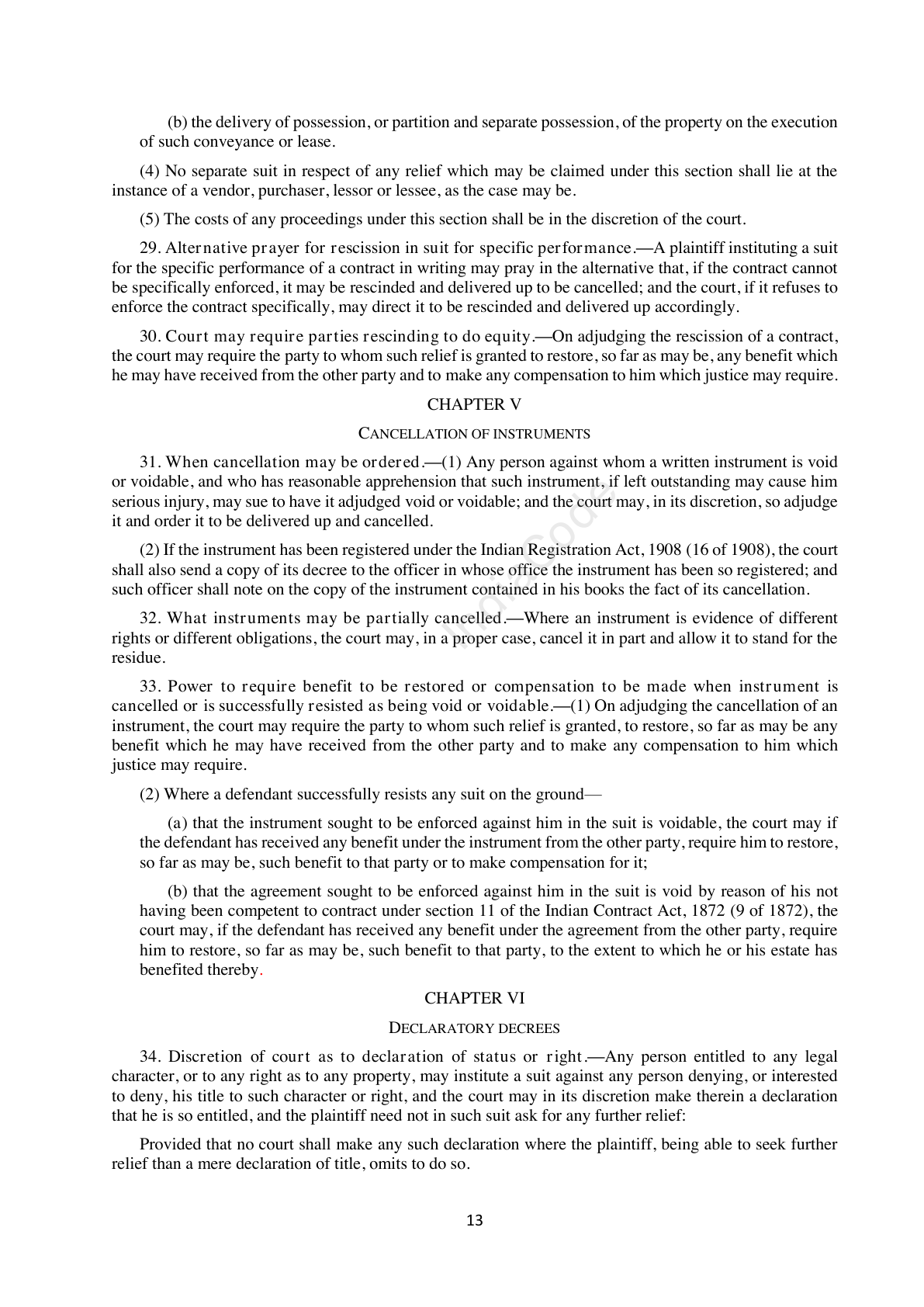
Full physical source page · unreviewed extraction
The Specific Relief Act, 1963: page 13
The Specific Relief Act, 1963, India Code delivered snapshot 6785305b261cbbde, physical page 13. Unreviewed extraction.
Source: official India Code PDF · catalog record. Fetched 2026-10-19T23:07:36Z. SHA-256 6785305b261cbbde103f8e68b6ace98dabc7a180b1eb621c94fa20186420939a.
Legal currency, territorial applicability and extraction fidelity are unverified. Catalog checksum/size differs from the delivered PDF; both identities are retained. Sections, state notes and footnotes share these physical pages. Compare the full original image.
Retained layout text
        (b) the delivery of possession, or partition and separate possession, of the property on the execution
    of such conveyance or lease.
    (4) No separate suit in respect of any relief which may be claimed under this section shall lie at the
instance of a vendor, purchaser, lessor or lessee, as the case may be.
    (5) The costs of any proceedings under this section shall be in the discretion of the court.
     29. Alternative prayer for rescission in suit for specific performance.—A plaintiff instituting a suit
for the specific performance of a contract in writing may pray in the alternative that, if the contract cannot
be specifically enforced, it may be rescinded and delivered up to be cancelled; and the court, if it refuses to
enforce the contract specifically, may direct it to be rescinded and delivered up accordingly.
    30. Court may require parties rescinding to do equity.—On adjudging the rescission of a contract,
the court may require the party to whom such relief is granted to restore, so far as may be, any benefit which
he may have received from the other party and to make any compensation to him which justice may require.
                                                 CHAPTER V
                                      CANCELLATION OF INSTRUMENTS
     31. When cancellation may be ordered.—(1) Any person against whom a written instrument is void
or voidable, and who has reasonable apprehension that such instrument, if left outstanding may cause him
                                                                       e
serious injury, may sue to have it adjudged void or voidable; and the court may, in its discretion, so adjudge
it and order it to be delivered up and cancelled.               od
    (2) If the instrument has been registered under the Indian Registration Act, 1908 (16 of 1908), the court
                                                            aC
shall also send a copy of its decree to the officer in whose office the instrument has been so registered; and
such officer shall note on the copy of the instrument contained in his books the fact of its cancellation.
                                                     di
    32. What instruments may be partially cancelled.—Where an instrument is evidence of different
                                                 In
rights or different obligations, the court may, in a proper case, cancel it in part and allow it to stand for the
residue.
     33. Power to require benefit to be restored or compensation to be made when instrument is
cancelled or is successfully resisted as being void or voidable.—(1) On adjudging the cancellation of an
instrument, the court may require the party to whom such relief is granted, to restore, so far as may be any
benefit which he may have received from the other party and to make any compensation to him which
justice may require.
    (2) Where a defendant successfully resists any suit on the ground—
        (a) that the instrument sought to be enforced against him in the suit is voidable, the court may if
    the defendant has received any benefit under the instrument from the other party, require him to restore,
    so far as may be, such benefit to that party or to make compensation for it;
        (b) that the agreement sought to be enforced against him in the suit is void by reason of his not
    having been competent to contract under section 11 of the Indian Contract Act, 1872 (9 of 1872), the
    court may, if the defendant has received any benefit under the agreement from the other party, require
    him to restore, so far as may be, such benefit to that party, to the extent to which he or his estate has
    benefited thereby.
                                                CHAPTER VI
                                           DECLARATORY DECREES
     34. Discretion of court as to declaration of status or right.—Any person entitled to any legal
character, or to any right as to any property, may institute a suit against any person denying, or interested
to deny, his title to such character or right, and the court may in its discretion make therein a declaration
that he is so entitled, and the plaintiff need not in such suit ask for any further relief:
     Provided that no court shall make any such declaration where the plaintiff, being able to seek further
relief than a mere declaration of title, omits to do so.


                                                       13
Compare original page image