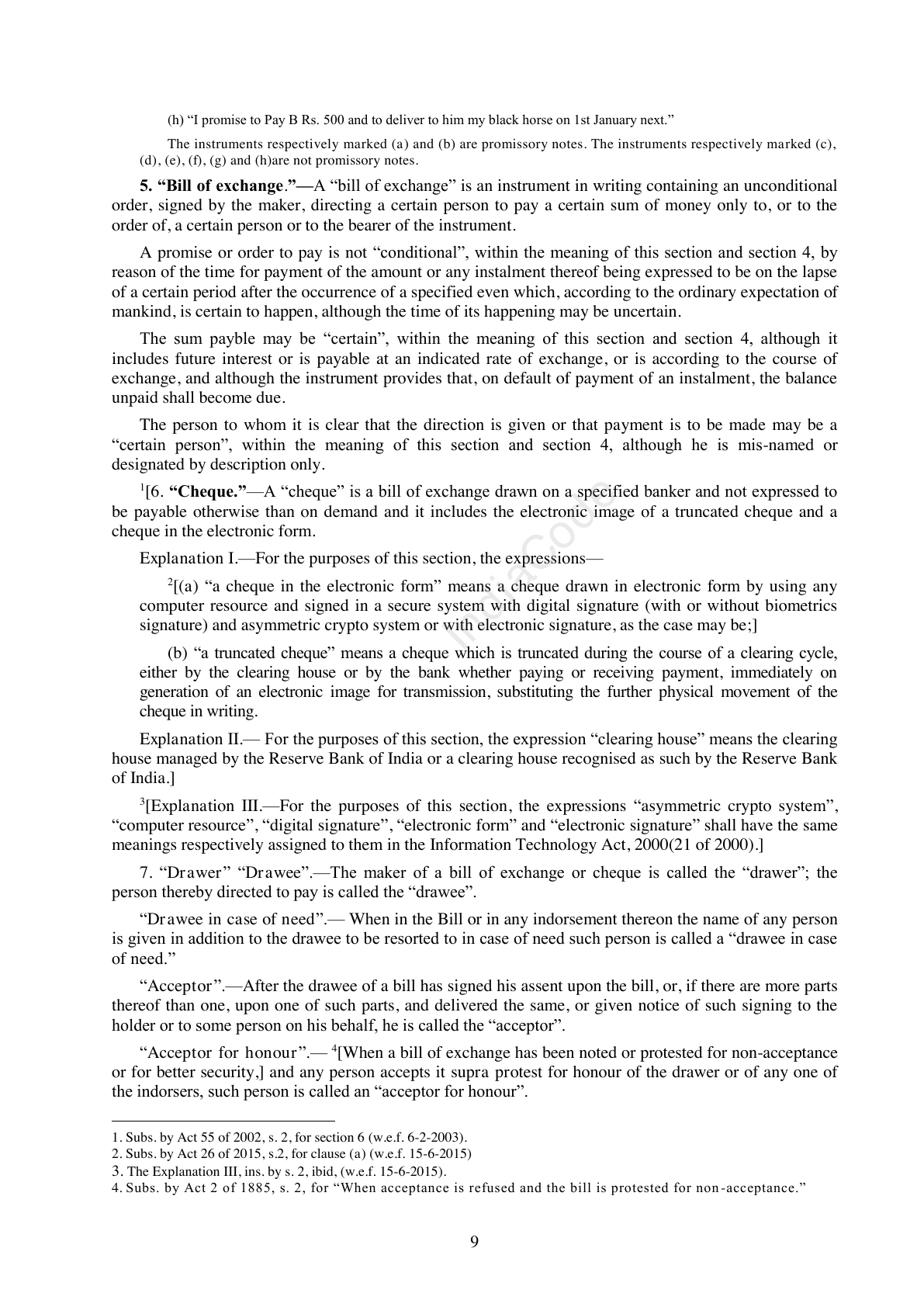
Full physical source page · unreviewed extraction
The Negotiable Instruments Act, 1881: page 9
The Negotiable Instruments Act, 1881, India Code delivered snapshot ed3e9db7f37052a1, physical page 9. Unreviewed extraction.
Source: official India Code PDF · catalog record. Fetched 2026-10-19T23:07:34Z. SHA-256 ed3e9db7f37052a1bc1cd665500910c5e123de888bce0375585e9a766bf38501.
Legal currency, territorial applicability and extraction fidelity are unverified. Catalog checksum/size differs from the delivered PDF; both identities are retained. Sections, state notes and footnotes share these physical pages. Compare the full original image.
Retained layout text
         (h) “I promise to Pay B Rs. 500 and to deliver to him my black horse on 1st January next.”
          The instruments respectively marked (a) and (b) are promissory notes. The instruments respectively marked (c),
    (d), (e), (f), (g) and (h)are not promissory notes.
    5. “Bill of exchange.”—A “bill of exchange” is an instrument in writing containing an unconditional
order, signed by the maker, directing a certain person to pay a certain sum of money only to, or to the
order of, a certain person or to the bearer of the instrument.
    A promise or order to pay is not “conditional”, within the meaning of this section and section 4, by
reason of the time for payment of the amount or any instalment thereof being expressed to be on the lapse
of a certain period after the occurrence of a specified even which, according to the ordinary expectation of
mankind, is certain to happen, although the time of its happening may be uncertain.
    The sum payble may be “certain”, within the meaning of this section and section 4, although it
includes future interest or is payable at an indicated rate of exchange, or is according to the course of
exchange, and although the instrument provides that, on default of payment of an instalment, the balance
unpaid shall become due.
    The person to whom it is clear that the direction is given or that payment is to be made may be a
“certain person”, within the meaning of this section and section 4, although he is mis-named or
designated by description only.
    [6. “Cheque.”—A “cheque” is a bill of exchange drawn on a specified banker and not expressed to
    1
                                                                                e
be payable otherwise than on demand and it includes the electronic image of a truncated cheque and a
cheque in the electronic form.                                           od
    Explanation I.—For the purposes of this section, the expressions—
                                                                  aC
         [(a) “a cheque in the electronic form” means a cheque drawn in electronic form by using any
         2

                                                            di
    computer resource and signed in a secure system with digital signature (with or without biometrics
    signature) and asymmetric crypto system or with electronic signature, as the case may be;]
                                                       In
        (b) “a truncated cheque” means a cheque which is truncated during the course of a clearing cycle,
    either by the clearing house or by the bank whether paying or receiving payment, immediately on
    generation of an electronic image for transmission, substituting the further physical movement of the
    cheque in writing.
    Explanation II.— For the purposes of this section, the expression “clearing house” means the clearing
house managed by the Reserve Bank of India or a clearing house recognised as such by the Reserve Bank
of India.]
    [Explanation III.—For the purposes of this section, the expressions “asymmetric crypto system”,
    3

“computer resource”, “digital signature”, “electronic form” and “electronic signature” shall have the same
meanings respectively assigned to them in the Information Technology Act, 2000(21 of 2000).]
    7. “Drawer” “Drawee”.—The maker of a bill of exchange or cheque is called the “drawer”; the
person thereby directed to pay is called the “drawee”.
     “Drawee in case of need”.— When in the Bill or in any indorsement thereon the name of any person
is given in addition to the drawee to be resorted to in case of need such person is called a “drawee in case
of need.”
    “Acceptor”.—After the drawee of a bill has signed his assent upon the bill, or, if there are more parts
thereof than one, upon one of such parts, and delivered the same, or given notice of such signing to the
holder or to some person on his behalf, he is called the “acceptor”.
     “Acceptor for honour”.— 4[When a bill of exchange has been noted or protested for non-acceptance
or for better security,] and any person accepts it supra protest for honour of the drawer or of any one of
the indorsers, such person is called an “acceptor for honour”.

1. Subs. by Act 55 of 2002, s. 2, for section 6 (w.e.f. 6-2-2003).
2. Subs. by Act 26 of 2015, s.2, for clause (a) (w.e.f. 15-6-2015)
3. The Explanation III, ins. by s. 2, ibid, (w.e.f. 15-6-2015).
4. Subs. by Act 2 of 1885, s. 2, for “When acceptance is refused and the bill is protested for non -acceptance.”


                                                              9
Compare original page image