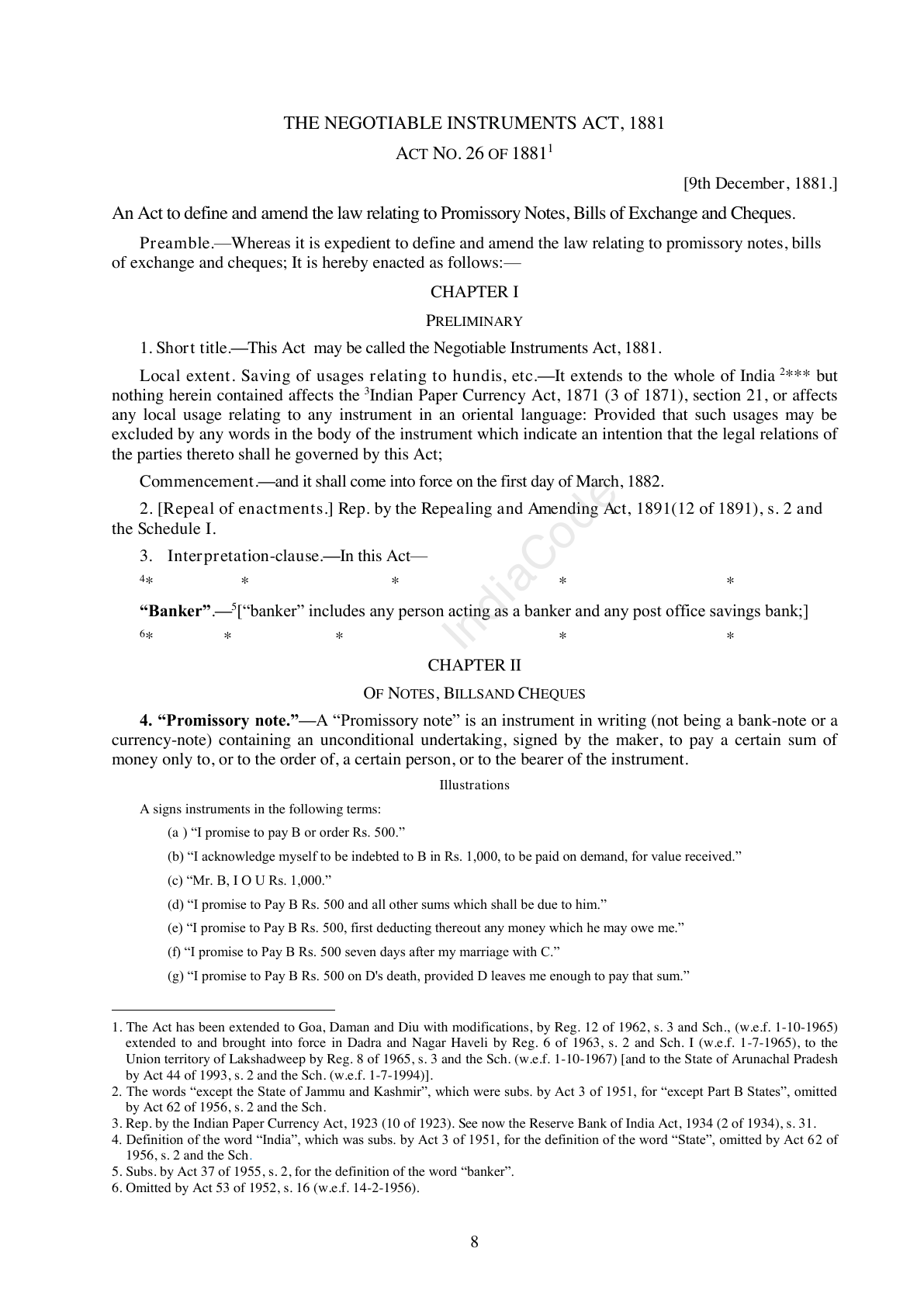
Full physical source page · unreviewed extraction
The Negotiable Instruments Act, 1881: page 8
The Negotiable Instruments Act, 1881, India Code delivered snapshot ed3e9db7f37052a1, physical page 8. Unreviewed extraction.
Source: official India Code PDF · catalog record. Fetched 2026-10-19T23:07:34Z. SHA-256 ed3e9db7f37052a1bc1cd665500910c5e123de888bce0375585e9a766bf38501.
Legal currency, territorial applicability and extraction fidelity are unverified. Catalog checksum/size differs from the delivered PDF; both identities are retained. Sections, state notes and footnotes share these physical pages. Compare the full original image.
Retained layout text
                              THE NEGOTIABLE INSTRUMENTS ACT, 1881
                                                  ACT NO. 26 OF 18811
                                                                                                     [9th December, 1881.]
An Act to define and amend the law relating to Promissory Notes, Bills of Exchange and Cheques.
    Preamble.—Whereas it is expedient to define and amend the law relating to promissory notes, bills
of exchange and cheques; It is hereby enacted as follows:—
                                                        CHAPTER I
                                                       PRELIMINARY
    1. Short title.—This Act may be called the Negotiable Instruments Act, 1881.
    Local extent. Saving of usages relating to hundis, etc.—It extends to the whole of India 2*** but
nothing herein contained affects the 3Indian Paper Currency Act, 1871 (3 of 1871), section 21, or affects
any local usage relating to any instrument in an oriental language: Provided that such usages may be
excluded by any words in the body of the instrument which indicate an intention that the legal relations of
the parties thereto shall he governed by this Act;
    Commencement.—and it shall come into force on the first day of March, 1882.
                                                                                   e
    2. [Repeal of enactments.] Rep. by the Repealing and Amending Act, 1891(12 of 1891), s. 2 and
the Schedule I.                                                           od
    3. Interpretation-clause.—In this Act—
    4
     *                 *                          *
                                                                   aC          *                             *
                                                             di
    “Banker”.—5[“banker” includes any person acting as a banker and any post office savings bank;]
    6
     *             *                     *              In                     *                             *
                                                        CHAPTER II
                                             OF NOTES, BILLSAND CHEQUES
    4. “Promissory note.”—A “Promissory note” is an instrument in writing (not being a bank-note or a
currency-note) containing an unconditional undertaking, signed by the maker, to pay a certain sum of
money only to, or to the order of, a certain person, or to the bearer of the instrument.
                                                          Illustrations
    A signs instruments in the following terms:
         (a ) “I promise to pay B or order Rs. 500.”
         (b) “I acknowledge myself to be indebted to B in Rs. 1,000, to be paid on demand, for value received.”
         (c) “Mr. B, I O U Rs. 1,000.”
         (d) “I promise to Pay B Rs. 500 and all other sums which shall be due to him.”
         (e) “I promise to Pay B Rs. 500, first deducting thereout any money which he may owe me.”
         (f) “I promise to Pay B Rs. 500 seven days after my marriage with C.”
         (g) “I promise to Pay B Rs. 500 on D's death, provided D leaves me enough to pay that sum.”


1. The Act has been extended to Goa, Daman and Diu with modifications, by Reg. 12 of 1962, s. 3 and Sch., (w.e.f. 1-10-1965)
   extended to and brought into force in Dadra and Nagar Haveli by Reg. 6 of 1963, s. 2 and Sch. I (w.e.f. 1-7-1965), to the
   Union territory of Lakshadweep by Reg. 8 of 1965, s. 3 and the Sch. (w.e.f. 1-10-1967) [and to the State of Arunachal Pradesh
   by Act 44 of 1993, s. 2 and the Sch. (w.e.f. 1-7-1994)].
2. The words “except the State of Jammu and Kashmir”, which were subs. by Act 3 of 1951, for “except Part B States”, omitted
   by Act 62 of 1956, s. 2 and the Sch.
3. Rep. by the Indian Paper Currency Act, 1923 (10 of 1923). See now the Reserve Bank of India Act, 1934 (2 of 1934), s. 31.
4. Definition of the word “India”, which was subs. by Act 3 of 1951, for the definition of the word “State”, omitted by Act 62 of
   1956, s. 2 and the Sch.
5. Subs. by Act 37 of 1955, s. 2, for the definition of the word “banker”.
6. Omitted by Act 53 of 1952, s. 16 (w.e.f. 14-2-1956).


                                                               8
Compare original page image