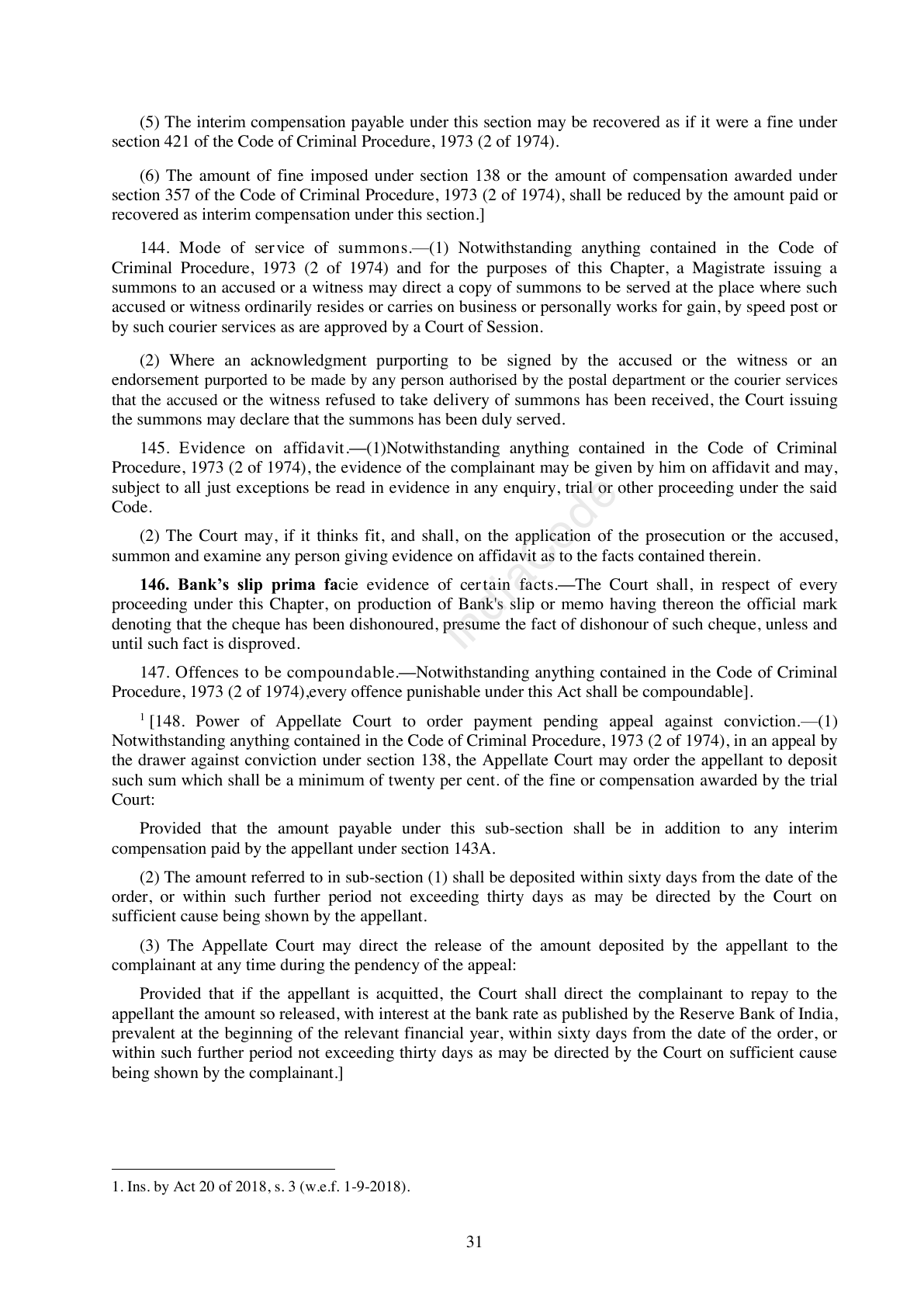
Full physical source page · unreviewed extraction
The Negotiable Instruments Act, 1881: page 31
The Negotiable Instruments Act, 1881, India Code delivered snapshot ed3e9db7f37052a1, physical page 31. Unreviewed extraction.
Source: official India Code PDF · catalog record. Fetched 2026-10-19T23:07:34Z. SHA-256 ed3e9db7f37052a1bc1cd665500910c5e123de888bce0375585e9a766bf38501.
Legal currency, territorial applicability and extraction fidelity are unverified. Catalog checksum/size differs from the delivered PDF; both identities are retained. Sections, state notes and footnotes share these physical pages. Compare the full original image.
Retained layout text
    (5) The interim compensation payable under this section may be recovered as if it were a fine under
section 421 of the Code of Criminal Procedure, 1973 (2 of 1974).
    (6) The amount of fine imposed under section 138 or the amount of compensation awarded under
section 357 of the Code of Criminal Procedure, 1973 (2 of 1974), shall be reduced by the amount paid or
recovered as interim compensation under this section.]
    144. Mode of service of summons.—(1) Notwithstanding anything contained in the Code of
Criminal Procedure, 1973 (2 of 1974) and for the purposes of this Chapter, a Magistrate issuing a
summons to an accused or a witness may direct a copy of summons to be served at the place where such
accused or witness ordinarily resides or carries on business or personally works for gain, by speed post or
by such courier services as are approved by a Court of Session.
     (2) Where an acknowledgment purporting to be signed by the accused or the witness or an
endorsement purported to be made by any person authorised by the postal department or the courier services
that the accused or the witness refused to take delivery of summons has been received, the Court issuing
the summons may declare that the summons has been duly served.
    145. Evidence on affidavit.—(1)Notwithstanding anything contained in the Code of Criminal
Procedure, 1973 (2 of 1974), the evidence of the complainant may be given by him on affidavit and may,
subject to all just exceptions be read in evidence in any enquiry, trial or other proceeding under the said
Code.                                                              e
                                                             od
   (2) The Court may, if it thinks fit, and shall, on the application of the prosecution or the accused,
summon and examine any person giving evidence on affidavit as to the facts contained therein.
                                                           aC
    146. Bank’s slip prima facie evidence of certain facts.—The Court shall, in respect of every
                                                      di
proceeding under this Chapter, on production of Bank's slip or memo having thereon the official mark
denoting that the cheque has been dishonoured, presume the fact of dishonour of such cheque, unless and
until such fact is disproved.                        In
    147. Offences to be compoundable.—Notwithstanding anything contained in the Code of Criminal
Procedure, 1973 (2 of 1974),every offence punishable under this Act shall be compoundable].
    1
     [148. Power of Appellate Court to order payment pending appeal against conviction.—(1)
Notwithstanding anything contained in the Code of Criminal Procedure, 1973 (2 of 1974), in an appeal by
the drawer against conviction under section 138, the Appellate Court may order the appellant to deposit
such sum which shall be a minimum of twenty per cent. of the fine or compensation awarded by the trial
Court:
   Provided that the amount payable under this sub-section shall be in addition to any interim
compensation paid by the appellant under section 143A.
    (2) The amount referred to in sub-section (1) shall be deposited within sixty days from the date of the
order, or within such further period not exceeding thirty days as may be directed by the Court on
sufficient cause being shown by the appellant.
   (3) The Appellate Court may direct the release of the amount deposited by the appellant to the
complainant at any time during the pendency of the appeal:
    Provided that if the appellant is acquitted, the Court shall direct the complainant to repay to the
appellant the amount so released, with interest at the bank rate as published by the Reserve Bank of India,
prevalent at the beginning of the relevant financial year, within sixty days from the date of the order, or
within such further period not exceeding thirty days as may be directed by the Court on sufficient cause
being shown by the complainant.]


1. Ins. by Act 20 of 2018, s. 3 (w.e.f. 1-9-2018).


                                                      31
Compare original page image