Full physical source page · unreviewed extraction
The Negotiable Instruments Act, 1881: page 30
The Negotiable Instruments Act, 1881, India Code delivered snapshot ed3e9db7f37052a1, physical page 30. Unreviewed extraction.
Source: official India Code PDF · catalog record. Fetched 2026-10-19T23:07:34Z. SHA-256 ed3e9db7f37052a1bc1cd665500910c5e123de888bce0375585e9a766bf38501.
Legal currency, territorial applicability and extraction fidelity are unverified. Catalog checksum/size differs from the delivered PDF; both identities are retained. Sections, state notes and footnotes share these physical pages. Compare the full original image.
Retained layout text
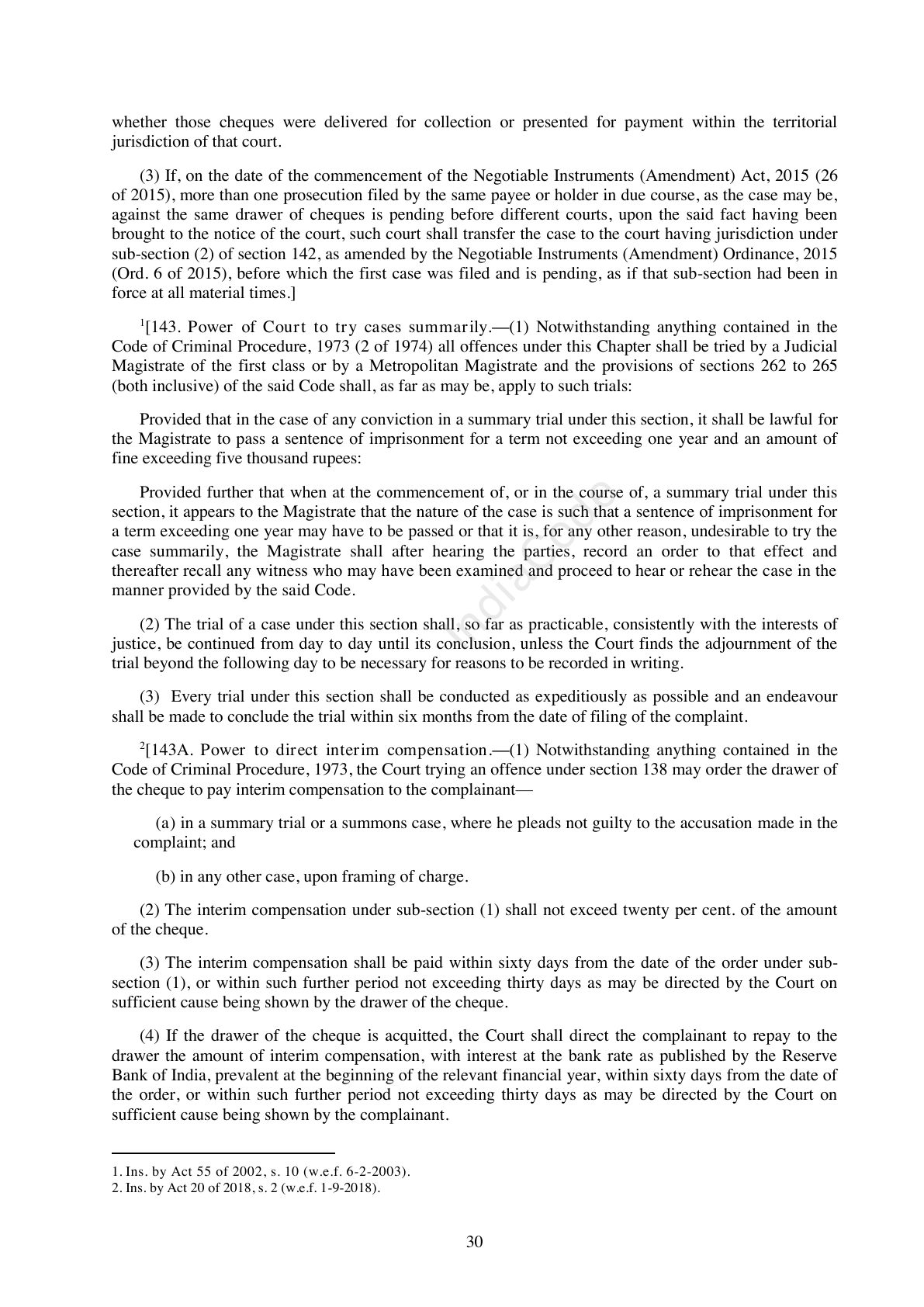
whether those cheques were delivered for collection or presented for payment within the territorial
jurisdiction of that court.
    (3) If, on the date of the commencement of the Negotiable Instruments (Amendment) Act, 2015 (26
of 2015), more than one prosecution filed by the same payee or holder in due course, as the case may be,
against the same drawer of cheques is pending before different courts, upon the said fact having been
brought to the notice of the court, such court shall transfer the case to the court having jurisdiction under
sub-section (2) of section 142, as amended by the Negotiable Instruments (Amendment) Ordinance, 2015
(Ord. 6 of 2015), before which the first case was filed and is pending, as if that sub-section had been in
force at all material times.]
    1
     [143. Power of Court to try cases summarily.—(1) Notwithstanding anything contained in the
Code of Criminal Procedure, 1973 (2 of 1974) all offences under this Chapter shall be tried by a Judicial
Magistrate of the first class or by a Metropolitan Magistrate and the provisions of sections 262 to 265
(both inclusive) of the said Code shall, as far as may be, apply to such trials:
    Provided that in the case of any conviction in a summary trial under this section, it shall be lawful for
the Magistrate to pass a sentence of imprisonment for a term not exceeding one year and an amount of
fine exceeding five thousand rupees:
     Provided further that when at the commencement of, or in the course of, a summary trial under this
                                                                      e
section, it appears to the Magistrate that the nature of the case is such that a sentence of imprisonment for
                                                                od
a term exceeding one year may have to be passed or that it is, for any other reason, undesirable to try the
case summarily, the Magistrate shall after hearing the parties, record an order to that effect and
                                                            aC
thereafter recall any witness who may have been examined and proceed to hear or rehear the case in the
manner provided by the said Code.
                                                       di
     (2) The trial of a case under this section shall, so far as practicable, consistently with the interests of
                                                      In
justice, be continued from day to day until its conclusion, unless the Court finds the adjournment of the
trial beyond the following day to be necessary for reasons to be recorded in writing.
    (3) Every trial under this section shall be conducted as expeditiously as possible and an endeavour
shall be made to conclude the trial within six months from the date of filing of the complaint.
    2
     [143A. Power to direct interim compensation.—(1) Notwithstanding anything contained in the
Code of Criminal Procedure, 1973, the Court trying an offence under section 138 may order the drawer of
the cheque to pay interim compensation to the complainant—
     (a) in a summary trial or a summons case, where he pleads not guilty to the accusation made in the
   complaint; and
        (b) in any other case, upon framing of charge.
     (2) The interim compensation under sub-section (1) shall not exceed twenty per cent. of the amount
of the cheque.
    (3) The interim compensation shall be paid within sixty days from the date of the order under sub-
section (1), or within such further period not exceeding thirty days as may be directed by the Court on
sufficient cause being shown by the drawer of the cheque.
    (4) If the drawer of the cheque is acquitted, the Court shall direct the complainant to repay to the
drawer the amount of interim compensation, with interest at the bank rate as published by the Reserve
Bank of India, prevalent at the beginning of the relevant financial year, within sixty days from the date of
the order, or within such further period not exceeding thirty days as may be directed by the Court on
sufficient cause being shown by the complainant.


1. Ins. by Act 55 of 2002, s. 10 (w.e.f. 6-2-2003).
2. Ins. by Act 20 of 2018, s. 2 (w.e.f. 1-9-2018).


                                                       30
Compare original page image