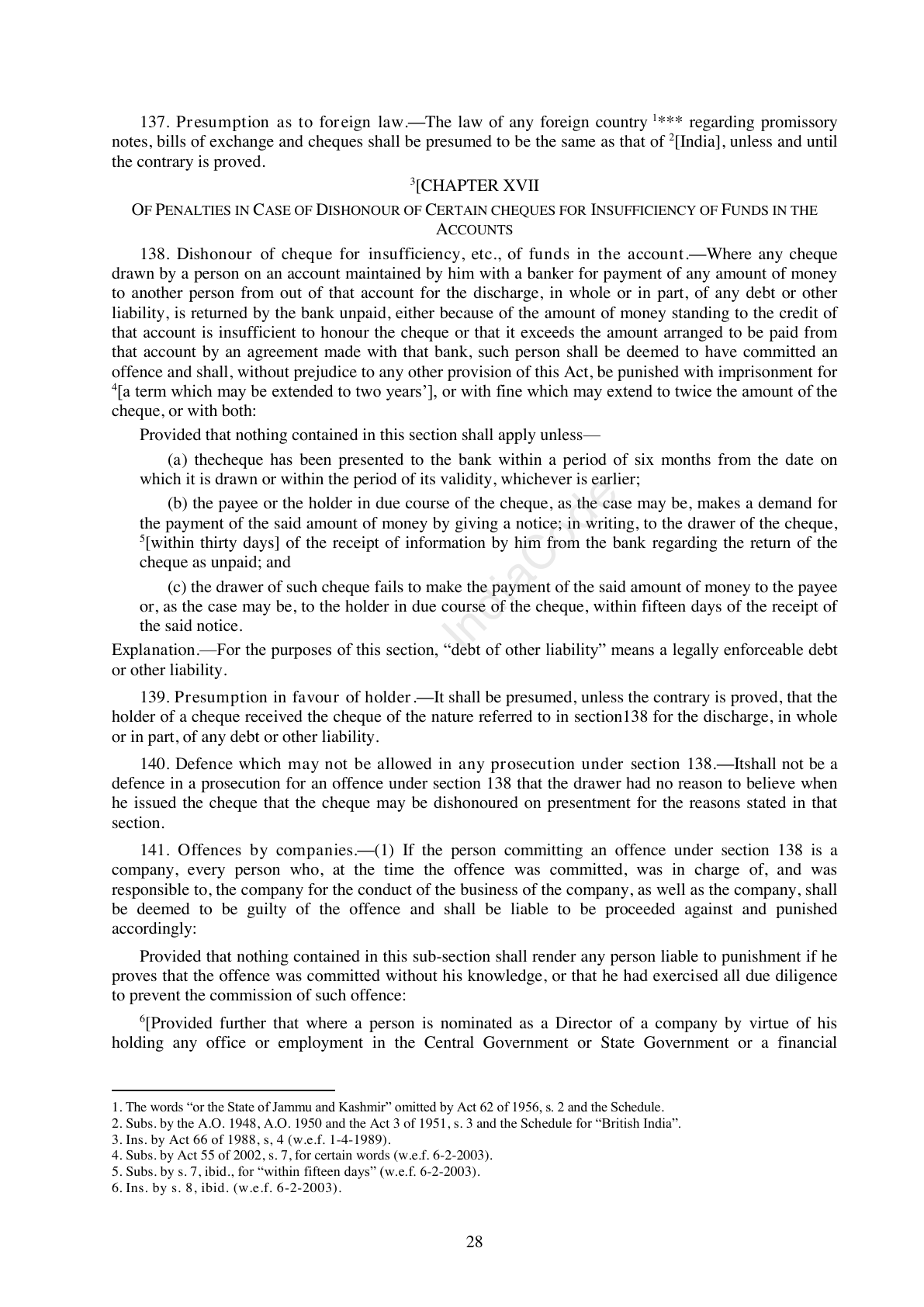
Full physical source page · unreviewed extraction
The Negotiable Instruments Act, 1881: page 28
The Negotiable Instruments Act, 1881, India Code delivered snapshot ed3e9db7f37052a1, physical page 28. Unreviewed extraction.
Source: official India Code PDF · catalog record. Fetched 2026-10-19T23:07:34Z. SHA-256 ed3e9db7f37052a1bc1cd665500910c5e123de888bce0375585e9a766bf38501.
Legal currency, territorial applicability and extraction fidelity are unverified. Catalog checksum/size differs from the delivered PDF; both identities are retained. Sections, state notes and footnotes share these physical pages. Compare the full original image.
Retained layout text
      137. Presumption as to foreign law.—The law of any foreign country 1*** regarding promissory
notes, bills of exchange and cheques shall be presumed to be the same as that of 2[India], unless and until
the contrary is proved.
                                                3
                                                  [CHAPTER XVII
    OF PENALTIES IN CASE OF DISHONOUR OF CERTAIN CHEQUES FOR INSUFFICIENCY OF FUNDS IN THE
                                                    ACCOUNTS
      138. Dishonour of cheque for insufficiency, etc., of funds in the account.—Where any cheque
drawn by a person on an account maintained by him with a banker for payment of any amount of money
to another person from out of that account for the discharge, in whole or in part, of any debt or other
liability, is returned by the bank unpaid, either because of the amount of money standing to the credit of
that account is insufficient to honour the cheque or that it exceeds the amount arranged to be paid from
that account by an agreement made with that bank, such person shall be deemed to have committed an
offence and shall, without prejudice to any other provision of this Act, be punished with imprisonment for
4
  [a term which may be extended to two years’], or with fine which may extend to twice the amount of the
cheque, or with both:
      Provided that nothing contained in this section shall apply unless—
           (a) thecheque has been presented to the bank within a period of six months from the date on
      which it is drawn or within the period of its validity, whichever is earlier;
                                                                                 e
           (b) the payee or the holder in due course of the cheque, as the case may be, makes a demand for
                                                                          od
      the payment of the said amount of money by giving a notice; in writing, to the drawer of the cheque,
      5
        [within thirty days] of the receipt of information by him from the bank regarding the return of the
      cheque as unpaid; and                                         aC
           (c) the drawer of such cheque fails to make the payment of the said amount of money to the payee
                                                             di
      or, as the case may be, to the holder in due course of the cheque, within fifteen days of the receipt of
      the said notice.
                                                        In
Explanation.—For the purposes of this section, “debt of other liability” means a legally enforceable debt
or other liability.
     139. Presumption in favour of holder.—It shall be presumed, unless the contrary is proved, that the
holder of a cheque received the cheque of the nature referred to in section138 for the discharge, in whole
or in part, of any debt or other liability.
    140. Defence which may not be allowed in any prosecution under section 138.—Itshall not be a
defence in a prosecution for an offence under section 138 that the drawer had no reason to believe when
he issued the cheque that the cheque may be dishonoured on presentment for the reasons stated in that
section.
    141. Offences by companies.—(1) If the person committing an offence under section 138 is a
company, every person who, at the time the offence was committed, was in charge of, and was
responsible to, the company for the conduct of the business of the company, as well as the company, shall
be deemed to be guilty of the offence and shall be liable to be proceeded against and punished
accordingly:
    Provided that nothing contained in this sub-section shall render any person liable to punishment if he
proves that the offence was committed without his knowledge, or that he had exercised all due diligence
to prevent the commission of such offence:
     6
     [Provided further that where a person is nominated as a Director of a company by virtue of his
holding any office or employment in the Central Government or State Government or a financial


1. The words “or the State of Jammu and Kashmir” omitted by Act 62 of 1956, s. 2 and the Schedule.
2. Subs. by the A.O. 1948, A.O. 1950 and the Act 3 of 1951, s. 3 and the Schedule for “British India”.
3. Ins. by Act 66 of 1988, s, 4 (w.e.f. 1-4-1989).
4. Subs. by Act 55 of 2002, s. 7, for certain words (w.e.f. 6-2-2003).
5. Subs. by s. 7, ibid., for “within fifteen days” (w.e.f. 6-2-2003).
6. Ins. by s. 8, ibid. (w.e.f. 6-2-2003).


                                                               28
Compare original page image